
Back to Journal

Breakfast Cereal: What Actually Makes One Better Than Another?

Published · Updated  · Sláinte Editorial

Fibre, sugar, salt and the bowl you actually pour all matter.

A legitimate wholegrain, protein or vitamin claim tells you something useful. It does not tell you everything. Compare the complete label before the front of the box makes the decision for you.

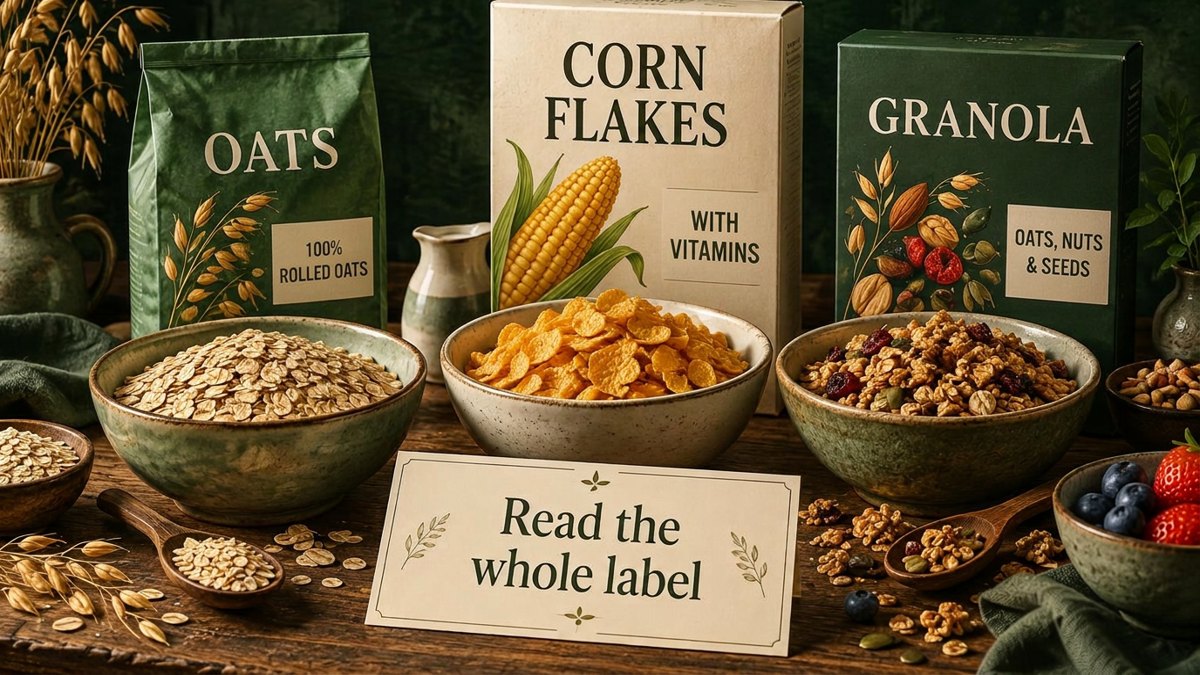
Illustrative oats, corn flakes and granola boxes and bowls beside a card reading Read the whole label
Illustrative packaging, not real product labels or scores.

The cereal aisle is one of the easiest places in a supermarket to get distracted by the front of the box.

HIGH PROTEIN

SOURCE OF FIBRE

WITH 8 VITAMINS

WHOLEGRAIN

LOW FAT

All of those claims can be completely legitimate.

None of them tells you whether the cereal is the better choice on its own.

One cereal might be heavily fortified but relatively low in fibre.

Another might be high in fibre but contain more sugar.

A granola might look “natural” while being much more energy-dense than a plain flaked cereal.

And a 30g serving on the box might bear little resemblance to the bowl you actually pour.

So rather than hunting for a magic cereal, compare the parts that actually change between products:

fibre, sugars, salt, wholegrains, ingredients, fortification and portion size.

Start with fibre

If you only check one positive nutrient on a cereal label, fibre is a useful place to start.

Irish healthy-eating guidance recommends wholemeal and wholegrain cereals and notes that they provide fibre as part of a balanced diet.

EU rules also give source of fibre and high fibre precise meanings.

A cereal can claim to be a source of fibre when it contains at least:

3g fibre per 100g

or:

1.5g per 100 kcal

A high fibre claim requires at least:

6g per 100g

or:

3g per 100 kcal.

That means “high fibre” is not just marketing language.

But there is still a catch.

A cereal can legally be high in fibre while also containing plenty of sugar or salt.

The fibre claim answers one question.

You still need the rest of the label.

Source of fibre

≥3g per 100g

or ≥1.5g per 100 kcal

High fibre

≥6g per 100g

or ≥3g per 100 kcal

A valid positive claim does not describe the whole cereal.

What does FSAI suggest looking for?

The Food Safety Authority of Ireland analysed 453 breakfast cereals sold in Ireland between July 2016 and March 2017, in a report published in 2020 and built a practical “Healthier Choice” framework using the nutrition label.

For a manufacturer-recommended serving, the FSAI framework looked for approximately:

  • 3g or more fibre
  • 6g or less sugar
  • 3g or less total fat
  • 1.5g or less saturated fat
  • 0.3g or less salt

The report also found that nutrition and health claims on the pack did not reliably distinguish the cereals meeting its healthier-choice criteria from the others.

The framework also allowed adjustments to the fat and saturated-fat limits to account for naturally occurring fats in nuts. It is a historical comparison framework, not a current survey of every cereal on Irish shelves.

That last point is especially useful.

A cereal can have a perfectly legal positive claim without being strong across every nutritional measure.

Fibre

≥3g

Per manufacturer-recommended serving

Sugars

≤6g

Per manufacturer-recommended serving

Total fat

≤3g

Nut-related adjustments were allowed

Saturated fat

≤1.5g

Nut-related adjustments were allowed

Salt

≤0.3g

Per manufacturer-recommended serving

FSAI’s 2020 practical comparison framework, not a universal health score or the legal definition of low sugar or low salt.

Do not start with calories

Two cereals can have very similar calories per 100g and very different nutritional profiles.

The current manufacturer nutrition information gives us a useful example.

Flahavan's Irish Porridge lists:

371 kcal per 100g

while Kellogg's Corn Flakes lists:

378 kcal per 100g.

Almost identical energy.

But their fibre, sugar, protein and salt differ substantially.

That is why:

lower calories = better cereal

is not a useful rule.

Sugar matters, but read it properly

The nutrition panel shows:

of which sugars

That is a useful number.

WHO recommends keeping free sugars below 10% of total energy intake, with a further reduction towards 5% providing additional benefits.

But the sugars line does not always tell you where the sugar came from.

Look at the ingredients too.

Possible sources include:

  • sugar
  • honey
  • syrups
  • fruit juice concentrates
  • dried fruit
  • malt extracts

Dried fruit complicates the picture because it can increase the total sugars number while also contributing fibre and micronutrients.

So:

higher sugar = automatically worse

can also be too simplistic.

The ingredient source and overall cereal still matter.

Our guide to daily sugar intake explains why the EU’s 90g total-sugars reference intake is different from WHO free-sugars guidance.

How to Read an Ingredients List

Wholegrain deserves attention

Irish healthy-eating guidance recommends choosing wholegrain or wholemeal cereals more often.

Wholegrain includes the bran, germ and endosperm of the grain, unlike a refined grain from which some components have been removed. Wholegrain does not necessarily mean the grain is physically intact.

That can mean more:

  • fibre
  • vitamins
  • minerals
  • intact grain components

But wholegrain is another example of a useful positive feature that does not automatically settle the whole product.

A cereal can contain wholegrain and still contain:

  • substantial added sugar
  • chocolate
  • syrups
  • large amounts of oil
  • significant salt

Look at the complete formulation.

Porridge is a useful benchmark

Plain oats give us one of the simplest cereal labels.

The current Flahavan's Irish Porridge label contains:

100% wholegrain rolled oats.

Per 100g, it currently lists:

  • 371 kcal
  • 0.9g sugars
  • 8.3g fibre
  • 11g protein
  • less than 0.01g salt

That makes plain oats a useful benchmark when looking at more complicated breakfast cereals.

Not because every person needs to eat porridge.

But because the ingredient list is so simple that you can see what changes as cereal becomes more formulated.

Fortified cereal is not “fake nutrition”

This is another area where online food discussions can become unnecessarily simplistic.

Many breakfast cereals are fortified with vitamins and minerals.

That means nutrients are added during manufacturing.

Those nutrients do not suddenly become meaningless because they were added.

The current Kellogg's Corn Flakes label, for example, includes added:

  • vitamin D
  • thiamin
  • riboflavin
  • niacin
  • vitamin B6
  • folic acid
  • vitamin B12
  • iron

A current 30g serving is listed as providing 50% of the reference value for vitamin D and 25% for several B vitamins.

That is a genuine nutritional characteristic of the product.

It should not be ignored simply because plain oats have a shorter ingredients list.

But fortification does not cancel sugar or salt

The reverse is equally important.

Added vitamins do not make every other part of the cereal irrelevant.

The same current Corn Flakes listing gives, per 100g:

  • 8g sugars
  • 3g fibre
  • 1.1g salt

Compare that with the current oats example:

  • 0.9g sugars
  • 8.3g fibre
  • less than 0.01g salt

The lesson is not:

Fortified cereal bad.

The lesson is:

Fortification is one positive characteristic. Fibre, sugar and salt remain separate characteristics.

Fortification can add

Vitamins and minerals

Genuine nutritional characteristics

Still check

Fibre, sugars and salt

Ingredients and portion still matter

One does not cancel the other.

Salt is easy to overlook

People naturally look for sugar in breakfast cereal.

Salt receives less attention.

But some cereals contain much more salt than others.

The current examples above make that obvious:

Flahavan's oats list:

<0.01g salt per 100g

Corn Flakes list:

1.1g per 100g.

That does not make corn flakes “toxic”.

It shows why only checking sugar misses part of the comparison.

Does protein matter?

Yes, but breakfast cereal does not need to become another protein competition.

Some cereals naturally contain more protein than others.

Protein may also be deliberately added to newer products.

That can be useful.

But just as with protein yoghurt:

more protein does not automatically mean better.

Check whether the protein increase came alongside changes in:

  • sugar
  • calories
  • fat
  • ingredients
  • portion size

What Does High Protein Mean?

Our protein yoghurt guide explains the same distinction between a useful protein number and the rest of the food.

What about granola?

Granola is the perfect example of why branding and appearance are poor shortcuts.

It can contain genuinely useful foods:

  • oats
  • nuts
  • seeds
  • dried fruit

It can also contain:

  • oil
  • honey
  • syrups
  • sugar

Those ingredients can make granola more energy-dense than a plain flaked cereal.

That does not make granola bad.

A bowl containing oats, nuts and seeds can be nutritionally useful.

But:

natural-looking

does not automatically mean:

lower calorie or lower sugar.

Read the actual product.

See our granola vs muesli comparison for three Flahavan’s products and their full nutrition labels.

Muesli can vary enormously too

One muesli might be mostly:

  • rolled oats
  • wheat flakes
  • nuts
  • seeds

Another could contain:

  • lots of dried fruit
  • chocolate
  • sweetened clusters
  • added sugar

There is no universal nutrition profile called:

muesli.

The category name is not enough.

Serving sizes can change the story

This is one of the easiest ways for cereal labels to become confusing.

Manufacturers often present nutrition per serving.

For example, the current Corn Flakes listing uses:

30g

as its serving.

Flahavan's uses:

40g

for its porridge example.

If you compare the serving columns directly, you are comparing different quantities of food.

That can make one product appear lower in:

  • sugar
  • calories
  • salt

simply because the stated serving is smaller.

For product-to-product comparison, start with:

per 100g

Then use the serving column to understand what you actually eat.

Corn Flakes example

30g serving

The manufacturer’s suggested portion

Porridge example

40g serving

A different quantity of cereal

Compare per 100g first; then consider the amount in your actual bowl.

And most people do not weigh their cereal

This creates another real-world issue.

A suggested 30g bowl can look surprisingly small.

If you routinely pour 60g, you are consuming roughly twice the cereal values shown for a 30g portion.

That is not a reason to obsessively weigh breakfast forever.

It is a reason to understand what the serving column represents.

For a week, measuring the bowl you normally pour can be more useful than assuming the front-of-pack serving matches reality.

Milk changes the breakfast too

Cereal is rarely eaten dry.

Add milk and you add:

  • protein
  • calcium
  • naturally occurring lactose
  • calories
  • potentially fat depending on the milk

Add yoghurt and the meal changes again.

Add fruit and you add more fibre and micronutrients.

Add honey and you increase free sugars. Our honey, sugar and maple syrup comparison explains how those sweeteners differ by equal weight.

The cereal label is the cereal.

It is not automatically the finished breakfast.

A low-sugar cereal can still be low in fibre

This is important because people often focus almost exclusively on sugar.

Imagine two cereals:

Cereal A

2g sugar per serving 0.8g fibre

Cereal B

5g sugar per serving 4g fibre

The first cereal contains less sugar.

That does not automatically settle which breakfast is better for you.

The whole nutrient profile matters.

This is exactly why FSAI's practical cereal framework looked at several characteristics simultaneously rather than a single nutrient.

Illustrative cereal A

2g sugars · 0.8g fibre

Per serving

Illustrative cereal B

5g sugars · 4g fibre

Per serving

Teaching examples, not real products or scores. The whole nutrient profile matters.

A high-fibre cereal can still contain sugar

The same logic works in reverse.

A cereal can genuinely qualify as high fibre while containing more sugar than another cereal.

The fibre claim remains valid.

It simply does not mean:

low sugar.

EU nutrition claims are designed to tell you something specific about a food, not to function as an overall health score.

Are breakfast cereals ultra-processed?

Some are.

Some are not.

Plain rolled oats are minimally processed compared with highly formulated cereals containing:

  • refined grains
  • flavours
  • sweeteners
  • colours
  • multiple texture agents

But processing classification and nutritional quality are not identical.

A fortified flaked cereal can still provide useful micronutrients.

A minimally processed cereal can still become a poor breakfast if covered in large quantities of added sugar.

Do not use processing classification as the only lens.

Ultra-Processed Foods

Does cereal need to be “perfect”?

No.

Breakfast is part of the whole diet.

A cereal that:

  • you enjoy
  • gives you useful fibre
  • does not load the bowl with sugar and salt
  • works with milk, yoghurt or fruit
  • fits your budget

can be perfectly reasonable.

The goal is not to find a cereal with every number at zero.

The goal is to know what you are buying.

What should you actually compare?

When two cereals are beside each other:

1. Fibre

Higher is generally useful.

Check whether it legally qualifies as source/high fibre.

2. Sugars

Compare per 100g first.

Then look at the ingredients to understand the likely sources.

3. Salt

Do not ignore it because the food tastes sweet.

4. Wholegrain content

Look at the ingredients rather than relying on brown packaging.

5. Protein

Useful, but not automatically the deciding factor.

6. Fortification

Added vitamins and minerals are real nutritional information.

7. Serving size

Compare equal quantities before comparing manufacturer portions.

8. Ingredients

Look at what actually makes up the cereal.

Fibre

Read the amount

A useful positive check

Sugars

Number and source

Read the ingredients too

Salt

Do not overlook it

Even in sweet cereals

Wholegrain

Read the ingredients

Not the colour of the box

Protein

Keep it in context

Not the only deciding factor

Fortification

Recognise added nutrients

They do not erase other numbers

Serving

Compare equal amounts

Per 100g, then your bowl

Ingredients

See what makes the cereal

The complete formulation

A real comparison: oats and corn flakes

The two manufacturer labels demonstrate why this framework works.

Flahavan's Irish Porridge, per 100g

  • 371 kcal
  • 0.9g sugars
  • 8.3g fibre
  • 11g protein
  • <0.01g salt
  • 100% wholegrain rolled oats

Kellogg's Corn Flakes, per 100g

  • 378 kcal
  • 8g sugars
  • 3g fibre
  • 7g protein
  • 1.1g salt
  • fortified with multiple vitamins and iron

Calories alone barely separate them.

The rest of the label does.

The oats are stronger on fibre, sugar and salt in this exact comparison.

The Corn Flakes provide substantial fortification.

That is a much more useful conclusion than:

one is healthy and one is unhealthy.

Similar energy, different labels

Per 100gFlahavan’s Irish PorridgeKellogg’s Corn Flakes
Energy371 kcal378 kcal
Sugars0.9g8g
Fibre8.3g3g
Protein11g7g
SaltLess than 0.01g1.1g

Manufacturer label examples checked 10 October 2026. Corn Flakes also provide added vitamins and iron; these figures are not a Sláinte Score or a ranking of all cereals.

Cereal A and B: real product results

Flahavan’s Irish Porridge Oats and Kellogg’s Corn Flakes, calculated from checked labels using the same food scoring rules as a scan. These are dry cereal results, without milk or toppings.

Cereal A

Flahavan’s Irish Porridge Oats
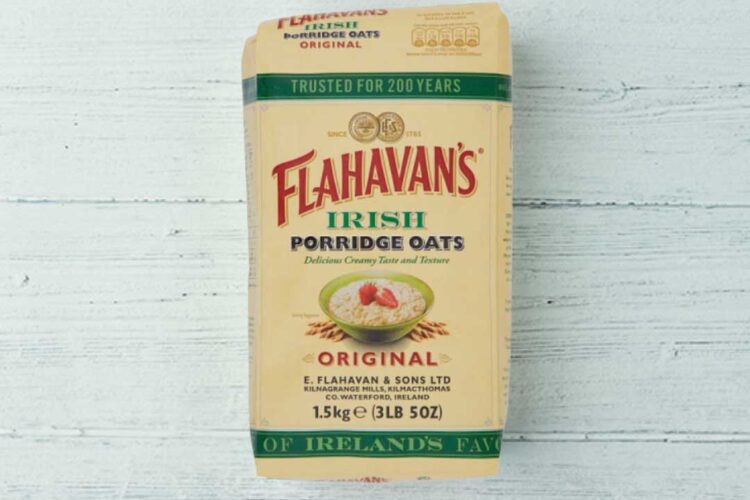
Flahavan’s Irish Porridge Oats pack

92

/100

Sláinte Score

Excellent

Short list, real food, nothing hiding.

  • Low in sugars
  • Low in saturated fat
  • Low in salt
  • Fits a balanced diet

What's inside (per 100 g)

The Good Stuff

Watch out for

AdditivesNo additives declared on this label0

Ingredients: 100% Wholegrain Rolled Oats.

The label declares salt below 0.01 g; the calculation uses 0.01 g as a conservative upper bound.

View the label source
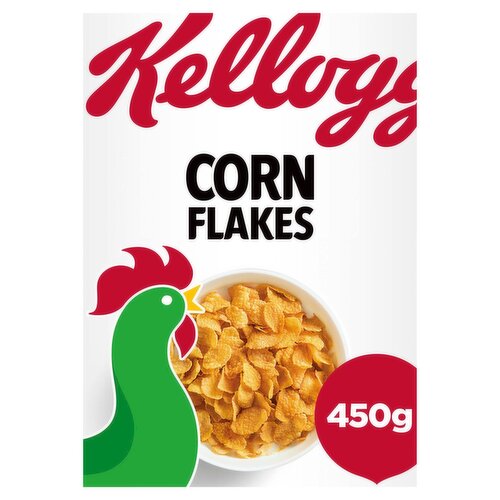
Cereal B

Kellogg’s Corn Flakes

Kellogg’s Corn Flakes pack

70

/100

Sláinte Score

Good

Grand for most of us, but it's barley through and through, so steer clear if you're coeliac.

  • Low in sugars
  • Low in saturated fat
  • 1 additive

What's inside (per 100 g)

The Good Stuff

Watch out for

Ingredients: Maize, BARLEY Malt Extract, Sugar, Salt, Niacin, Iron, Vitamin B6, Riboflavin, Thiamin, Folic Acid, Vitamin D, Vitamin B12.

View the label source

Labels checked 10 October 2026. These examples are not personal scan-history entries. The score does not give a separate bonus for added vitamins and minerals; Corn Flakes’ fortification remains useful information. No processing group has been assigned to these examples.

How the food score is calculated

What this means when you're shopping

1

Check fibre first

A cereal providing around 3g or more per bowl is a useful benchmark from FSAI's Irish work.

2

Check sugar

Look at both the number and the ingredients.

3

Check salt

Especially between similar flaked cereals.

4

Look for wholegrain

Preferably high in the ingredients list.

5

Recognise fortification

Do not dismiss vitamins just because they were added.

6

Compare per 100g

Then look at the portion you actually eat.

7

Add the rest of breakfast

Milk, yoghurt, fruit, nuts and toppings all change the final meal.

How Sláinte helps

Breakfast cereal is a perfect example of why one-number shopping does not work.

A cereal can be:

high fibre

but relatively sugary.

Another can be:

low sugar

but low in fibre.

Another can be:

fortified

but salty.

Sláinte can bring those pieces together so a front-of-pack claim does not become the entire product story.

The point is not to find a cereal with a perfect label.

It is to make the trade-offs obvious.

Food Labels Explained

How to Read an Ingredients List

For named products, see our Irish breakfast cereal comparison, or open the cereal comparison tool.

Milk and yoghurt change the meal too: see plain vs flavoured yoghurt.

Frequently asked questions

What should I look for in a breakfast cereal?

Start with fibre, sugars, salt, wholegrain content, ingredients and serving size. Fortification and protein can also be useful characteristics.

How much fibre should cereal contain?

EU rules allow a source of fibre claim from at least 3g per 100g or 1.5g per 100 kcal, while high fibre requires 6g per 100g or 3g per 100 kcal.

Is porridge healthier than breakfast cereal?

Plain oats can have a strong nutritional profile, but “breakfast cereal” covers hundreds of different products. Compare exact products rather than entire categories.

Is fortified cereal unhealthy?

No. Added vitamins and minerals are genuine nutrients. Fortification simply should not make sugar, salt or fibre invisible.

Is granola healthy?

It can contain useful wholegrains, nuts and seeds, but some granolas are also energy-dense and contain added sugars or oils. Check the exact label.

Is low-sugar cereal always healthier?

No. It could still be low in fibre or relatively high in salt.

Should I compare cereals per serving or per 100g?

Use per 100g for a fair product-to-product comparison, then use the serving information to understand the amount you actually eat.

Are all cereals ultra-processed?

No. Breakfast cereals range from plain rolled oats to highly formulated products.

The short version

  • Do not choose cereal from the front of the box alone.
  • Fibre is one of the most useful first checks.
  • In the EU, high-fibre and source-of-fibre claims have legal thresholds.
  • FSAI's Irish cereal work used a practical benchmark of around 3g fibre or more and 6g sugar or less per recommended serving, alongside limits for fat, saturates and salt.
  • Sugar is important, but not the only thing to check.
  • Salt can vary considerably between cereals.
  • Wholegrain is useful but does not automatically mean low sugar.
  • Added vitamins and minerals are genuine nutritional positives.
  • Fortification does not erase a cereal's sugar, salt or fibre profile.
  • Serving sizes can make comparisons look better or worse.
  • Compare per 100g first.
  • Your actual bowl may be larger than the suggested serving.
  • Milk and toppings change the finished breakfast.
  • Granola and muesli are categories, not nutritional guarantees.
  • There is no single “healthy cereal” rule.
  • Compare the whole label.