
Back to Journal

Granola vs Muesli: Which Is Actually Healthier?

Published · Updated  · Sláinte Editorial

In our three-product comparison, regular granola contained 103 more calories per 100g than muesli. But another granola contained more than twice the fibre.

Both contain oats. Both often contain nuts, seeds and dried fruit. Both are marketed as wholesome breakfast options. Yet one can contain considerably more calories than the other.

So which should you choose? The answer depends on what you're comparing. We examined three Flahavan's products sold in Tesco Ireland, looking at their ingredients, sugar, fibre, fat and energy content.

The results challenge some familiar assumptions about what makes a healthy breakfast.

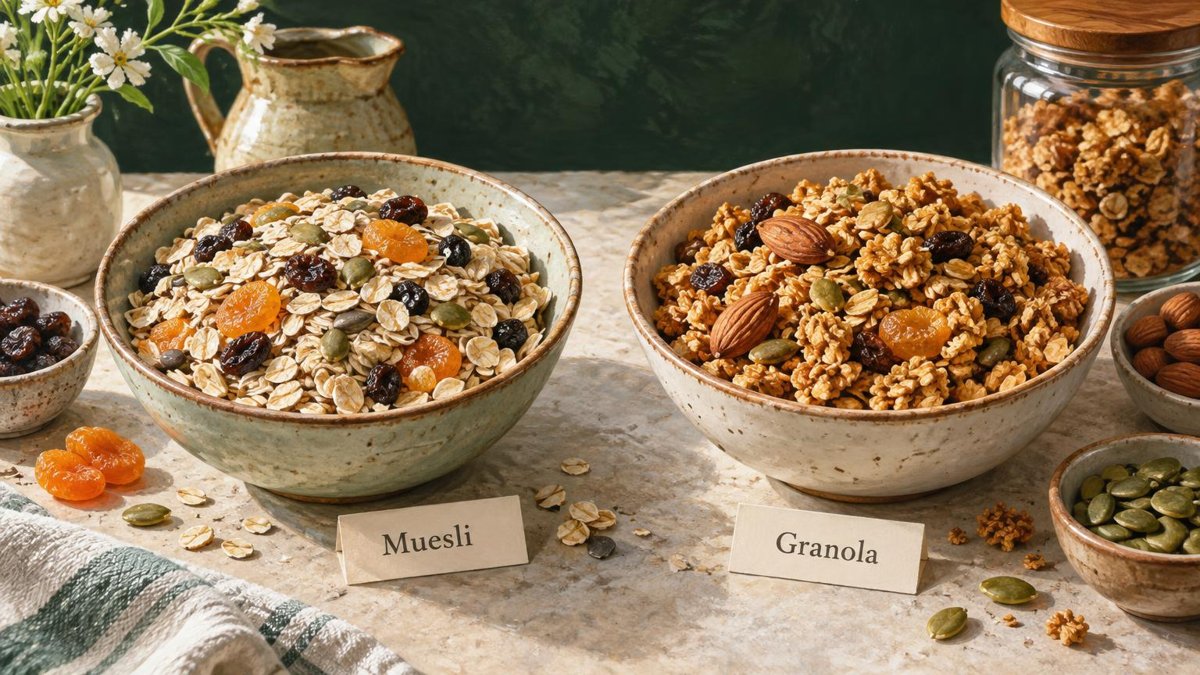
Muesli with loose oats, raisins and seeds beside toasted granola clusters in two ceramic bowls
Granola and muesli can contain similar ingredients. The proportions and preparation make the difference.

What is the difference between granola and muesli?

The biggest difference is how they're prepared.

Muesli is generally a mixture of rolled oats, other cereal flakes, dried fruit, nuts and seeds. The finished mixture is usually not baked together.

Granola is typically baked or toasted. Oil and sweetening ingredients such as sugar, honey or syrup are often used to help create its crunchy texture.

But recipes vary.

MuesliGranola
TextureLoose, soft or chewyCrunchy, often clustered
PreparationUsually mixed without baking the complete blendUsually baked or toasted
Common ingredientsOats, grains, dried fruit, seedsOats, nuts, seeds, oils, sweeteners
Added sugarDepends on the recipeDepends on the recipe
FibreDepends on the ingredientsDepends on the ingredients
Energy densityVariesOften higher

Neither food has a fixed nutritional profile.

A granola containing plenty of nuts and seeds might provide substantial fibre and unsaturated fats. A muesli containing a large proportion of sweetened dried fruit might provide more sugar than expected.

The product name tells you how the food is generally made.

The nutrition label tells you what's actually inside.

Three Irish supermarket products compared

Rather than comparing imaginary examples, we examined three products from Flahavan's, the Waterford-based oat producer.

Using the same brand helps demonstrate how different formulations can produce different nutritional results.

Product 1: Flahavan's Hi8 Muesli Original

This contains 68% wholegrain cereals, 25% dried fruit and 5% seeds.

Its ingredients include rolled oats, wheat flakes, rye flakes, raisins, apricots, dates, sunflower seeds and pumpkin seeds.

The product is labelled as having no added sugar.

Product 2: Flahavan's Original Fruit & Nut Granola

This granola contains 50% wholegrain oats, 16% seeds, 8% almonds and 7% dried fruit.

Sugar, rapeseed oil and honey also appear in the ingredient list.

The oats are coated with sugar and honey before toasting.

Product 3: Flahavan's No Added Sugar Granola, Raisin, Cashew & Almond

This version contains 50% wholegrain oats, 11% raisins, 6.4% nuts, seeds, rapeseed oil and chicory root fibre.

It contains no added sugar according to the product label.

What the nutrition labels reveal

All figures are per 100g of dry cereal.

NutrientHi8 MuesliFruit & Nut GranolaNo Added Sugar Granola
Calories350 kcal453 kcal396 kcal
Total sugars16g17.6g11g
Fibre6.1g6.1g15.2g
Protein9.2g10.8g8.9g
Total fat5.4g21.3g17.3g
Saturated fat0.9g2.97g3.7g
Salt0.02g0.1g0.1g

Sources: the supplied Tesco Ireland listings, cross-checked against Ardkeen’s Hi8 Muesli Original listing and SuperValu’s two granola listings on 11 October 2026. Tesco blocked automated access, so its pages could not be independently re-read. SuperValu lists 0.1g salt for the Fruit & Nut Granola, rather than the less-than-0.1g figure supplied in the draft. These are three specific products, not representative averages for all granola or muesli. Product formulations can change.

The comparison reveals three important things.

The muesli contains the fewest calories.

At 350 calories per 100g, it's less energy-dense than either granola.

The regular granola contains the most fat.

Much of that fat comes from ingredients such as seeds, almonds and rapeseed oil, so the total fat figure alone does not establish that it is nutritionally inferior.

The no-added-sugar granola contains the most fibre.

At 15.2g per 100g, it contains more than twice as much fibre as either of the other products.

That final result is particularly interesting.

A product can contain more fat and calories while also providing more fibre.

That's why simply asking whether granola or muesli is healthier doesn't produce a reliable answer.

Why does granola often contain more calories?

The answer is largely in the recipe.

Fat provides approximately 9 calories per gram, while digestible carbohydrates and protein provide approximately 4 calories per gram.

Granola recipes often contain oils, nuts and seeds, which increase their energy density.

That does not make those ingredients unhealthy.

Nuts and seeds can provide fibre, protein, vitamins, minerals and unsaturated fats. Rapeseed oil is also predominantly unsaturated fat.

But a higher-fat cereal will often provide more calories for the same weight.

Consider the two original Flahavan's products.

The muesli contains 5.4g of fat per 100g.

The regular granola contains 21.3g.

That's almost four times as much total fat.

The result is a noticeable difference in calories.

What about an actual breakfast bowl?

A 100g comparison is useful for reading labels, but many people eat considerably less than that at breakfast.

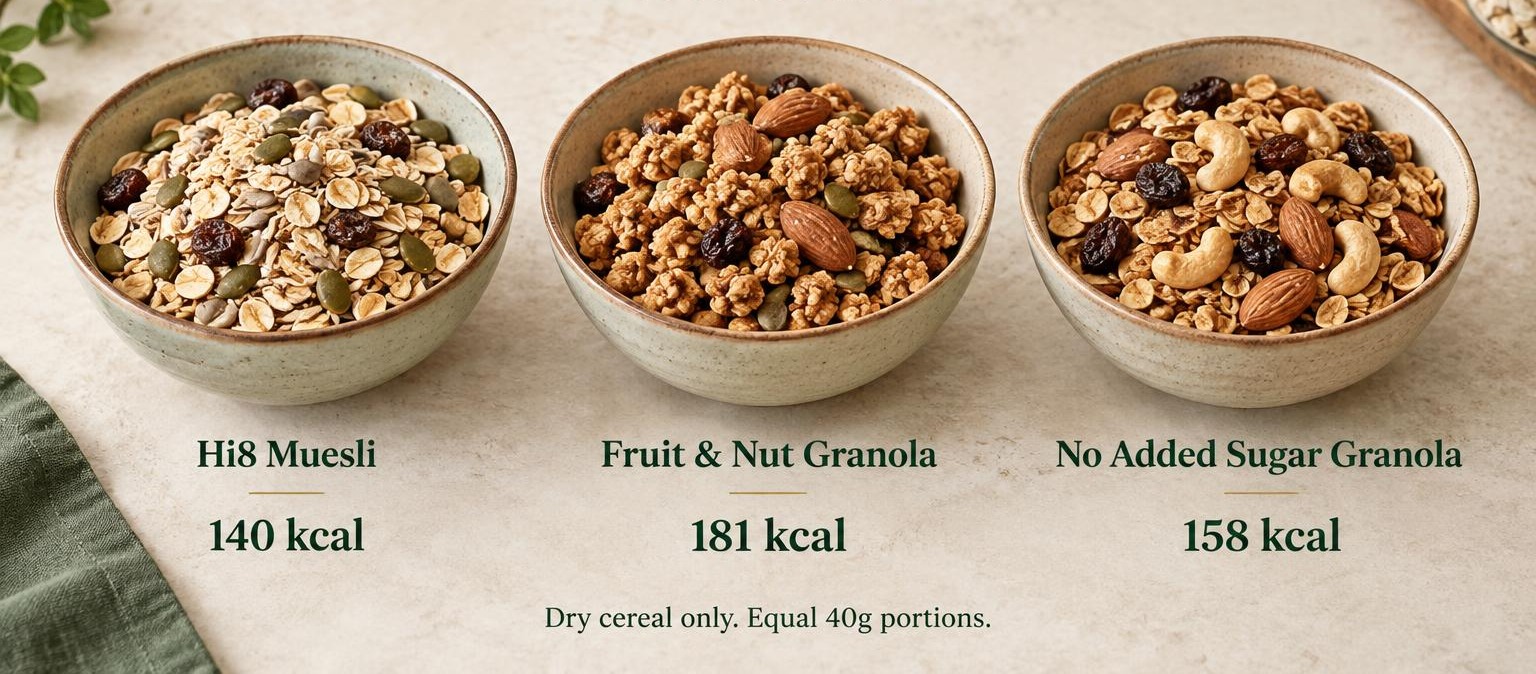
Here's what an equal 40g portion provides.

ProductCalories per 40g
Hi8 Muesli140 kcal
Fruit & Nut Granola181 kcal
No Added Sugar Granola158 kcal

The regular granola provides 41 more calories than the muesli in an equal 40g portion.

Increase both portions to 60g and the difference rises to approximately 62 calories.

This is before adding milk, yoghurt, fruit or other toppings.

The numbers are not an argument against granola.

They simply demonstrate why portion size matters, especially when comparing energy-dense cereals.

A person with higher energy requirements might find a more energy-dense breakfast useful. Someone looking for a lighter breakfast might prefer a different formulation or portion.

Three illustrated cereal bowls with 40g portion energy values: 140, 181 and 158 kcal
Equal portions make the calorie difference easier to understand. Dry cereal only; milk and toppings are not included. Bowls are illustrative, not measured portions.

Does granola contain more sugar than muesli?

It can, but it doesn't have to.

Look again at the three products.

The regular granola contains 17.6g of total sugars per 100g.

The muesli contains 16g.

The no-added-sugar granola contains 11g.

So in this comparison, the muesli contains more total sugar than one of the granolas.

How can that happen?

Because the sugar printed in the nutrition table does not exclusively represent added sugar.

Dried fruit changes the picture

Flahavan's Hi8 Muesli contains 25% dried fruit, including raisins, apricots and dates.

Those fruits naturally contain sugars.

The nutrition table includes those sugars in the total.

Meanwhile, the regular granola contains sugar and honey as ingredients, alongside naturally occurring sugars from dried fruit.

The standard EU nutrition table does not provide a separate mandatory figure for added sugars.

That means you cannot reliably calculate the exact amount of added sugar by looking at the total sugar number alone.

The ingredients list provides the context.

What does the WHO recommend?

The World Health Organization recommends keeping free sugars below 10% of total daily energy intake, with additional potential benefits from reducing them further.

Free sugars include sugar added to foods and drinks, as well as sugars naturally present in honey, syrups, fruit juices and fruit juice concentrates.

Naturally occurring sugars within intact fruit are treated differently.

That distinction is useful when comparing an unsweetened muesli containing raisins with granola sweetened using sugar and honey.

It doesn't mean that unlimited dried fruit is advisable, or that total sugar can be ignored.

It means the food supplying the sugar matters.

Read more: What "No Added Sugar" Actually Means.

Why doesn't 'no added sugar' mean low sugar?

Food manufacturers cannot use these terms interchangeably.

Under EU Regulation 1924/2006, a product making a no added sugars claim must meet conditions concerning added sugars and foods used for their sweetening properties.

But it may still contain naturally occurring sugars.

A low sugars claim has a different requirement.

For solid foods, it generally means no more than 5g of total sugars per 100g.

ClaimWhat it means
No added sugarsNo sugars or other foods used for sweetening have been added, subject to the legal conditions
Low sugarsNo more than 5g sugars per 100g for solid foods
Sugars-freeNo more than 0.5g sugars per 100g or 100ml

Neither the Hi8 Muesli nor the No Added Sugar Granola meets the low-sugars threshold based on the published total sugar figures.

That doesn't invalidate their no-added-sugar claims.

It shows why the distinction exists.

No added sugar describes how the product is formulated. Low sugar describes how much total sugar it contains.

The biggest surprise is actually fibre

Fibre deserves just as much attention as sugar when comparing breakfast cereals.

The HSE recommends wholegrain and wholemeal cereals as part of a healthy diet, partly because they provide dietary fibre.

Fibre supports normal bowel function and contributes to digestive health.

Under EU nutrition-claim rules, a food can qualify as high in fibre when it contains at least 6g of fibre per 100g, or at least 3g per 100 calories.

All three of the Flahavan's products in our comparison meet the 6g-per-100g threshold.

But the difference between them is substantial.

  • Hi8 Muesli: 6.1g fibre per 100g.
  • Original Fruit & Nut Granola: 6.1g fibre per 100g.
  • No Added Sugar Granola: 15.2g fibre per 100g.

Why is the no-added-sugar granola so high in fibre?

One important ingredient is chicory root fibre.

Chicory root fibre often contains inulin-type fructans, which are fermentable dietary fibres.

Manufacturers can use these ingredients to increase the fibre content of foods.

That's a legitimate nutritional characteristic.

But there is a distinction between how much fibre a food contains and how a particular person tolerates that fibre.

According to Monash University's FODMAP research guidance, ingredients such as inulin and chicory root fibre can contribute to gas, bloating and abdominal discomfort in some people with irritable bowel syndrome.

That doesn't make them inherently harmful.

It means some people may be more sensitive to them than others.

A high-fibre product can be useful, but more fibre is not automatically better for every person or every meal.

The source of that fibre matters too.

Is granola unhealthy because it contains oil?

No.

You'll often see rapeseed oil, sunflower oil or other vegetable oils in granola.

These ingredients may help produce its texture, improve flavour or contribute to its fat content.

But the presence of an oil does not establish whether the finished cereal is healthy or unhealthy.

It's useful to distinguish total fat from saturated fat.

The original Flahavan's granola contains 21.3g of total fat per 100g, but 2.97g of that is saturated fat.

The remainder is predominantly unsaturated fat.

Current WHO dietary guidance generally favours unsaturated fats over saturated fats.

That means a cereal containing nuts, seeds and rapeseed oil should not automatically be treated as nutritionally poor because its total fat figure is high.

The amount, type of fat and complete nutritional composition all matter.

We explored this in more detail in Seed Oils: Are We Blaming the Wrong Thing?.

Is homemade granola healthier?

Homemade granola gives you greater control over the ingredients.

You can combine rolled oats with nuts, seeds, cinnamon and a measured quantity of oil or sweetener.

That makes it easier to adjust the recipe to your preferences.

But homemade doesn't automatically mean lower sugar or fewer calories.

A mixture containing generous quantities of maple syrup, honey, oil and nuts can still be energy-dense.

Likewise, a shop-bought granola might contain no added sugar and provide a useful amount of fibre.

The better question is what goes into the recipe and how much you're eating.

A simple alternative

If you want more control without baking anything, try assembling your own muesli.

Start with plain rolled oats.

Add a small handful of nuts or seeds, some fruit and milk or plain yoghurt.

You can adjust the sweetness, texture and portion size.

It doesn't have to be complicated or expensive.

Plain oats are widely available in Irish supermarkets and provide a simple starting ingredient.

Five things to check before buying either

The next time you're choosing between two bags of granola or muesli in Tesco, Dunnes Stores, SuperValu, Aldi or Lidl, use this approach.

1. Start with the ingredients

Look for wholegrain cereals and identify the main ingredients.

Check whether sugar, honey or syrup has been added.

Remember that nuts and seeds can be nutritionally useful ingredients, even though they increase the calorie content.

2. Compare fibre per 100g

Using the same weight makes comparisons fair.

A high-fibre claim in the EU has a defined threshold, but higher fibre alone does not determine the healthiest choice.

3. Look at sugars and their sources

Use the total sugar figure alongside the ingredients.

A muesli containing raisins and dates is different from a granola containing added sugar and honey, even when their total sugar figures are similar.

4. Check saturated fat and total calories

Don't judge the food on total fat alone.

Look at saturated fat, the ingredients supplying the fat and the energy content.

5. Consider what you actually eat

A 40g serving of granola and an 80g serving are very different quantities.

Milk, yoghurt, nuts, fruit and other toppings also contribute to the final meal.

Compare the dry cereal first, then consider the complete breakfast.

So which is actually healthier?

For the three products examined, there is no single winner across every nutritional measure.

If you're comparing calorie density, the Hi8 Muesli has the lowest figure.

If you're comparing fibre, the No Added Sugar Granola has substantially more.

If you're comparing total sugar, the No Added Sugar Granola has the lowest figure of the three.

If you're comparing saturated fat, the Hi8 Muesli has the lowest figure.

These are observations from the current product listings, not complete health scores or universal rankings.

The regular Fruit & Nut Granola also contains meaningful amounts of oats, seeds, almonds and fibre. Its higher calorie and total fat content should be considered alongside those ingredients.

The appropriate choice depends on your preferences, dietary needs, portions and the rest of your diet.

If you're choosing between two products on a supermarket shelf, comparing their actual nutrition and ingredients is more useful than assuming one category is always better.

How Sláinte helps

The difficulty with food labels is that a product can look excellent under one measure and less favourable under another.

A granola might be high in fibre but relatively energy-dense.

A muesli might contain no added sugar but still provide substantial total sugars from dried fruit.

A lower-sugar cereal might contain ingredients that don't suit everyone's digestion.

Sláinte is designed to help make these differences easier to understand when scanning food products.

The Sláinte Score considers multiple characteristics of a product rather than relying on a single front-of-pack claim.

Our published methodology weights food scoring across:

  • 55% Nutrition: Including relevant nutrients such as fibre, protein, sugars, salt and saturated fat.
  • 30% Ingredients/additive concern: Assessing recognised additives within the scoring rules.
  • 15% Quality signals: Considering processing classification and ingredient-list length where data is available.

Category-specific rules and guardrails also apply.

A high fibre figure doesn't automatically guarantee an excellent Sláinte Score, just as the presence of oil doesn't automatically make a product poor.

The exact result depends on the verified product record and the complete scoring rules.

We have not assigned Sláinte Scores to the three products in this article.

You can read the full scoring methodology.

Scan your breakfast cereal

Frequently asked questions

Is muesli healthier than granola?

Not necessarily. Muesli is often lower in added oils and may be less energy-dense, but individual formulations vary. Some granolas contain more fibre or less total sugar than certain mueslis. Compare the complete label.

Is granola good for weight loss?

Granola can fit into a diet intended to support weight loss, but many varieties are energy-dense. Portion size and overall energy intake matter. A cereal's name alone does not determine whether it supports weight management.

Is muesli high in sugar?

Some mueslis contain substantial total sugars from dried fruit. Others include added sweeteners. Check both the total sugar figure and the ingredient list.

Why is granola higher in calories?

Many granolas contain added oils, nuts, seeds and sweeteners. These can increase energy density. However, calorie content varies depending on the formulation.

Is no-added-sugar granola healthier?

It may be preferable for someone looking to limit added sugars, but that claim doesn't tell you everything about fibre, saturated fat, total calories or the ingredients. Compare the complete nutritional profile.

Is granola better than porridge?

They serve different preferences and can both fit into a balanced diet. Plain porridge oats generally have a simpler formulation, while granola often contains additional ingredients. The exact products and portions determine the comparison.

Is homemade granola healthier than supermarket granola?

Homemade granola allows you to control the recipe, but it can still contain considerable sugar, oil and calories. Shop-bought products also vary widely.

Can granola or muesli be gluten-free?

Some versions can be, but not all. Muesli may contain wheat, rye or barley, while oats require particular care for people with coeliac disease because of potential gluten contamination. Choose an appropriately labelled gluten-free product when medically required, and always check the current packaging.

The short version

  • Muesli and granola can contain many of the same ingredients.
  • Granola is generally baked or toasted, often with oil and sweetening ingredients.
  • Granola is frequently more energy-dense, but individual products vary.
  • The Hi8 Muesli examined contains 350 calories per 100g.
  • The original Fruit & Nut Granola contains 453 calories per 100g.
  • The No Added Sugar Granola contains 396 calories per 100g.
  • The no-added-sugar granola has the highest fibre content of the three.
  • No added sugar does not mean sugar-free or necessarily low sugar.
  • Dried fruit contributes naturally occurring sugars.
  • Oils, nuts and seeds contribute calories but can also provide useful nutrients.
  • Compare per 100g, then consider your actual serving size.
  • Neither granola nor muesli is automatically the healthier category.

The best comparison is between two actual products, not two breakfast labels.

Product formulations can change. Nutrition figures in this article refer to the named Irish-market products; the physical packaging remains the final reference when purchasing.