Back to Journal

How Much Sugar Is Too Much? Reading Irish Food Labels

Published · Updated  · Sláinte Editorial

A standard 330ml can of Coca-Cola contains 35g of sugar.

According to its nutrition label, that's 39% of an average adult's daily reference intake for sugars.

But the World Health Organization recommends keeping free sugars below 50g a day for someone consuming 2,000 calories, with potential additional benefits from reducing them below 25g.

So why does the label appear to allow 90g?

Because the 90g reference intake on European food labels and the WHO recommendation for free sugars measure two different things.

It's one of the most important distinctions to understand when reading food packaging in Ireland.

Sugar appears in soft drinks, breakfast cereals, yoghurts, sauces, breads, snacks and foods we wouldn't necessarily consider sweet. But not all sugar on the nutrition label comes from the same source.

To understand how much is too much, you need to know which sugars the guidance covers, what the label actually measures and how much you're consuming.

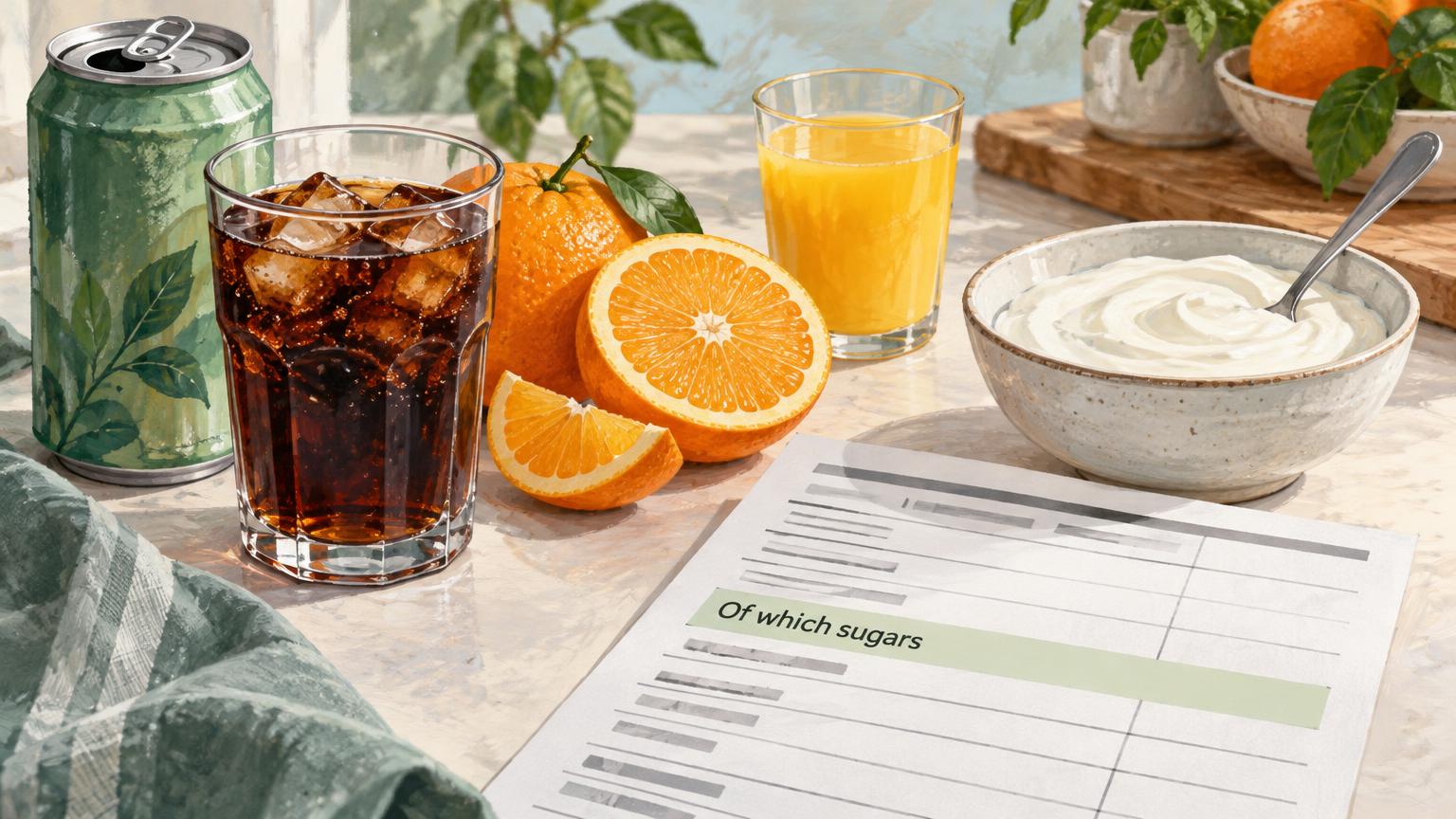
A generic soft-drink can, orange juice and natural yoghurt beside an of which sugars label
The sugar figure is only the beginning. What matters is how much you’re consuming and where the sugar comes from.

How much sugar should you have per day?

The World Health Organization recommends that adults and children keep free sugars below 10% of their total daily energy intake.

It also suggests that reducing free sugars below 5% may provide additional health benefits.

For someone consuming approximately 2,000 calories a day, that works out as follows.

WHO guidanceFree sugars per day
Below 10% of daily energyLess than 50g
Below 5% of daily energyLess than 25g

These are examples based on a 2,000-calorie diet, not universal gram limits for everyone.

Someone consuming less energy would have a proportionally lower amount, while someone consuming more energy would have a proportionally higher amount.

The recommendation is also not an instruction to eat 25g or 50g of sugar.

It is guidance about limiting intake.

What does that look like in teaspoons?

A level teaspoon of granulated sugar contains approximately 4g.

Using that rough conversion:

  • 25g of sugar is about six teaspoons.
  • 50g is about twelve teaspoons.
  • 35g is almost nine teaspoons.

That means a single 330ml can of regular Coca-Cola contains more sugar than the amount corresponding to WHO's suggested 5% level for a 2,000-calorie diet.

But there's an important detail.

The WHO recommendations concern free sugars, not every gram of sugar naturally present in food.

To understand the difference, we need to look at the types of sugar.

What are free sugars?

Free sugars include sugars added to foods or drinks by manufacturers, cooks or consumers.

They also include sugars naturally present in honey, syrups, fruit juice and fruit juice concentrates.

Examples include:

  • Sugar added to soft drinks.
  • Sugar added to biscuits and breakfast cereals.
  • Honey used to sweeten yoghurt.
  • Maple syrup added to porridge.
  • Sugars naturally present in orange juice.
  • Sugar stirred into tea or coffee.

These sugars count towards the WHO free-sugars recommendation.

What about sugar in fruit and milk?

The naturally occurring sugars in whole fruit and plain milk are treated differently.

Whole fruit contains sugars within the food's cellular structure, alongside fibre, water and other nutrients.

Milk naturally contains lactose, a type of sugar.

The WHO free-sugars definition does not include the sugars naturally present in intact fruit or plain milk.

This doesn't mean that all naturally occurring sugars are nutritionally identical, or that the total amount of food consumed stops mattering.

It means that the WHO recommendation was designed around a specific category of sugars.

For example, a glass of plain milk can contain nearly 10g of sugar without having any sugar added during production.

Those sugars still appear on the nutrition label.

But they are not counted as free sugars under the WHO definition.

Why does an Irish food label say 90g of sugar per day?

This is where confusion can begin.

Under Regulation (EU) No 1169/2011, nutrition labels can display percentages based on standard reference intakes for an average adult.

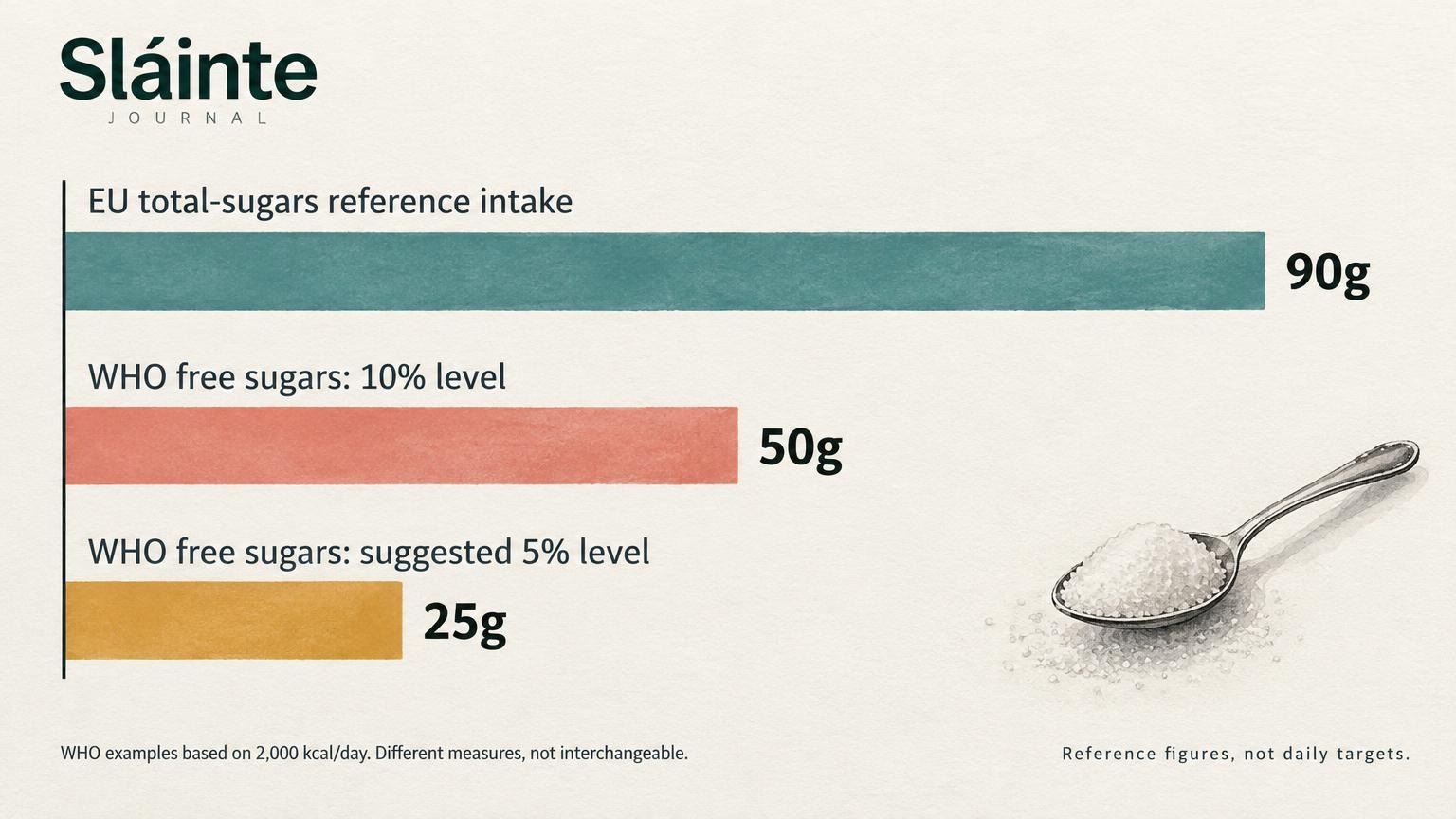
The European reference intake for total sugars is 90g per day.

The reference is based on an illustrative 2,000-calorie diet.

But the figure includes all sugars, whether naturally present or added.

It is not the same as the WHO free-sugars recommendation.

The difference

MeasureAmountWhat it covers
EU adult reference intake90gTotal sugars
WHO below-10% recommendationLess than 50gFree sugars, for a 2,000-calorie diet
WHO suggested below-5% levelLess than 25gFree sugars, for a 2,000-calorie diet

These numbers should not be used interchangeably.

The 90g reference intake provides a standard denominator for nutrition labelling.

It is not a recommendation to consume 90g of added sugar every day.

That's why a product's percentage of reference intake may look relatively modest even when it contains a substantial quantity of added sugar.

Proportional bars comparing 90g total sugars reference intake with the 50g and 25g WHO free-sugars levels
The EU reference intake and WHO recommendations measure different categories of sugar.

A real example: Coca-Cola Original Taste

Let's look at a product sold in Irish supermarkets.

According to Tesco Ireland's listing, a standard 330ml can of Coca-Cola Original Taste contains:

NutrientPer 100mlPer 330ml can
Calories42 kcal139 kcal
Carbohydrate10.6g35g
Of which sugars10.6g35g
Fat0g0g
Salt0g0g

The ingredients list begins with carbonated water, followed by sugar.

That means the 35g of sugar is added sugar, and it falls within the WHO definition of free sugars.

Now compare that with the two systems.

The can contains:

  • Approximately 39% of the EU's 90g total-sugars reference intake.
  • The equivalent of 70% of the WHO 50g free-sugars boundary for a 2,000-calorie diet.
  • 140% of the WHO's suggested 25g level for that same diet.

The label's 39% figure is mathematically correct.

But it answers a different question from the WHO guidance.

This is why the percentage printed on the front of a pack should not be your only reference point.

And it illustrates how easily a drink can contribute a substantial quantity of free sugars without making you feel particularly full.

Three Irish supermarket drinks with very different sugars

Now compare Coca-Cola with two other familiar products.

All three contain sugar.

But that doesn't mean the sugar has the same origin or nutritional context.

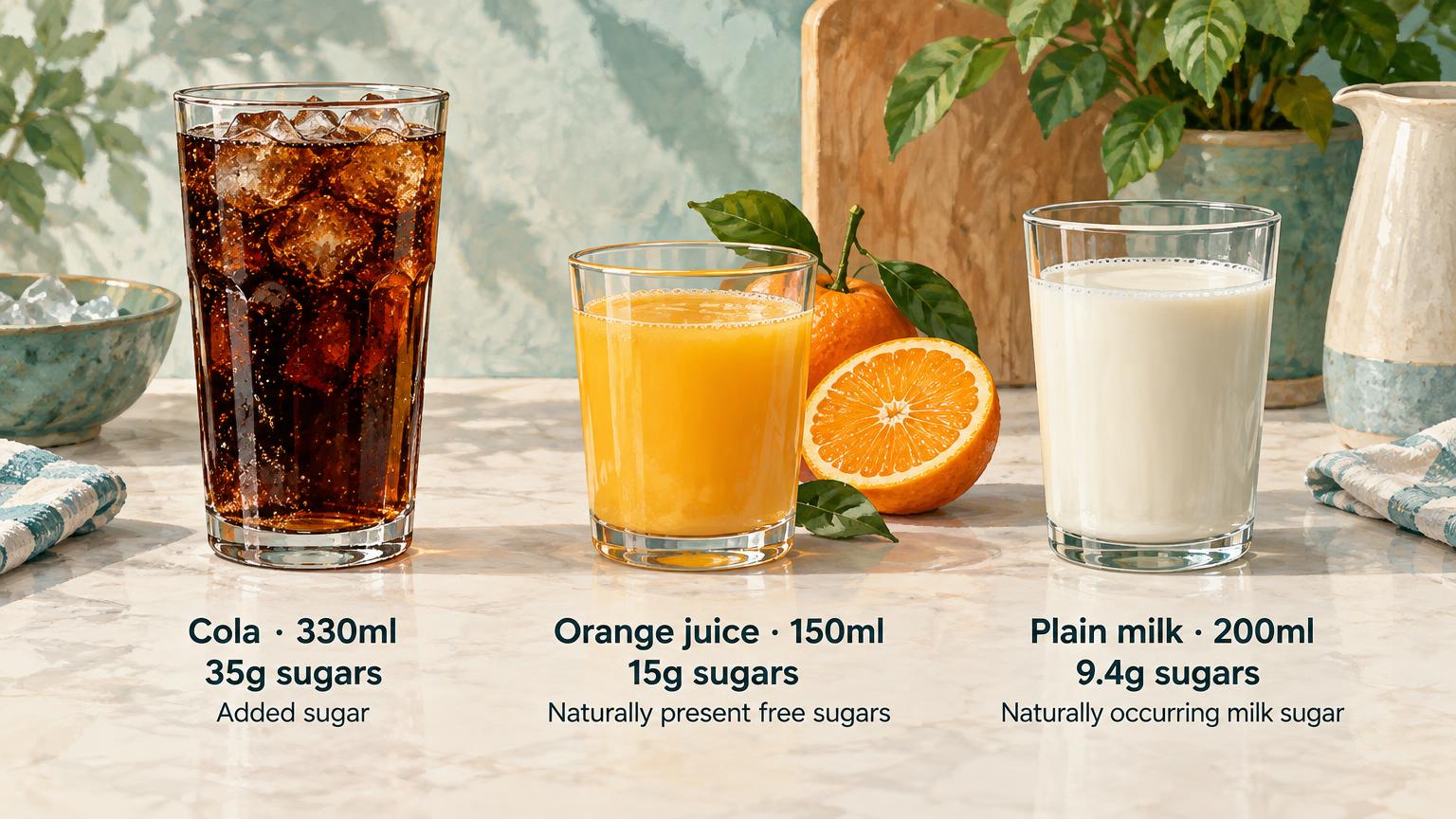
ProductSugars per 100mlExample servingSugars per serving
Coca-Cola Original Taste10.6g330ml35g
Tesco 100% Pure Orange Juice Smooth10g150ml15g
Avonmore Fresh Whole Milk4.7g200ml9.4g

Sources: Tesco Ireland’s cola and milk listings, Tesco’s orange juice listing and Avonmore’s manufacturer information, cross-checked on 13 October 2026. Values are rounded as declared; check current packaging for reformulations.

At first glance, Coca-Cola and orange juice have similar sugar concentrations.

But their ingredients and nutritional characteristics differ.

Coca-Cola: added sugar

The Coca-Cola contains sugar added during manufacture.

That sugar counts towards free-sugars intake.

Its nutrition information also shows that it contains essentially no protein or fat.

Orange juice: naturally present, but still free sugars

Tesco's 100% Pure Orange Juice Smooth lists 10g of sugars per 100ml.

The juice contains vitamin C, but its naturally occurring sugars are still classified as free sugars by the WHO.

This can surprise people.

A juice can be made entirely from fruit, with nothing added, and still contribute free sugars.

The distinction is related to the form in which the fruit is consumed.

Whole oranges retain their structure and more of their natural fibre, while juice contains much less fibre.

A modest serving of 100% juice can still fit into a balanced diet.

But drinking several large glasses is not nutritionally equivalent to eating several whole oranges.

Avonmore milk: naturally occurring lactose

Avonmore Fresh Whole Milk contains 4.7g of sugars per 100ml.

Its sugar is naturally occurring lactose.

The product also provides protein, calcium and other nutrients.

Unlike the sugar added to regular Coca-Cola, naturally occurring lactose in plain milk is not classified as free sugar by the WHO.

The total-sugars column includes it anyway.

That's why comparing foods using only the total-sugar figure can be misleading.

Cola, orange juice and milk: 35g, 15g and 9.4g sugars in the illustrated serving sizes
All three drinks contain sugar, but the source and nutritional context differ.

How do you actually read sugar on a food label?

In Ireland, most prepacked foods must carry a nutrition declaration under EU food information rules.

The mandatory nutrition information is presented per 100g or per 100ml.

You'll usually see something like this:

Example nutrition table

NutrientPer 100g
Energy400 kcal
Fat12g
Of which saturates3g
Carbohydrate65g
Of which sugars22g
Protein8g
Salt0.4g

Illustrative values, not a real product.

The figure beside of which sugars tells you the total sugars present.

That includes added sugars and naturally occurring sugars.

It does not tell you exactly how much sugar a manufacturer added to the product.

What about carbohydrate?

Carbohydrate and sugar are not interchangeable.

In EU nutrition declarations, the carbohydrate figure includes sugars and other available carbohydrates such as starch.

For example, a food containing 65g of carbohydrate and 22g of sugars does not contain 65g of sugar.

The sugars are part of the carbohydrate total.

The distinction also matters because a food low in sugars may still contain substantial starch.

For someone managing blood glucose, the broader carbohydrate content can be important.

How can you tell whether sugar has been added?

The ingredients list provides another piece of the picture.

Under EU food information rules, ingredients are generally listed in descending order of their weight when used in manufacture.

So ingredients appearing near the beginning of the list usually make up a greater proportion of the product than those towards the end.

Sugar may appear under several names.

Common examples include:

  • Sugar or sucrose.
  • Glucose.
  • Dextrose.
  • Glucose syrup.
  • Fructose.
  • Invert sugar syrup.
  • Honey.
  • Maple syrup.
  • Molasses.
  • Fruit juice concentrate used for sweetening.

These names do not all identify identical ingredients.

But they can help you recognise sugar-containing ingredients and sources of sweetness.

Can manufacturers split sugar into different ingredients?

A recipe may contain several distinct sugar sources, each listed separately.

For example:

Oats, glucose syrup, wheat flour, sugar, vegetable oil, honey, cocoa powder.

Glucose syrup, sugar and honey appear as separate ingredients because they are separate components.

Their individual positions do not reveal their combined quantity.

It's also not possible to calculate the precise amount of added sugar simply by counting how many sweetening ingredients appear.

That would require more information about the recipe.

The reliable approach is to read the nutrition table and ingredients together.

You can explore the full process in our guide to reading ingredients lists in Ireland.

What counts as low sugar or sugar-free in Ireland?

Unlike vague marketing descriptions, some sugar-related nutrition claims have precise legal conditions.

Under EU Regulation 1924/2006, the following thresholds apply.

Nutrition claimLegal threshold
Low sugars, solid foodsNo more than 5g sugars per 100g
Low sugars, liquidsNo more than 2.5g sugars per 100ml
Sugars-freeNo more than 0.5g sugars per 100g or 100ml
No added sugarsNo added mono- or disaccharides or other foods used for sweetening

There are additional rules governing how these claims can be used.

For example, where a food naturally contains sugars, a product using the no-added-sugars claim should also indicate that it contains naturally occurring sugars.

Does no added sugar mean low sugar?

No.

A muesli containing substantial quantities of dried fruit may have no added sugars while still displaying a relatively high total-sugars figure.

The same principle applies to unsweetened fruit juice.

A claim can be accurate without making the product low in total sugar.

We've covered that distinction in detail in What Does "No Added Sugar" Actually Mean?.

Does the type of food change how you should judge sugar?

Yes.

Consider a breakfast cereal, natural yoghurt and a soft drink.

All three can contain sugars, but their nutritional roles are different.

Breakfast cereal

For cereal, sugar is worth considering alongside fibre, wholegrain content, salt and portion size.

Two cereals with similar total sugars might contain very different amounts of fibre.

One might derive much of its sugar from dried fruit, while another includes added sugar or syrups.

Read our breakfast cereal comparison guide.

Yoghurt

Plain yoghurt naturally contains milk sugar.

Flavoured yoghurt may contain naturally occurring lactose alongside added sugar or other sweetening ingredients.

Checking the ingredients helps distinguish those formulations.

Protein and saturated fat may also differ between products.

Our plain versus flavoured yoghurt comparison explores two Glenisk products using their actual labels.

Soft drinks

For a regular sugary soft drink, the sugar content is often a particularly important part of the nutritional profile.

There may be little fibre or protein to consider.

Replacing a sugary soft drink with water eliminates the free sugars supplied by that drink.

A sugar-free alternative can also reduce sugar intake, but any sweeteners or caffeine need to be considered separately.

Read more: Is Sugar-Free Really Better for You?.

Why does too much free sugar matter?

The WHO recommendations are based on public-health evidence, particularly relating to body weight and dental health.

Dental health

Bacteria in dental plaque can use sugars to produce acids.

Repeated acid exposure contributes to the process of tooth decay.

Both the amount and frequency of sugar consumption are relevant to dental health.

Continually sipping sugary drinks throughout the day can expose teeth to repeated acid attacks.

The WHO's lower suggested free-sugars intake reflects, in part, the potential benefits for dental health.

Body weight

Sugar-containing foods and drinks contribute energy.

When overall energy intake regularly exceeds energy expenditure, weight gain can occur over time.

Sugar-sweetened drinks are a particular public-health concern because they can provide substantial energy without the same satiety as many solid foods.

But sugar does not operate independently of the rest of the diet.

Eating a food containing sugar does not automatically cause weight gain.

Overall diet quality

Foods containing free sugars vary enormously.

A glass of orange juice can supply vitamin C, while a regular soft drink may provide little nutritional value beyond energy.

A yoghurt containing some added sugar can still supply protein and calcium.

The point is not that every food with free sugar has the same nutritional value.

It's that higher free-sugars consumption can make it more difficult to maintain a balanced diet, particularly when sugary foods and drinks displace more nutritious alternatives.

Five practical ways to understand your sugar intake

You don't need to weigh every ingredient or calculate every gram to make more informed choices.

Start with the products you consume most often.

1. Check your regular drinks

Soft drinks, energy drinks, fruit juices and sweetened coffees can make a substantial contribution to free-sugars intake.

Read the label for the amount you actually drink, not just per 100ml.

2. Compare similar products

If you're choosing between two cereals, compare their sugars per 100g.

Then check fibre, ingredients and portion size.

Comparing a cereal with plain milk based only on total sugar doesn't tell you which food is more nutritious.

3. Read beyond the front-of-pack claim

No added sugar, organic, natural and high protein all describe different characteristics.

None automatically establishes the complete nutritional quality of the food.

4. Notice repeated sources of sugar

A sweetened cereal, sugary drink, biscuit and dessert can contribute to the same day's free-sugars intake.

Each choice may seem relatively small in isolation.

Together they can add up.

5. Make changes you can maintain

Replacing some sugary drinks with water, reducing sugar added to hot drinks or choosing a less-sweetened everyday cereal can reduce free-sugars intake.

There's no requirement to eliminate every food containing sugar.

A sustainable dietary pattern matters more than treating one ingredient as something to fear.

How Sláinte helps you understand sugar

The difficulty with food labels is that one number rarely explains the complete product.

A yoghurt can contain naturally occurring milk sugar.

A cereal can contain added sugar but also substantial fibre.

A sugar-free drink can contain authorised sweeteners and caffeine.

The Sláinte food scanner brings nutrition information, ingredients and relevant product characteristics together to make these differences easier to understand.

Under the published Sláinte food-scoring methodology, the final score is built from three main components:

ComponentWeight
Nutrition quality55%
Ingredients30%
Processing and quality signals15%

Sugars form part of the nutrition component, alongside factors such as energy, saturated fat, salt, fibre and protein.

Ingredients and processing are assessed separately, with additional category rules and guardrails.

The EU 90g reference intake is used for explanatory daily-context figures, not to calculate the Sláinte Score.

And a low sugar value does not automatically guarantee an excellent score.

The aim is to help you understand what is in the product, what contributed to its result and whether another option may suit your needs better.

You can read the full Sláinte methodology.

Scan your next food product to see its nutrition, ingredients and available alternatives.

Scan your next food product with Sláinte

Frequently asked questions

How much sugar should an adult have per day?

The WHO recommends that free sugars provide less than 10% of daily energy intake, with additional potential benefits from reducing intake below 5%. For an illustrative 2,000-calorie diet, those levels correspond to less than 50g and less than 25g of free sugars respectively.

Is 30g of sugar a day too much?

It depends on the type of sugar and the person's energy requirements. Thirty grams of free sugars would exceed the WHO's suggested 5% level for a 2,000-calorie diet, but remain below the 10% level. Thirty grams of total sugars could include naturally occurring lactose from milk, which is not classified as free sugar.

Why does the food label say 90g of sugar?

The EU's 90g figure is a standard reference intake for total sugars for an average adult. It is not the WHO's recommended limit for free sugars and should not be interpreted as a daily target for added sugar.

Does fruit sugar count towards your daily sugar limit?

The naturally occurring sugars in intact whole fruit are not included in the WHO free-sugars definition. Sugars naturally present in fruit juice and fruit juice concentrates are included.

Does milk contain sugar?

Yes. Plain milk naturally contains lactose. This appears under "of which sugars" on the nutrition declaration, even when no sugar has been added.

Is honey healthier than regular sugar?

Honey may contain small amounts of other substances, but it remains a source of free sugars under WHO guidance. Replacing table sugar with honey does not eliminate free-sugars intake.

How can I tell how much added sugar is in a product?

The standard EU nutrition declaration shows total sugars rather than a separate mandatory added-sugars figure. The ingredients list can show whether sugar or other sweetening ingredients have been added, but often cannot reveal their exact combined quantity.

Is sugar-free food always healthier?

No. A sugars-free claim tells you that a product meets a specific sugar threshold. It does not establish its overall nutritional quality. Check the rest of the nutrition information and ingredients.

Is orange juice as bad as fizzy drinks?

They can have similar sugar concentrations, but their nutritional characteristics differ. Pure orange juice can supply vitamin C and other nutrients, while regular sugary soft drinks may provide few essential nutrients. Both can contribute free sugars. Portion size matters.

Should people with diabetes only check the sugar figure?

No. Total carbohydrate intake is also relevant to blood-glucose management. People with diabetes should follow advice appropriate to their treatment and individual dietary needs rather than relying only on the "of which sugars" figure.

The short version

  • The WHO recommends keeping free sugars below 10% of daily energy intake.
  • Reducing free sugars below 5% may provide additional health benefits.
  • For a 2,000-calorie diet, these levels correspond to less than 50g and less than 25g respectively.
  • The EU's 90g reference intake is for total sugars, not free sugars.
  • A standard 330ml Coca-Cola contains 35g of sugar.
  • Fruit juice contains free sugars, even when no sugar has been added.
  • Plain milk contains naturally occurring lactose, which is not classified as free sugar.
  • "Of which sugars" includes both added and naturally occurring sugars.
  • No added sugar and sugar-free have different legal meanings.
  • The ingredients list helps identify added sweetening ingredients.
  • Compare similar foods per 100g or 100ml, then consider your actual portion.
  • Sugar is one part of a food's nutritional profile, not the entire verdict.

The most useful question isn't simply how many grams of sugar a product contains. It's where those sugars come from, how much you're consuming and what the rest of the food provides.

Product information and sources reviewed on 13 October 2026. Nutrition figures reflect the named retailer and manufacturer listings and can change. Always check the current packaging.