
Check protein per 100g
This tells you how protein-dense the product actually is.
Published · Updated · Sláinte Editorial
More protein can be useful. It still needs to sit beside the rest of the label.
A protein yoghurt can be a convenient snack, but 20g on the front does not settle the sugar, ingredients or portion questions. Here is what the claim means and how to compare pots fairly.
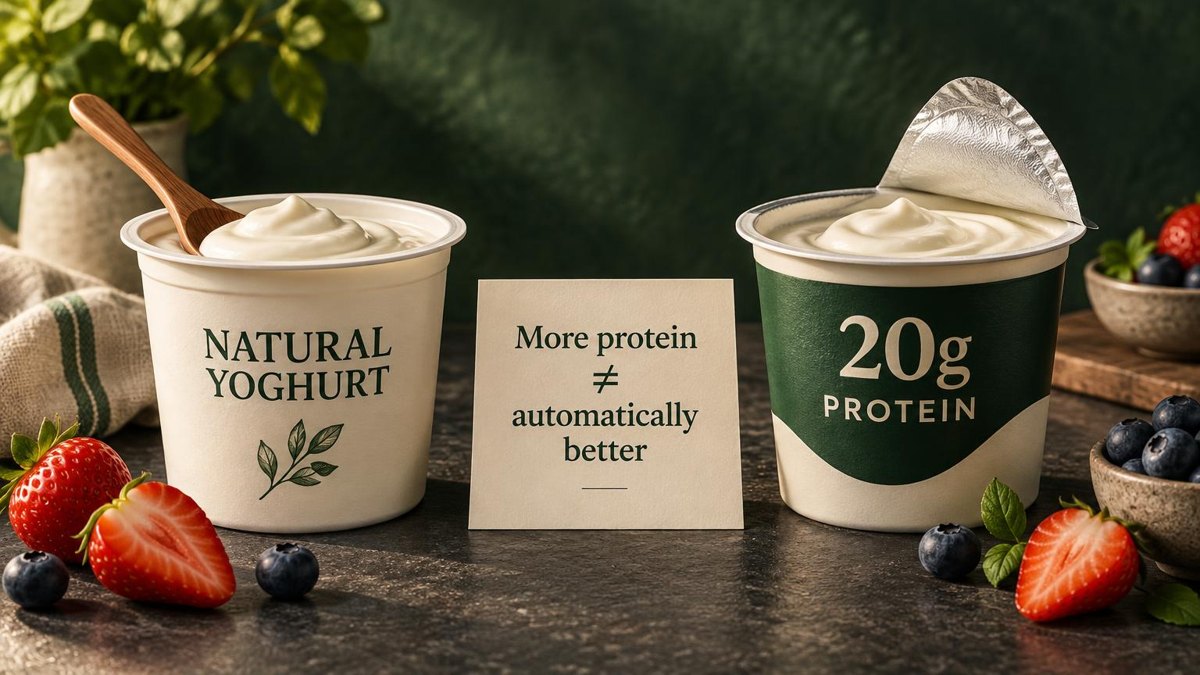
Walk down the yoghurt aisle now and protein is everywhere.
20G PROTEIN
HIGH PROTEIN
0% FAT
NO ADDED SUGAR
It can make an ordinary pot of yoghurt look almost outdated.
But does more protein automatically make the yoghurt better?
No.
It makes it higher in protein.
That can be genuinely useful, especially if you are trying to increase protein without reaching for another shake or bar.
But the protein number still needs to sit beside the rest of the label.
Sugar.
Calories.
Ingredients.
Sweeteners.
Fat.
And, most importantly, whether you actually need the extra protein in the first place.
In the EU, high protein is not simply a marketing phrase.
There is a legal threshold.
A food can make a high protein claim when at least:
20% of its energy value comes from protein.
A source of protein claim has a lower threshold of 12% of energy.
That is important because:
20g of protein
and:
20% of energy from protein
are not the same thing.
A large pot could contain a lot of protein simply because the serving itself is large.
The regulated claim looks at the protein in relation to the food's total energy.
At least 20% of energy from protein
At least 12% of energy from protein
Neither claim is the same as saying 20g protein per pot.
There is more than one way to make a high-protein yoghurt.
Traditional strained yoghurts remove part of the liquid portion.
That concentrates the milk solids, including protein, and produces a thicker texture.
This is one reason Greek-style and Icelandic-style products can contain considerably more protein than standard yoghurt.
Manufacturers can also adjust the milk base so there is more protein before fermentation.
High-protein yoghurt can also be formulated using ingredients such as:
These ingredients can increase protein and change the texture of the finished yoghurt. Research on yoghurt production describes both concentration and dairy-protein fortification as established ways of producing higher-protein products.
None of those approaches automatically makes a yoghurt good or bad.
They simply explain where the extra protein came from.
Concentrates the milk solids
Raises protein in the milk base
Raises protein in the finished yoghurt
Glenisk's current high-protein range gives a useful real-world example.
Its high-protein strained yoghurts are marketed at around 20g protein per pot, depending on the flavour and pot size. The company's current product pages show roughly 8.2 to 10g of protein per 100g across several of the range.
That is substantially more protein than many conventional yoghurts.
But the different flavours also show why stopping at the protein number is a mistake.
A flavoured protein yoghurt can also contain:
while a natural high-protein yoghurt may have a much simpler ingredients list.
Same product category.
Different formulation.
No.
This is one of the most useful things to check.
Yoghurt naturally contains sugar because milk contains:
lactose
FSAI describes lactose as the naturally occurring sugar in milk and dairy foods including yoghurt.
So seeing:
4g sugars
on a plain yoghurt does not automatically mean four grams of sugar were added.
Likewise, a flavoured high-protein yoghurt may contain both:
That is why the nutrition table and ingredients list need to be read together.
Milk sugar appears in the sugars line
Sugar, syrups or fruit preparations may also appear
Take two different ideas:
This may contain mostly:
This may also include:
The protein content can be excellent in both.
Their sugar profile can still be quite different.
For example, Glenisk's current flavoured high-protein range lists added sugar in several flavour preparations, while its natural high-protein yoghurt has a much simpler ingredients list.
So:
HIGH PROTEIN
does not mean:
LOW SUGAR
unless the label actually supports both claims.
20g PROTEIN
Front of pot
Another common combination is:
HIGH PROTEIN + 0% FAT
That can be useful if someone wants a lower-fat yoghurt.
But removing fat does not automatically make a product superior.
Fat contributes:
A full-fat natural yoghurt and a 0% flavoured protein yoghurt are therefore not simply:
bad version vs good version.
They are different foods with different nutritional profiles.
Check what replaced or accompanied the fat reduction.
Possibly, but the answer is more nuanced than the marketing version.
Protein generally appears capable of increasing fullness under some controlled conditions.
A meta-analysis of human studies found higher-protein preloads increased reported fullness compared with lower-protein versions, although the authors also highlighted limitations in the available evidence.
Specific yoghurt studies have produced mixed results.
One small trial in healthy women compared yoghurt snacks containing 5g, 14g and 24g of protein. The 24g protein yoghurt produced greater fullness and delayed the next eating occasion compared with the lower-protein snacks.
But another trial comparing yoghurts with 5g and 14g protein found no meaningful difference in hunger, fullness or subsequent food intake.
So the honest conclusion is:
Higher-protein yoghurt may help with fullness, particularly when the protein difference is substantial, but more protein does not guarantee that everyone will feel dramatically fuller.
Protein contributes to the maintenance and growth of muscle mass.
That does not mean the words:
PROTEIN YOGHURT
build muscle by themselves.
Muscle gain depends on the wider picture, including:
Protein yoghurt can simply be a convenient food for getting more protein into that diet.
Not necessarily.
EFSA's Population Reference Intake for protein for healthy adults is:
0.83g per kilogram of body weight per day.
EFSA also notes that average protein intake among European adults is generally at or above that reference level.
That does not mean 0.83g/kg is the ideal target for every athlete, older adult or person with a specific goal.
Protein needs vary.
But it does mean the average person does not automatically become protein-deficient because they bought ordinary yoghurt instead of the 20g pot.
Protein yoghurt can be genuinely convenient for:
Someone lifting weights or doing significant sport may deliberately aim for more protein than a sedentary adult.
A yoghurt can be an easy snack or breakfast addition.
Replacing a low-protein snack with a high-protein yoghurt may be useful.
Protein intake and distribution can become increasingly important with age, although individual requirements need proper context.
Not every food needs a performance reason.
If you like a high-protein yoghurt and it fits your diet, that is enough.
Not exactly.
Greek or strained yoghurt is naturally concentrated and can therefore contain more protein than standard yoghurt.
But:
Greek-style
does not automatically mean:
high protein
under the legal EU definition.
And a product labelled high protein does not necessarily have to be made by traditional straining.
Read the actual nutrition information.
Skyr is another dairy product commonly associated with high protein and low fat.
Its production and cultural origins differ from standard yoghurt, but from a shopper's perspective the useful comparison is still the final label:
Do not assume the product name alone tells you which one is nutritionally best.
They serve overlapping but different purposes.
A yoghurt is a food.
A protein shake is usually a more concentrated protein delivery format.
Yoghurt can also provide nutrients naturally associated with dairy and has a different texture, food matrix and satiety experience.
A shake may be:
Neither needs to “win”.
The better choice depends on what you actually need.
Some high-protein yoghurts use sugar.
Others use non-sugar sweeteners.
Others use a combination.
That is why two pots with almost identical:
20g PROTEIN
claims can have quite different ingredient lists.
If you see sweeteners such as:
read them as part of the wider formulation rather than assuming:
sweetener = bad yoghurt.
Some do.
Some do not.
Depending on the formulation you might see:
These ingredients can help with:
A strained natural yoghurt may have a very short ingredients list.
A dessert-style protein yoghurt may have a longer one.
Ingredient count alone still does not tell you whether one is automatically healthier.
Yoghurt contains bacterial cultures involved in fermentation.
But contains cultures and clinically proven probiotic benefit are not automatically the same statement.
FSAI treats probiotic terminology and health claims carefully under EU health-claims rules.
Do not assume a yoghurt improves gut health simply because bacteria appear in the ingredients.
If a manufacturer makes a specific health claim, assess that specific claim and evidence.
It can be.
For context, a 70kg adult using EFSA's general adult PRI of 0.83g/kg would correspond to roughly:
58g protein per day.
A 20g yoghurt would therefore represent around a third of that reference amount.
But this is only a teaching comparison.
It does not mean:
Everyone weighing 70kg should aim for exactly 58g
or:
One protein yoghurt supplies one-third of everyone's ideal intake.
Individual requirements vary substantially with circumstances and goals.
0.83g/kg × 70 = 58.1g/day
About one-third of that reference
Population reference example, not a personalised target.
This is another marketing trick worth understanding.
Imagine:
20g protein in 200g
15g protein in 150g
Both contain:
10g protein per 100g.
Pot A has more total protein because the serving is bigger.
It is not necessarily a more protein-dense product.
When comparing similar yoghurts, look at:
protein per 100g
and:
protein per actual pot.
Both are useful.
20g protein per pot
15g protein per pot
Illustrative pots, not real product results. More per pot can simply mean more yoghurt.
Protein gets the largest writing on the pack.
The rest of the nutrition still matters.
Are they mainly naturally occurring milk sugars?
Does the ingredients list include added sugar?
Especially when comparing full-fat and lower-fat products.
A dessert-style high-protein pot can be quite different from plain strained yoghurt.
How simple or formulated is the product?
Is the pot 150g, 200g, 500g or 1kg?
Are you trying to increase protein?
Or are you buying it because the packaging made ordinary yoghurt suddenly feel inadequate?
Glenisk's current range demonstrates how different products can sit under the same high protein umbrella.
Its natural high-protein yoghurt lists a very simple milk-and-cultures formulation, while flavoured versions can include sugar, fruit preparations, coffee, flavourings or stabilisers depending on the variety.
Some of the current single pots are marketed as delivering around:
20g protein per pot.
That is a real nutritional difference.
But it still does not remove the need to compare the rest of the formulation.
There is no universal answer.
A plain high-protein yoghurt may be an excellent fit for someone who wants:
A plain ordinary yoghurt might also be an excellent food for someone who already gets plenty of protein.
A highly flavoured protein yoghurt might contain more protein but also more added ingredients or sugars than a plain alternative.
So the word:
PROTEIN
should not function like a health score.
It tells you something valuable.
It does not tell you everything.
This tells you how protein-dense the product actually is.
This tells you what you will actually consume.
Remember that yoghurt naturally contains lactose.
Especially for flavoured products.
Protein does not cancel the rest of the nutrition.
Plain vs plain. Strawberry vs strawberry. Single pot vs single pot.
More is not automatically better.
Protein is one of the easiest nutrients to turn into a health halo.
A pot can shout:
20G PROTEIN
while everything else sits quietly on the back.
Sláinte can help put the headline back into context.
The useful view is not only:
How much protein?
It is:
High protein can absolutely be a positive.
It just should not be the only thing you see.
It can be a useful high-protein food, but the protein amount does not describe the entire product. Check sugars, energy, fat and ingredients too.
Under EU rules, at least 20% of the food's energy must come from protein for a high-protein claim.
Not necessarily. Straining often raises the protein concentration, but the exact nutrition label determines whether the product qualifies as high protein.
Usually, yes. Milk naturally contains lactose. Flavoured yoghurts may also contain added sugars or other sweetening ingredients.
It is a substantial amount of protein for one snack, but whether you need it depends on your total diet and requirements.
Some studies suggest higher-protein yoghurt can increase fullness or delay subsequent eating, but yoghurt studies have not produced identical results in every comparison.
Protein supports muscle maintenance and growth, but resistance training, total daily intake and recovery all matter.
Not automatically. It has more protein, but ‘better’ depends on the exact products and what you need from them.
Last reviewed: 9 October 2026