
Why does plain yoghurt contain sugar?
Milk naturally contains lactose.
Published · Updated · Sláinte Editorial
Look at a tub of plain yoghurt and you may still see sugar on the nutrition table.
That does not automatically mean someone added table sugar to it.
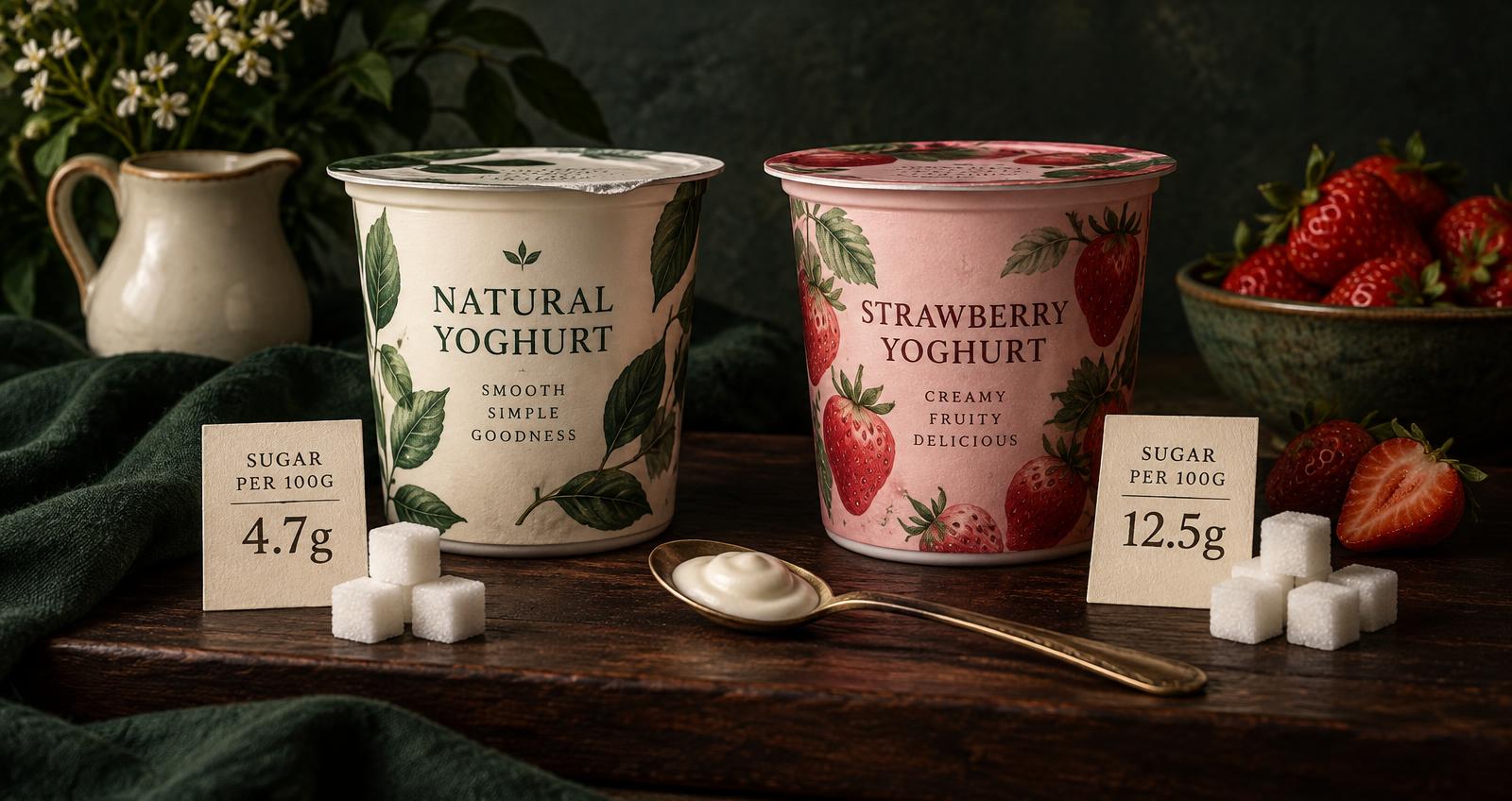
Milk naturally contains lactose.
The ingredients list helps explain where the total sugar number comes from.
Per 100g:
Per 100g:
The flavoured product’s ingredients include cane sugar.
Because milk contains lactose.
That naturally occurring milk sugar appears in the total sugars value on the nutrition declaration.
So 3.3g sugars does not automatically mean 3.3g added sugar.
EU nutrition declarations generally give a value for of which sugars.
That is total sugars.
It does not automatically separate naturally occurring lactose from sugar added during manufacturing.
The ingredients list is therefore important.
No.
It may be tempting to say 10.3g minus 3.3g equals 7g added sugar.
That would assume the two products have identical amounts of every naturally occurring sugar and ingredient.
We do not have enough evidence to make that calculation.
The accurate statement is: the flavoured yoghurt has a higher total-sugars value and lists cane sugar as an ingredient.
The plain yoghurt listing gives 3.3g protein per 100g.
The mango and vanilla listing gives 2.8g per 100g.
Again, this describes the exact products.
Both researched products listed 4.2g fat per 100g.
That is useful because it prevents another common shortcut: flavoured does not automatically mean lower fat, and plain does not automatically mean higher fat.
Read the actual label.
No.
Organic status and sugar content answer different questions.
An organic product can contain added sugar. A conventional product can be unsweetened.
Yoghurt products may contain live cultures.
If an article discusses specific digestive or probiotic benefits, those claims need their own evidence and must comply with the relevant health-claims rules.
For yoghurt, check:
Milk naturally contains lactose.
No.
No. Check the exact product.
No.
Not reliably from the standard nutrition table alone.
Last reviewed: 5 October 2026