
Are oats always healthier than cereal?
No universal conclusion should be made from two products.
Published · Updated · Sláinte Editorial
Which is healthier, porridge or corn flakes?
That sounds like a simple question.
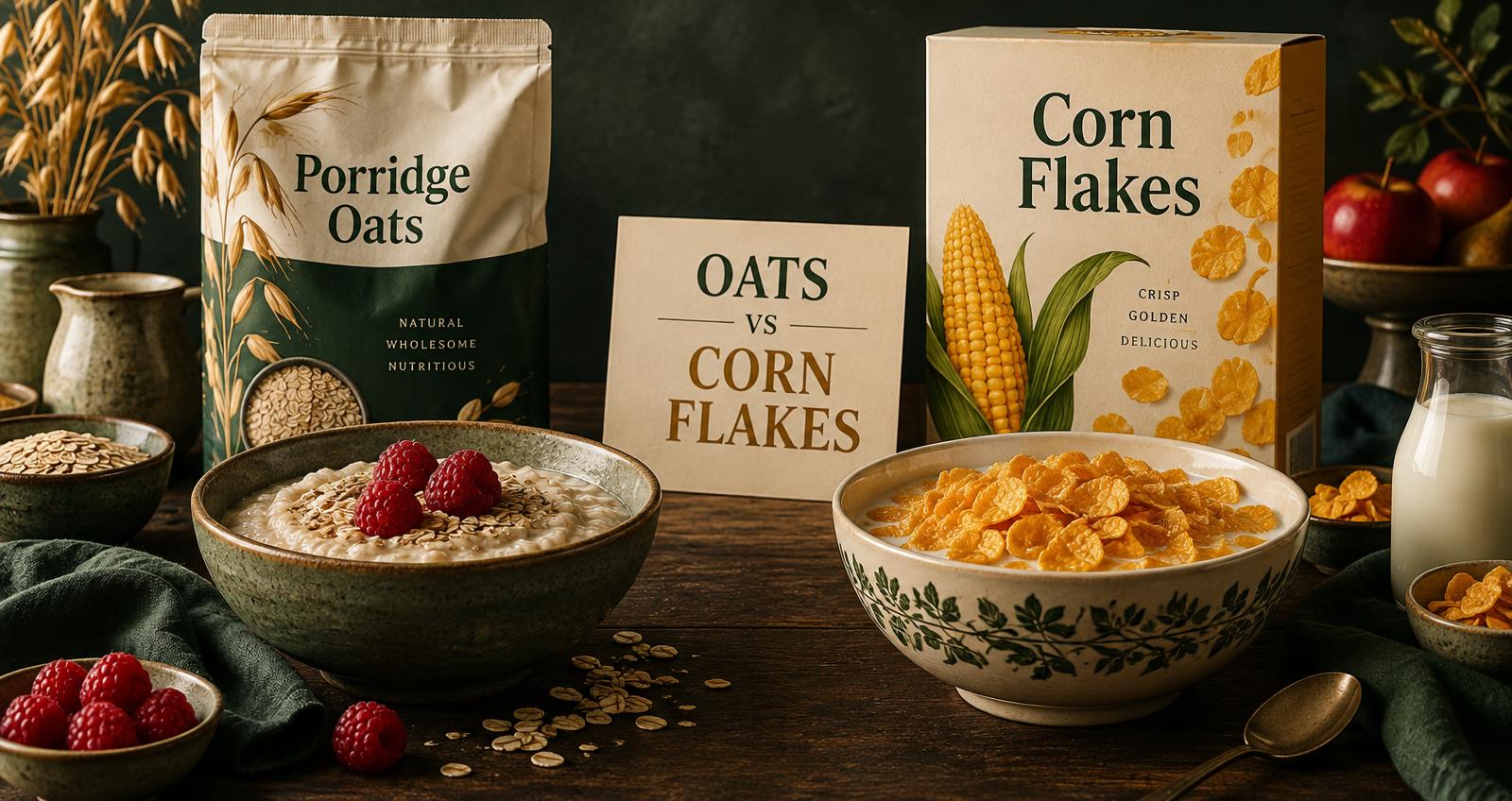
But even a two-product comparison shows why one headline number is rarely enough.
The Irish product listings give us a useful case study.
This is not a ranking of every breakfast cereal in Ireland. It is a comparison of two exact products.
Per 100g:
Per 100g:
The first surprise is energy.
371 kcal vs 378 kcal per 100g is a relatively small difference.
If calories were the only number you looked at, the two products could appear very similar.
The rest of the label tells a different story.
The oats listing gives 0.9g sugars per 100g.
The Corn Flakes listing gives 8g per 100g.
That is a clear declared difference between these two products.
It should not be generalised to every cereal or every oat product.
The oats record gives 8.3g fibre per 100g.
Corn Flakes gives 3g per 100g.
Again, that gives useful context that energy alone missed.
Flahavan’s gives 11g per 100g.
Corn Flakes gives 7g per 100g.
That does not turn porridge into a protein supplement. It simply describes another difference between the exact products.
The biggest declared contrast here is salt.
Flahavan’s listing: less than 0.01g per 100g.
Corn Flakes listing: 1.1g per 100g.
The question is not whether salt makes Corn Flakes “bad”. It is that salt deserves to be visible when comparing these foods.
Corn flakes may also provide added vitamins and minerals through fortification.
That information should not be ignored because it complicates a simple good-vs-bad story.
A proper comparison includes both advantages and limitations.
Manufacturer portions can differ.
For teaching purposes, an equal 40g comparison can show what the two products provide on the same quantity basis.
Clearly label this as a calculated equal-weight comparison rather than a manufacturer serving recommendation.
Porridge may be cooked with milk, water, fruit, honey or nut butter.
Corn flakes may be eaten with milk, yoghurt, fruit or added sugar.
The finished breakfast can therefore look quite different from the dry cereal record.
Keep the base product and the prepared meal conceptually separate.
For these exact products, the oats listing shows less sugar, more fibre, more protein and much less salt, while their declared energy per 100g is similar.
Corn Flakes may provide fortification that also deserves to be recognised.
That is a useful comparison.
It is more accurate than saying All cereal is bad or Porridge is always healthy.
Sláinte can help show several parts of the product together instead of reducing breakfast to calories or sugar alone.
No universal conclusion should be made from two products.
The standard nutrition table reports total sugars, not necessarily added sugars.
It is part of the product’s nutritional composition and can be relevant.
It provides a consistent basis across products.
Serving size changes how much you consume. It does not change the underlying per-100g composition.
Last reviewed: 5 October 2026