
Back to Journal

Honey vs Sugar vs Maple Syrup: Are Natural Sweeteners Actually Healthier?

Published · Updated  · Sláinte Editorial

An equal 15g portion of Tesco clear honey contains 12.2g of sugar. The same weight of Tesco maple syrup contains 9.2g. Neither is sugar-free, and both count towards the World Health Organization's recommendations for limiting free sugars.

Honey is natural. Maple syrup comes from trees. Date syrup comes from fruit.

Ordinary white sugar doesn't have quite the same wholesome reputation.

That's why you'll often see recipes replacing sugar with honey, maple syrup or dates and describing the result as healthier.

But does changing the source of sweetness really change the nutritional value of the food?

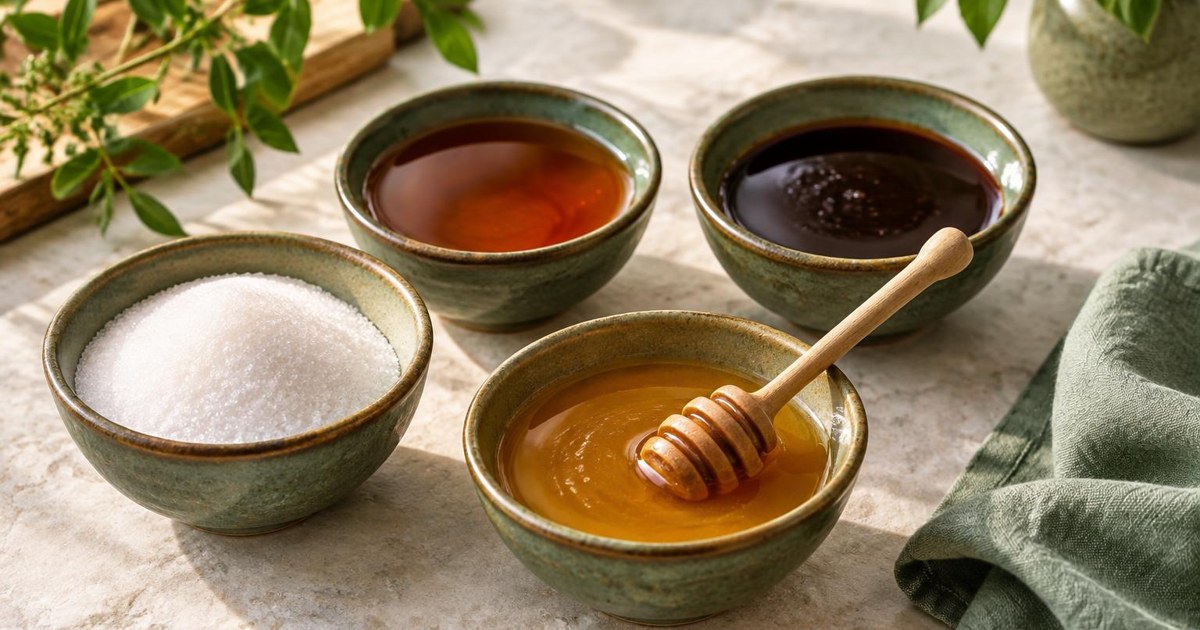
Four ceramic bowls containing white sugar, golden honey, amber maple syrup and dark date syrup
Four different sweeteners, four different nutritional profiles. But all contribute sugars.

That doesn't mean there's no difference between these ingredients.

There are differences in flavour, composition, water content and the amounts of sugar they contain.

The question is how significant those differences really are.

We compared four sweetening products available from Tesco Ireland, including sugar from Dublin-based Gem Pack Foods, to find out what the labels actually tell us.

Why do natural sweeteners have a healthier reputation?

Honey, maple syrup and date syrup have appealing origin stories.

Honey is produced by bees from flower nectar.

Maple syrup is made by concentrating sap collected from maple trees.

Date syrup is produced from dates, a fruit containing naturally occurring sugars.

These ingredients are different from refined white sugar in their composition and production.

Some contain small amounts of minerals and other naturally occurring compounds.

They also have distinctive flavours, which may influence how much someone chooses to use.

But there's an important distinction.

Being natural does not automatically mean a food has less sugar, fewer calories or a greater nutritional benefit.

White sugar also originates from plants, usually sugar beet or sugar cane.

The difference is how those ingredients are processed and what remains in the finished product.

To understand whether one is nutritionally preferable, we need to move beyond its origin.

We need to read the label.

Four sweeteners from Irish supermarkets compared

We examined the published nutrition information for four products listed by Tesco Ireland. The figures below were cross-checked against the linked retailer listings on 15 October 2026; recipes and labels can change.

The comparison includes:

  • Gem Granulated Sugar, a product from Irish company Gem Pack Foods.
  • Tesco Clear Honey.
  • Tesco Finest Grade A Dark Maple Syrup.
  • Biona Organic Squeezy Date Syrup.

These are specific products, not averages for all honey, sugar or syrup.

What the nutrition tables show

ProductCalories per 100gSugars per 100g
Gem Granulated Sugar394 kcal100g
Tesco Clear Honey327 kcal81g
Tesco Finest Dark Maple Syrup261 kcal61g
Biona Organic Date Syrup285 kcal67g

Sources: Tesco Ireland's published product nutrition listings, checked 15 October 2026.

The differences are quite substantial when compared per 100g.

The granulated sugar contains 100g of sugars per 100g because it is essentially pure sugar.

The honey contains 81g.

The date syrup contains 67g.

The maple syrup contains 61g.

So maple syrup contains considerably less sugar per 100g than granulated sugar.

But that doesn't mean its sugars are harmless or should be excluded from dietary recommendations.

Why do the numbers differ?

One reason is water.

Granulated sugar is a dry crystalline product.

Honey and syrups contain water alongside their sugars and other constituents.

The sugar is therefore less concentrated by weight.

That explains much of the difference in the figures.

It also means replacing sugar with an identical weight of honey or maple syrup may reduce the amount of sugar added to a recipe.

However, the final result depends on how much sweetener is used, the recipe and the size of the portion.

A baker might use more or less of a liquid sweetener to achieve the desired taste and texture.

A lower sugar concentration is not the same thing as a healthier finished meal.

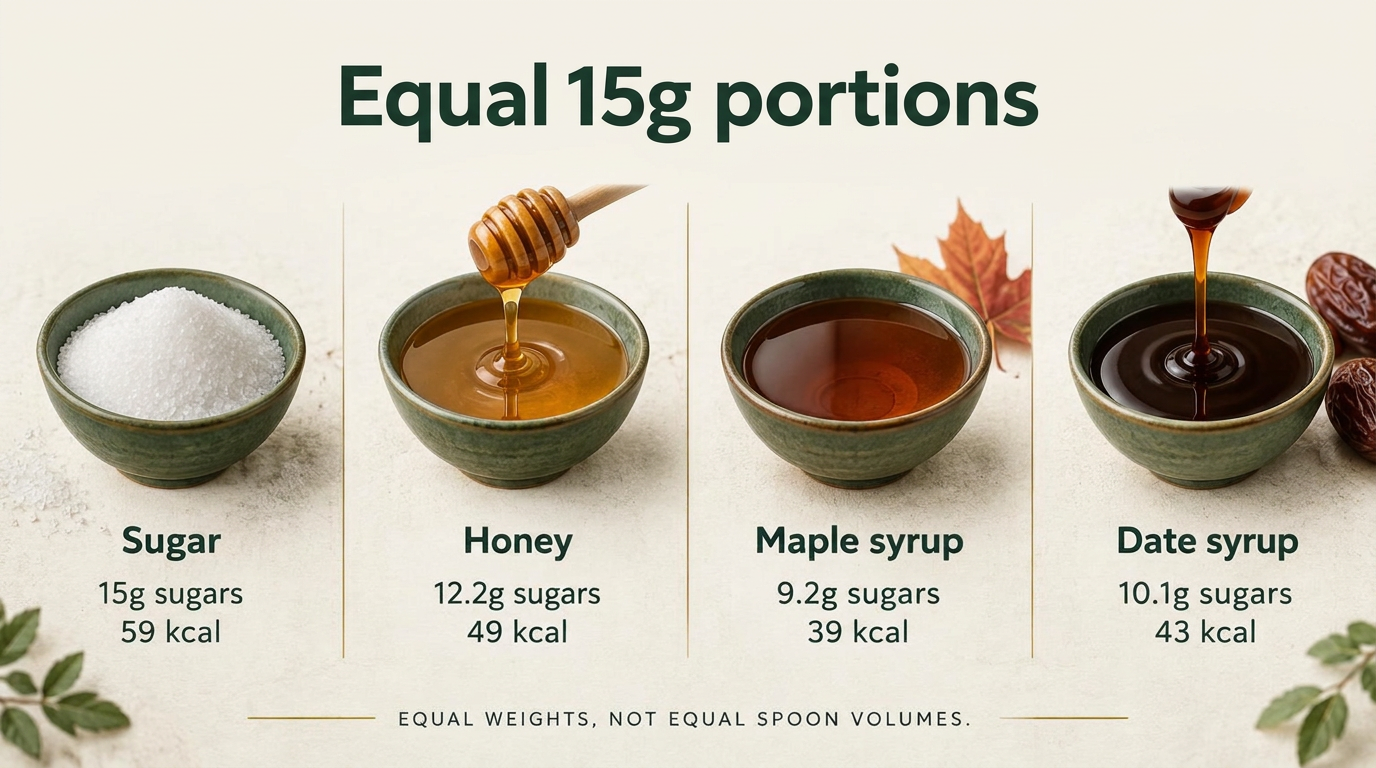
What does a 15g portion actually contain?

Most people don't eat 100g of honey or maple syrup in one sitting.

A tablespoon is a more recognisable quantity.

For a fair comparison, we used 15g of each product rather than assuming that a tablespoon has the same weight across different ingredients.

ProductCalories per 15gSugars per 15g
Gem Granulated Sugar59 kcal15g
Tesco Clear Honey49 kcal12.2g
Tesco Finest Dark Maple Syrup39 kcal9.2g
Biona Organic Date Syrup43 kcal10.1g

Values calculated from the published per-100g nutrition figures. Figures are rounded. A 15g serving is not necessarily equivalent to the same spoon volume for each product.

The differences are real.

A 15g serving of maple syrup provides approximately 5.8 grams less sugar than the same weight of granulated sugar.

But there's another way to interpret those numbers.

That same 15g of maple syrup still contains approximately 9.2g of sugar.

Replacing sugar with maple syrup doesn't remove sugar from your diet.

It changes how much you're consuming at a given weight and the source of that sweetness.

The distinction matters, particularly when ingredients are marketed as healthier substitutes.

Four equal 15g portions: sugar 15g sugars, honey 12.2g, maple syrup 9.2g and date syrup 10.1g
Natural sweeteners can contain less sugar by weight than granulated sugar, but they still contribute meaningful amounts.

Is honey actually healthier than sugar?

Honey has been used as a food for thousands of years.

It's valued for its flavour and contains naturally occurring compounds beyond sugar and water.

But nutritionally, it's still a concentrated source of sugars.

The Tesco Clear Honey we examined contains:

  • 327 calories per 100g.
  • 81g of sugars per 100g.
  • 0.5g of protein per 100g.
  • 0.5g of fibre per 100g.

Those last two figures are very small, particularly when considering a typical serving.

Honey may contain trace quantities of minerals and other compounds, but the presence of these substances doesn't establish that using honey instead of sugar will produce a meaningful health benefit.

The quantity consumed matters.

Does honey count as free sugar?

Yes.

The World Health Organization explicitly includes sugars naturally present in honey within its definition of free sugars.

This may seem confusing.

Honey is a naturally occurring food, and nobody needs to add table sugar to pure honey for it to taste sweet.

But free sugar isn't simply another term for artificially added sugar.

It's a dietary classification that includes added sugars alongside those naturally present in honey, syrups and fruit juices.

That's why replacing sugar in your tea with honey doesn't make the sweetness disappear from your free-sugars intake.

What about honey's antibacterial properties?

Honey has properties that have been studied for antimicrobial effects, particularly in specialised medical applications.

Medical-grade honey is sometimes used in wound-care products.

But the evidence for a medical-grade topical product shouldn't be transferred directly to claims about eating ordinary supermarket honey.

Using honey in porridge or tea is not an established way of preventing illness or improving general health.

It is best treated as a sweetening ingredient that can be enjoyed as part of a balanced diet.

Important: The Food Safety Authority of Ireland advises against giving honey to children under 12 months because of the risk of infant botulism.

Is maple syrup better than sugar?

Maple syrup has become particularly popular in porridge, granola, pancakes and homemade baking.

It's often promoted as a less refined alternative to sugar.

Pure maple syrup is made from concentrated maple sap.

The Tesco Finest Dark Maple Syrup in our comparison contains 61g of sugars per 100g.

That's lower than both the granulated sugar and the honey we examined.

Does maple syrup contain minerals?

Pure maple syrup can provide naturally occurring micronutrients, including the mineral manganese and the vitamin riboflavin, although the amounts depend on the product and serving.

It also contains plant-derived compounds.

However, the presence of micronutrients doesn't automatically make it a useful source of those nutrients in an everyday diet.

A small drizzle of maple syrup is still predominantly a source of sugar and energy.

And consuming substantial quantities to obtain more minerals would also increase free-sugars intake.

There are more nutrient-dense ways to obtain vitamins and minerals.

Is maple syrup lower in sugar?

It can be lower in total sugars by weight than granulated sugar.

Our product comparison demonstrates that.

But there are two important qualifications.

First, maple syrup brands and formulations can differ.

Second, some products marketed with maple flavours are blends rather than pure maple syrup.

This is where the ingredients list becomes especially useful.

Not every maple syrup product is pure maple syrup

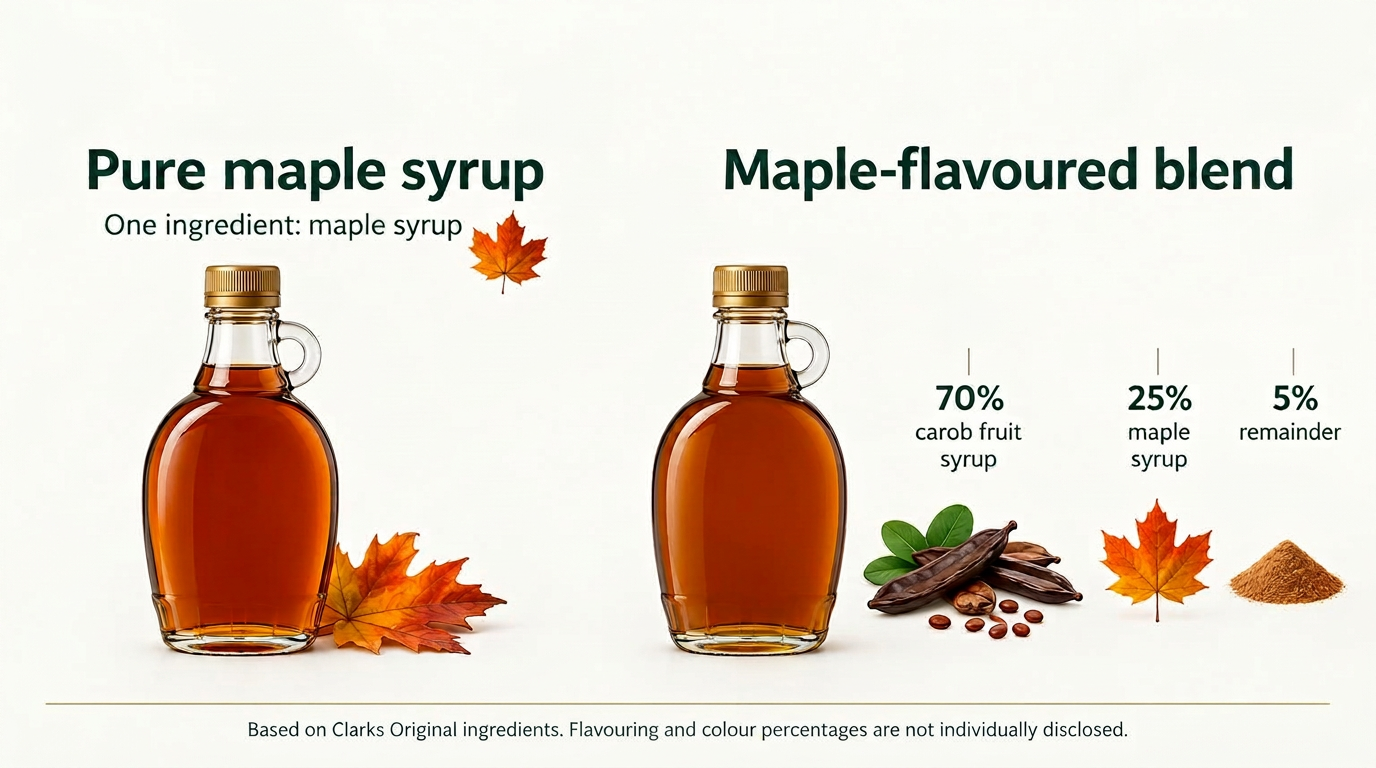
Take Clarks Original Maple Syrup, another product listed by Tesco Ireland.

Its retailer listing identifies it as a maple-flavoured blend. The comparison below follows Tesco Ireland’s listed formulation; the manufacturer also lists a newer formulation, so check the bottle you buy.

The ingredients are:

  • Carob fruit syrup (carob and apple): 70%.
  • Maple syrup: 25%.
  • Natural flavouring.
  • Colour: plain caramel.

That means only one quarter of the product is declared as maple syrup.

The product contains 55g of sugars per 100g.

Its label also compares its sugar content with white granulated sugar.

Those are specific, verifiable characteristics.

But the example demonstrates why a product name or flavour isn't enough to identify the full formulation.

If you're buying maple syrup specifically because you want pure maple syrup, the ingredients list is the place to check.

Pure maple syrup compared with the Tesco-listed Clarks blend of 70% carob fruit syrup and 25% maple syrup
Two products can use similar maple imagery while containing very different ingredient combinations.

What about date syrup?

Date syrup is often marketed as an alternative to refined sugar.

Because it comes from dates, it's tempting to assume that it provides the same nutritional benefits as eating the whole fruit.

But whole dates and date syrup are not nutritionally interchangeable.

The Biona Organic Date Syrup we examined contains:

  • 285 calories per 100g.
  • 67g of sugars per 100g.
  • Less than 0.5g of fibre per 100g.
  • 1.5g of protein per 100g.

The fibre figure is particularly revealing.

Whole dates versus date syrup

Whole dates contain naturally occurring sugars, but they also retain fibre and the structure of the original fruit.

Processing dates into a syrup changes the form in which they're consumed.

The Biona syrup contains less than 0.5g of fibre per 100g according to its nutrition label.

So although the syrup is made from dates, it cannot be assumed to provide the same fibre benefits as whole dates.

Does date syrup count as free sugar?

The WHO definition includes sugars present in syrups.

Therefore, date syrup is a source of free sugars.

The fact that those sugars originate from fruit does not exempt them from the definition.

This is different from the sugars naturally contained within intact whole fruit.

There can be more nuance with fruit purées and pastes, depending on how they're processed, so those shouldn't automatically be treated as identical to either whole fruit or syrup.

For the product we're examining, however, the distinction is straightforward.

It's a syrup, and it contains a substantial amount of sugar.

Is natural sugar different from added sugar?

The terminology can make this confusing.

The word natural describes something about an ingredient's origin or production.

Added sugar refers to sugars introduced during the preparation or manufacture of a food.

Free sugars is the broader dietary category used by organisations such as WHO.

These categories overlap, but they don't mean the same thing.

Food or ingredientNaturally occurring sugars?Counts towards WHO free sugars?
Whole appleYesNo, for sugars within intact fruit
Plain milkYesNo, for naturally occurring lactose
HoneyYesYes
Pure maple syrupYesYes
Date syrupYesYes
White sugar added to foodAdded during preparationYes
100% fruit juiceYesYes

A sugar can be naturally occurring and still count as free sugar.

That is probably the most important distinction in this article.

For a closer look at EU claims, read What Does "No Added Sugar" Actually Mean?.

What does the scientific evidence say?

Two major authorities provide useful context.

World Health Organization

WHO recommends keeping free sugars below 10% of daily energy intake.

It also suggests that reducing free sugars below 5% may provide additional health benefits.

For someone consuming approximately 2,000 calories daily, those percentages correspond to:

  • Less than 50g of free sugars at the 10% level.
  • Less than 25g at the suggested 5% level.

These are illustrative amounts, not fixed gram limits for every person.

Honey, maple syrup and date syrup all contribute free sugars.

The recommendations do not create a general exemption for sweeteners derived from natural sources.

European Food Safety Authority

In its 2022 scientific assessment of dietary sugars, EFSA concluded that added and free sugars should be kept as low as possible within a nutritionally adequate diet.

EFSA also explained that the available evidence did not allow scientists to establish a tolerable upper intake level for dietary sugars.

That's an important distinction.

It does not mean there is a scientifically proven amount of sugar below which every health risk disappears.

Nor does it mean that eating any sugar is automatically harmful.

It means that reducing excessive added and free-sugars intake is consistent with the available evidence.

The broader dietary pattern remains important.

Does honey raise blood sugar differently from ordinary sugar?

Honey, maple syrup and table sugar differ in their proportions of individual sugars, water and other constituents.

Those differences can influence how they behave in food and how the body responds to them.

But it would be misleading to promise that honey or maple syrup will prevent a blood-glucose rise.

Both contain digestible sugars.

The glycaemic response to a meal also depends on the amount eaten and the other foods consumed.

For example, adding a small quantity of honey to a bowl of oats and nuts produces a different overall meal from drinking a large sweetened beverage.

A lower reported glycaemic index for an ingredient, where available, does not establish that the finished meal is healthier.

People managing diabetes should consider total carbohydrate intake and follow personalised clinical or dietetic guidance rather than assuming that natural sweeteners can be used without restriction.

Is organic syrup healthier?

Organic describes how food is produced under a recognised set of standards.

It does not automatically mean that the finished product is low in sugar or calories.

Biona Organic Date Syrup contains 67g of total sugars per 100g.

That figure remains relevant regardless of its organic certification.

An organic label can provide meaningful information about production methods.

But it shouldn't be interpreted as a complete nutritional assessment.

The same principle applies to words such as natural, traditional, pure and unrefined.

Each may describe a particular characteristic.

None automatically establishes the entire product's health value.

What about the sugar in whole fruit?

This is where the distinction becomes genuinely useful.

Compare eating a whole apple with adding syrup to a bowl of porridge.

The whole apple provides water, fibre and other nutrients in the structure of an intact fruit.

The syrup provides a concentrated source of sweetness with much less of that original food structure.

Both can be enjoyed, but they do different things nutritionally.

The WHO free-sugars recommendations do not apply to sugars naturally present within intact whole fruit.

That does not mean portion sizes or total energy intake are irrelevant.

It simply reflects the scientific distinction between sugars within whole foods and free sugars.

For a naturally sweet addition to breakfast, fresh fruit may be a useful alternative to repeatedly adding larger quantities of syrup.

Five things to check when choosing a sweetener

You don't need to avoid every sweetener or calculate every gram of sugar.

But a few simple comparisons can make supermarket shopping more informative.

1. Look at sugars per 100g

This allows you to compare products fairly.

Our examples ranged from 61g to 100g of sugars per 100g.

The differences are meaningful, but they don't create a sugar-free option.

2. Check the actual ingredients

A product with maple flavouring is not necessarily pure maple syrup.

A syrup can contain several components, even when one ingredient is emphasised on the front.

Read the ingredients to see what you're buying.

3. Think about the amount you use

A small drizzle and several large spoonfuls contribute very different amounts of sugar.

Consider how much you actually add to your food or drink.

4. Don't assume organic means low sugar

Organic certification doesn't override the nutrition table.

Use both pieces of information for what they actually tell you.

5. Consider whether you need sweetness at all

Plain yoghurt, porridge and other foods can be enjoyed with fruit, spices or without additional sweetening.

Taste preferences vary, and there is no requirement to remove all sweetness from your diet.

The aim is simply to make a considered choice rather than relying on a health-related impression created by packaging.

How Sláinte evaluates products like these

Sláinte is designed to help people understand food labels without reducing every decision to one ingredient.

That matters when comparing sweeteners.

Honey may have a very short ingredient list, but it also contains substantial sugar.

Date syrup may be organic and made from fruit, but it provides very little fibre compared with whole fruit.

Maple syrup may contain less sugar by weight than granulated sugar, but it is still a source of free sugars.

These are different nutritional and compositional characteristics.

Under Sláinte's published methodology, products are assessed using three weighted components.

Scoring componentWeight
Nutrition quality55%
Ingredients30%
Processing and quality signals15%

Nutrition includes relevant factors such as sugars, energy, saturated fat, salt, fibre and protein, with appropriate product-category rules.

The ingredients component considers the declared formulation.

Processing and quality signals contribute to the remaining part of the score.

Additional category-specific rules, ceilings and floors may apply.

Importantly, the published methodology includes protection against automatically placing a single-ingredient, additive-free, unprocessed food below certain more heavily formulated products solely because of its nutrient profile.

That's why the score should be understood together with its explanation.

A natural ingredient is not automatically sugar-free, and a low ingredient count is not a complete nutrition score.

We haven't assigned Sláinte Scores to the four products in this article. Exact results require their verified product records and the current scoring engine.

You can explore the Sláinte scoring methodology or try the food scanner.

Frequently asked questions

Is honey healthier than white sugar?

Honey contains some naturally occurring compounds beyond sugars, and it has a different composition from white sugar. However, it remains a concentrated source of free sugars. There isn't sufficient justification to treat ordinary honey as a substantially healthier everyday replacement simply because it's natural.

Is maple syrup better for you than sugar?

Pure maple syrup can contain less sugar and fewer calories by weight than granulated sugar, as shown in our product comparison. But it still contributes free sugars. The quantity consumed and the broader diet matter.

Is date syrup healthier than refined sugar?

Date syrup is made from fruit, but it's still a concentrated source of sugars. The Biona Organic Date Syrup we examined contains 67g of sugars and less than 0.5g fibre per 100g. It shouldn't be treated as nutritionally equivalent to whole dates.

Does honey count as added sugar?

Honey naturally contains sugars, so pure honey itself does not need to have sugar added. However, when honey is added to another food as a sweetener, it contributes to that food's free-sugars content. WHO also classifies the sugars naturally present in honey as free sugars.

Can diabetics eat honey instead of sugar?

Honey contains digestible carbohydrates that can affect blood glucose. It is not an unrestricted alternative to sugar for people with diabetes. Portion size, total carbohydrate and individual dietary guidance remain important.

Is maple syrup better than honey for weight loss?

Maple syrup can provide fewer calories per equal weight than honey, depending on the products compared. But neither ingredient independently causes weight loss. Overall energy intake, dietary pattern and portion size matter much more than simply switching between the two.

Is organic sugar healthier than ordinary sugar?

Organic certification concerns production standards. It does not automatically change the amount of sugar or energy in the finished product. Compare the nutrition information rather than assuming an organic claim guarantees a healthier option.

Does natural sugar cause tooth decay?

Free sugars, including those naturally present in honey and syrups, contribute to tooth-decay risk. WHO advises limiting free-sugars intake as part of its dental-health recommendations. Natural origin does not eliminate that risk.

Is fruit a better option than syrup?

Whole fruit generally provides fibre, water and other nutrients in its intact food structure. Its naturally occurring intrinsic sugars are not classified as free sugars by WHO. Syrups are concentrated sweetening ingredients, so they are not nutritionally interchangeable with whole fruit.

The short version

  • Honey, maple syrup and date syrup all contain substantial amounts of sugar.
  • White granulated sugar contains approximately 100g of sugars per 100g.
  • The Tesco honey examined contains 81g of sugars per 100g.
  • The Tesco maple syrup contains 61g of sugars per 100g.
  • The Biona date syrup contains 67g of sugars per 100g.
  • Honey and syrups count towards WHO free-sugars recommendations.
  • Natural does not automatically mean healthier.
  • Organic certification does not mean a product is low in sugar.
  • Pure maple syrup and maple-flavoured syrup blends are not necessarily the same product.
  • Whole dates and date syrup differ considerably in their fibre content.
  • Honey should not be given to infants under 12 months.
  • Portion size, ingredients and total dietary intake matter more than the sweetener's reputation.

Honey, maple syrup and date syrup can all be useful ingredients. But replacing white sugar with something that sounds more natural does not automatically make a food healthier.

The best choice is the one that fits your needs, tastes and overall diet, with an understanding of what the product actually contains.