
01
Unprocessed or minimally processed
Fruit, vegetables, eggs, milk, plain oats, fresh meat and nuts.
Foods that remain close to their original form. They may be washed, chilled, frozen or dried without substantially changing the food.
Processing is useful information. It is not a complete verdict on a food.
Ultra-processed food is everywhere: breakfast cereals, protein bars, flavoured yoghurts, ready meals, crisps, sauces and soft drinks. Even foods marketed as high protein, natural or healthy can fit the definition.
But ultra-processed does not simply mean unhealthy. It does not mean a product contains an E number, and it does not mean every packaged food should be avoided. The useful question is what makes a food ultra-processed and how that shows up on an Irish supermarket label.
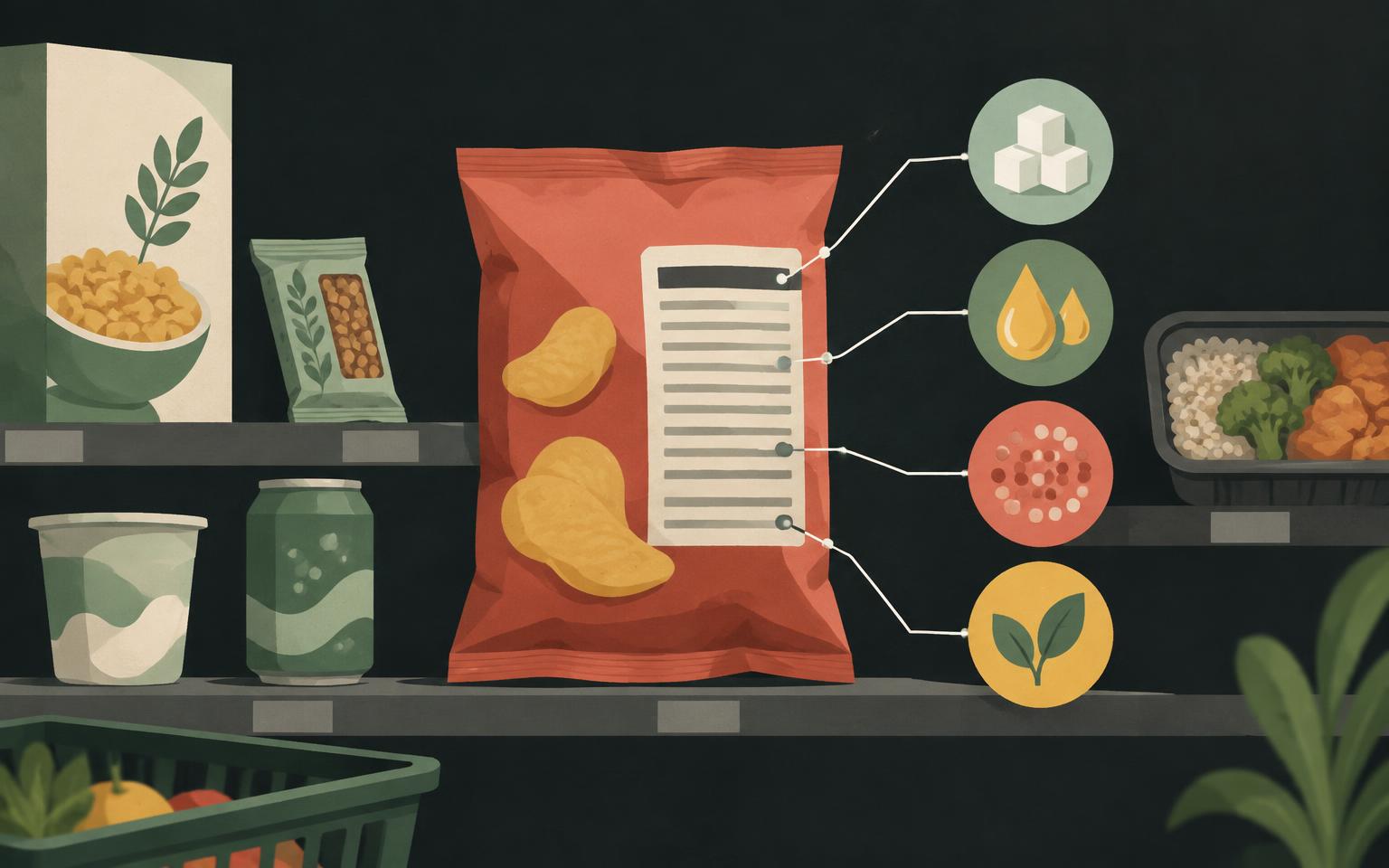
The term comes largely from the NOVA food classification system, which groups foods according to how they are processed. It is not simply a measure of how many ingredients are in a product.
A food can be processed without being ultra-processed. Freezing vegetables is processing. Turning milk into cheese is processing. Canning beans is processing. Ultra-processed foods generally go further.
They are often industrial formulations made using combinations of ingredients, substances derived from foods and additives that would not normally be used when preparing the same type of food in a kitchen. That can include protein isolates, modified starches, flavourings, colours, emulsifiers and some sweeteners.
The important word is formulation.
The NOVA system
01
Fruit, vegetables, eggs, milk, plain oats, fresh meat and nuts.
Foods that remain close to their original form. They may be washed, chilled, frozen or dried without substantially changing the food.
02
Butter, oil, sugar and salt.
Ingredients generally used to prepare other foods rather than eaten as a meal on their own.
03
Cheese, tinned vegetables with salt, simple bread and salted nuts.
Foods commonly made by combining Group 1 foods with Group 2 ingredients, while the original food remains recognisable.
04
Soft drinks, packaged snacks, instant noodles, some cereals, protein bars, ready meals and flavoured yoghurts.
Industrial formulations that may use food-derived substances and additives to create particular flavours, textures, colours, shelf lives or eating experiences.
Putting a food in Group 4 does not automatically tell you its nutritional quality. That distinction matters when two formulations have very different nutrition panels.
There is no large ultra-processed box printed on the front. You have to inspect the ingredients. Imagine a cereal bar labelled: oats, glucose syrup, milk chocolate, sugar, vegetable oil, whey protein concentrate, humectant, emulsifier, flavouring and sweetener.
The oats are not what make it ultra-processed, and neither is the wrapper. The overall formulation and the types of ingredients being used indicate a greater degree of industrial processing.
Used to create or strengthen flavours. They can signal a highly formulated product, but their presence does not automatically make it harmful.
Help ingredients that would normally separate stay mixed in products such as sauces, ice cream, chocolate and baked goods.
Ingredients such as sucralose, aspartame and acesulfame K can appear instead of, or alongside, sugar in drinks and protein products.
Starches altered to thicken a product, improve its texture or help it remain stable during manufacturing and storage.
Used to change or restore appearance. Some come from familiar sources and others have E numbers, but colour alone does not define nutritional quality.
Not necessarily. This is one of the easiest mistakes to make.
A curry containing tomatoes, onions, chickpeas, garlic, ginger and ten different spices could have a very long ingredient list while being made almost entirely from ordinary foods. Meanwhile, a product with fewer ingredients could still contain substances characteristic of an ultra-processed formulation.
Length is a clue. It is not a verdict. Look at what the ingredients actually are.
No. This is particularly important.
An E number identifies an additive authorised for use under European food rules. Even familiar substances have E numbers. Vitamin C, or ascorbic acid, is E300. Curcumin, the yellow pigment associated with turmeric, is E100.
Food additives sold in Ireland are regulated under EU rules. Permitted additives appear on an authorised list with conditions governing where and how they may be used. On an ingredient label, they generally appear by their function followed by a name or E number, such as preservative: sodium nitrite or preservative: E250.
Seeing an E number should prompt, “What is it and why is it being used?” It should not automatically prompt, “This product is bad.”
Authorised food additives in the EU are assessed before they can be used under specified conditions. Safety assessments consider potential health effects and expected levels of exposure. Where appropriate, an acceptable daily intake can be established.
That does not mean every additive should be treated identically. Different substances have different functions, evidence and usage limits. It means additive is too broad a category to use as a synonym for dangerous.
Sláinte considers recognised ingredients individually rather than penalising a product simply because an E number appears on the label.
Research has found associations between diets high in ultra-processed foods and a number of poorer health outcomes. That does not mean every individual product classified as ultra-processed has the same nutritional profile.
One Group 4 product could be high in sugar, salt and saturated fat while providing very little fibre or protein. Another could have a substantially different nutritional profile but still be considered ultra-processed because of the way it is formulated.
Giving both foods exactly the same verdict because they share one processing category removes useful information. Processing matters. So do nutrition and ingredients. Looking at only one of them can be misleading.
The front of a typical protein bar might say 20 g protein, low sugarand high fibre. Those statements can all be true.
Turn the packet around and you may find milk protein, collagen hydrolysate, humectants, sweeteners, flavourings, emulsifiers and a chocolate coating. It is clearly a formulated product. But that does not automatically make it a worse choice than a chocolate bar containing much more sugar and considerably less protein.
This is where a binary “ultra-processed equals bad” system begins to struggle. You need more information.

The Sláinte method
Sláinte does not score food on processing alone. The live scoring method considers three areas, so a simple ingredient list cannot hide poor nutrition and a formulated product is not treated as identical to every other formulated product.
55%
The declared nutritional profile, including sugar, salt, saturated fat, fibre and protein.
30%
The ingredients themselves, including recognised additives and their individual concern levels.
15%
Processing signals and the quality and completeness of the product information.
Compare per 100 g or 100 ml. Pay particular attention to sugar, saturated fat and salt, while considering fibre and protein.
Ingredients appear in descending order by weight. Start with the first few, then consider unfamiliar names in context.
Ask whether the product is mostly recognisable foods or depends heavily on isolates, flavours, sweeteners, colours and emulsifiers.
Next time you shop, pick up two versions of the same type of product: two cereals, two protein bars, two yoghurts or two pasta sauces. Ignore the front of the packaging for a moment and turn them around.
Compare the nutrition per 100 g. Read the first five ingredients. Look at the additives. Then ask which one you would choose if neither package had branding on the front.
That is often a more useful comparison than judging a whole category. It is also the kind of work a responsible food scanner should help you do faster: use the number as a shortcut, but keep the explanation as the useful part.
Ultra-processed foods are generally industrial formulations made using combinations of food-derived substances, ingredients and additives. The term is most commonly associated with Group 4 of the NOVA food classification system.
Ultra-processing and nutritional quality are not exactly the same thing. Foods within the ultra-processed category can have very different levels of sugar, salt, saturated fat, fibre and protein. Processing is useful information, but it should not necessarily be the only information considered.
No. An E number identifies an additive authorised for food use in the European Union. Different additives serve different purposes and should be considered individually rather than treating every E number as inherently harmful.
Many are, particularly those made using protein isolates or concentrates alongside sweeteners, flavourings, emulsifiers and other functional ingredients. Individual formulations vary, so check the actual product rather than assuming every protein bar is identical.
It depends on the bread. A relatively simple bread made from flour, water, yeast and salt may be processed without fitting the typical ultra-processed formulation. Other packaged breads can contain additional functional ingredients and additives.
Plain yoghurt made primarily from milk and bacterial cultures is different from some heavily formulated flavoured products containing sweeteners, flavours, thickeners or other ingredients. Check the ingredient list rather than judging the entire category.
Usually not reliably. Claims such as high protein, natural, low sugar or source of fibre describe specific characteristics, but not the entire formulation. Turn the pack around and inspect the ingredients and nutrition information.