
Ascorbic acid
Antioxidant (vitamin C)
A nutrition table full of numbers. An ingredients list full of words.
Pick up almost any packaged food and turn it around. Most of us know the ingredients list is important. The harder part is knowing what it actually tells you.
Why is one ingredient first? Why are some percentages shown? Why are certain words in bold? What's the difference between E300 and ascorbic acid? And does a long ingredient list automatically mean a product is unhealthy? Here's how to read an ingredients list properly.
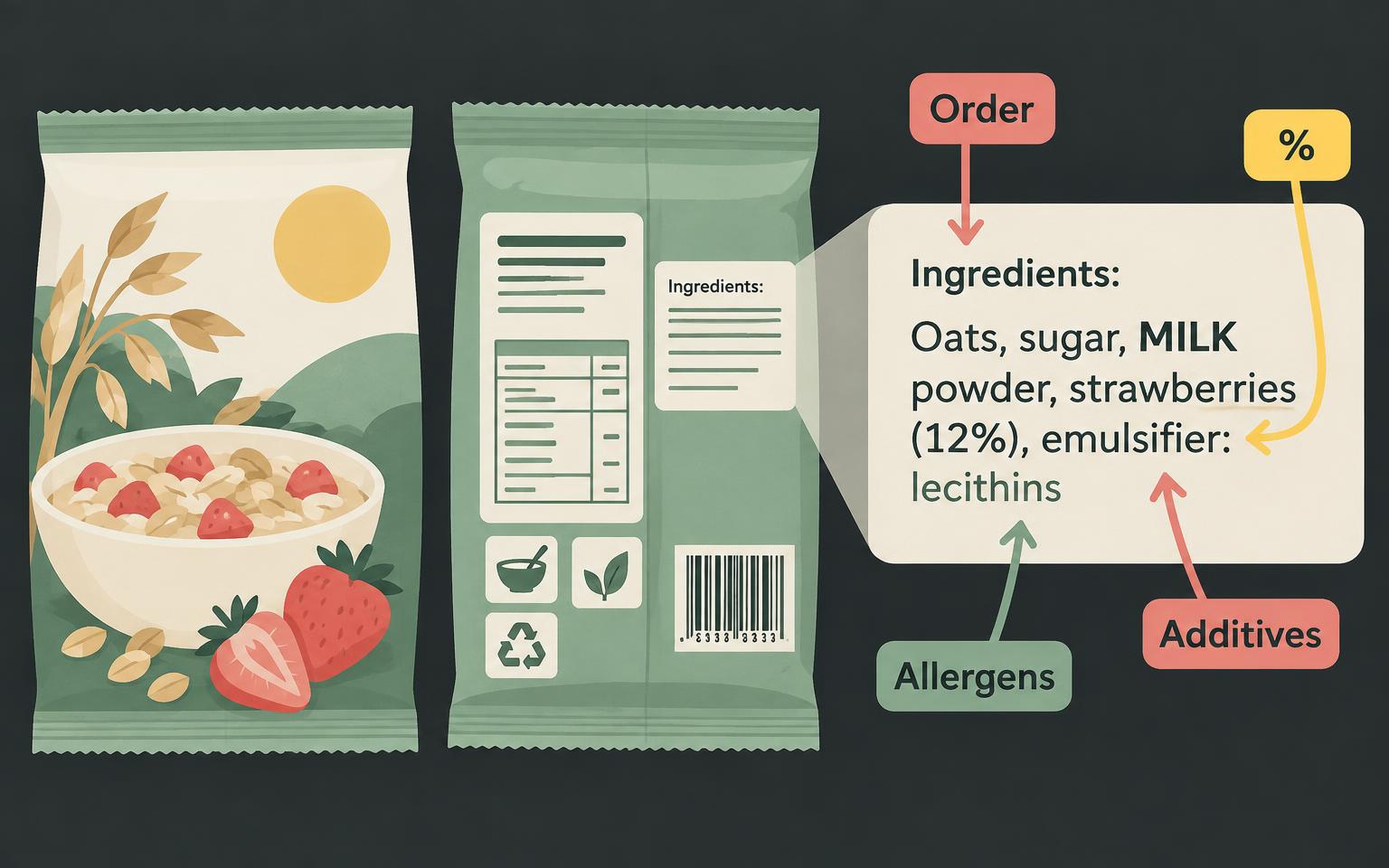
This is probably the most useful thing to know. For prepacked foods containing multiple ingredients, ingredients are generally listed in descending order of weight as recorded when the food is made.
The ingredient used in the greatest amount appears first.
So in "oats, sugar, vegetable oil, cocoa powder, salt", oats were used in a greater amount than sugar, sugar in a greater amount than vegetable oil, and so on, subject to the detailed labelling rules. The first few ingredients often tell you a lot about what a product is primarily made from.
Generally most → least by weight
This isn't a legal rule. It's just a useful shopping habit. Because ingredients are generally ordered by weight, the beginning of the list quickly shows you the main structure of the food.
Product A
Oats, almonds, raisins, sunflower seeds, honey…
Product B
Sugar, glucose syrup, wheat flour, vegetable oil, cocoa…
You don't need to make a health judgement yet. You've already learned what the two products are largely made from, which is more useful than counting ingredients.
Not necessarily. This is a common misunderstanding. Being first only tells you that an ingredient is present in a greater amount than each ingredient listed after it. Imagine a product made of 30% oats, 25% nuts, 20% fruit, 15% seeds and 10% other ingredients. Oats would appear first, but still wouldn't make up half the food.
First ingredient does not mean the majority of the product, unless a percentage confirms it.
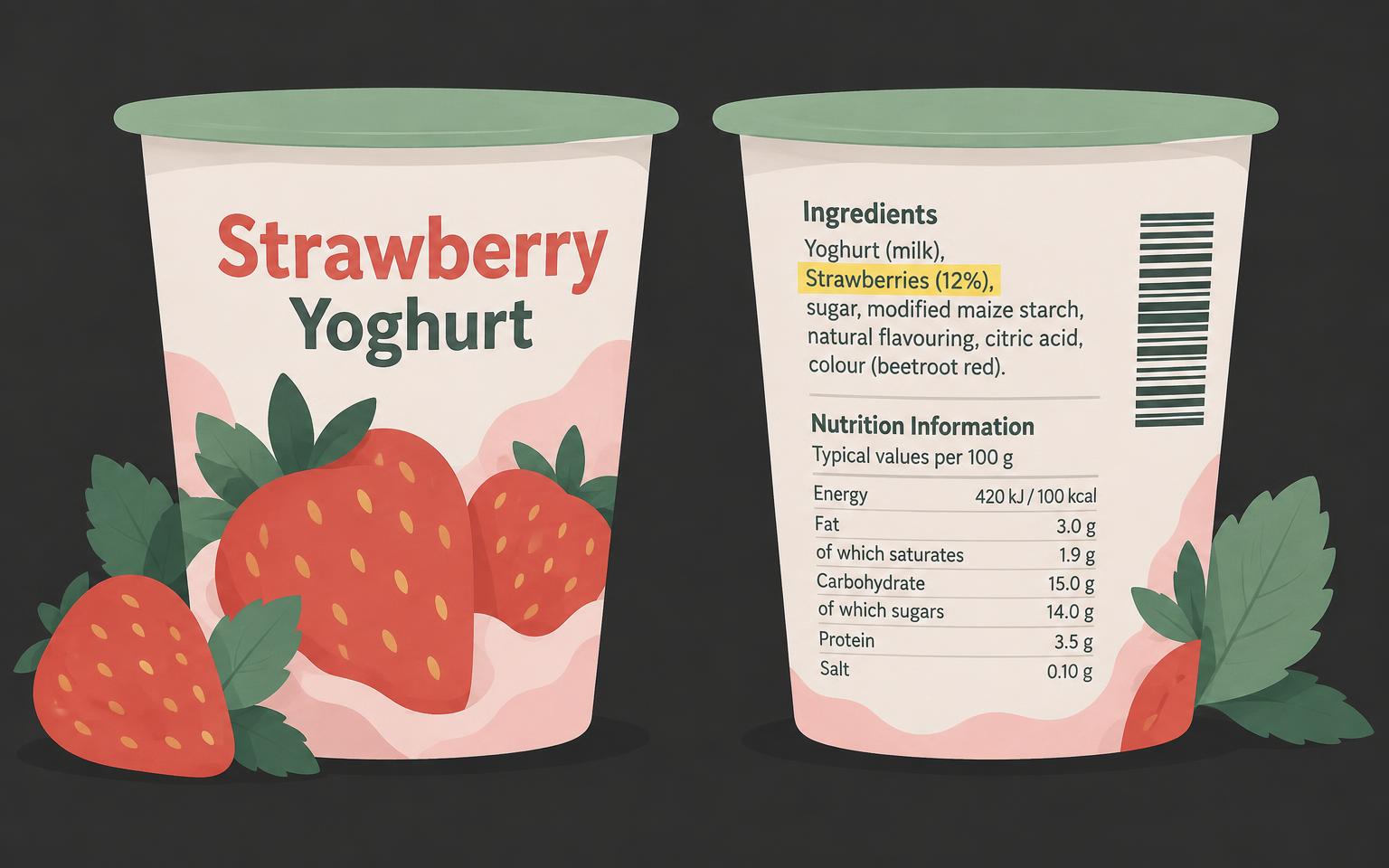
You might see strawberries (12%), chicken (35%) or butter (8%). Those percentages aren't randomly added. Under food labelling rules, the amount of certain ingredients must be declared in specific circumstances. This is known as QUID, or Quantitative Ingredient Declaration. A percentage is generally required where an ingredient is:
So for a ham and mushroom pizza, the quantities of ham and mushroom may need to be declared. That lets you see whether the ingredient promoted on the front actually makes up a meaningful amount of the product.
On many labels you'll see certain ingredients in bold, capital letters or otherwise emphasised. This is usually allergen information. There are 14 allergens covered by mandatory EU allergen declaration rules, and for prepacked food, allergens used as ingredients must be clearly emphasised within the ingredients list.
Ingredients: WHEAT flour, sugar, MILK powder, EGGS, salt.
Cereals include wheat, rye and barley. Nuts means certain tree nuts. Sulphites count above the specified threshold.
There's an important distinction between "contains peanuts" and "may contain peanuts". If peanuts are deliberately used as an ingredient, they must be declared accordingly. "May contain" statements are precautionary warnings about a potential cross-contamination risk.
Ingredient
Sugar, PEANUTS, cocoa butter…
Cross-contact warning
May contain peanuts.
For someone with a food allergy, this can be extremely important. People with diagnosed allergies should rely on the current packaging and appropriate medical guidance rather than assuming any product database is always up to date.
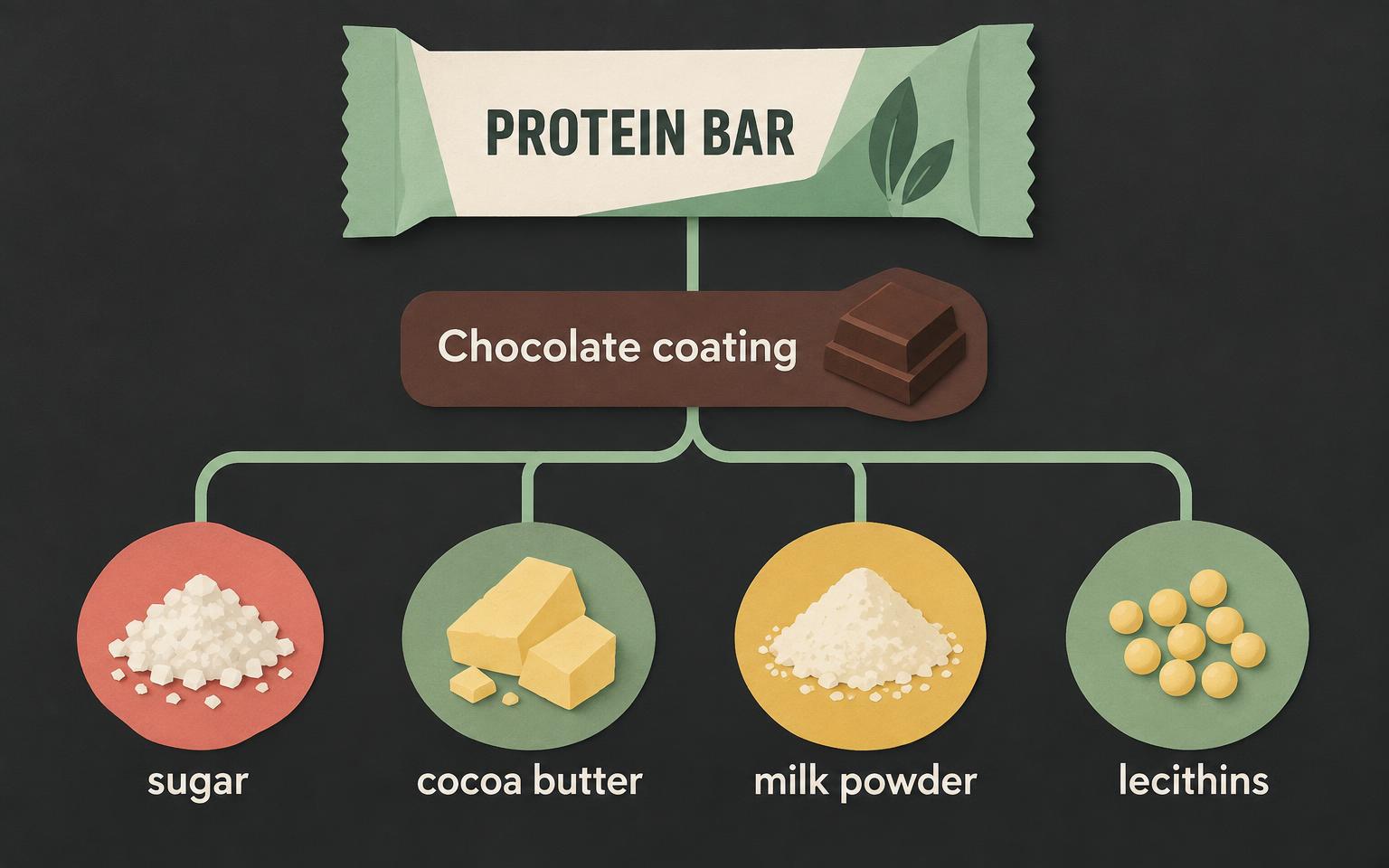
Sometimes an ingredient is itself made from several ingredients. In "milk chocolate (sugar, cocoa butter, milk powder, cocoa mass, emulsifier: lecithins)", the chocolate is one ingredient of the main product, and the brackets explain what that chocolate contains.
You'll often see this with chocolate, sauces, fillings, bread components, seasoning mixes and coatings. It's why an ingredients list can look much longer than expected: it may be showing you the ingredients inside other compound ingredients.
If you see E300, E322, E440 or E950, you are looking at identifiers for authorised food additives. They aren't danger scores. The useful question isn't "does it have an E number?" It's what additive is this, and why is it being used?
Antioxidant (vitamin C)
Emulsifier
Gelling agent
Sweetener
On an ingredients list you might see "preservative: sodium nitrite", "sweetener: sucralose" or "emulsifier: lecithins". The first word tells you the technological function of that additive in the food. So "emulsifier: lecithins" reads as: lecithins are being used here as an emulsifier. That gives you far more information than an unfamiliar name in isolation.
Function: Emulsifier
Ingredient: Lecithins
"If you can't pronounce an ingredient, don't eat it" sounds simple. It just isn't a reliable way to evaluate food. Ascorbic acid sounds more complicated than vitamin C. Sodium bicarbonate sounds more complicated than baking soda. And a familiar-sounding ingredient isn't automatically beneficial either: sugar is very easy to pronounce.
Identify unfamiliar ingredients rather than fearing unfamiliar words.
Sometimes a short list can indicate a simpler product, but ingredient count isn't a nutritional score. Oats, almonds, walnuts, seeds, raisins, cocoa, cinnamon, milk, yoghurt and fruit is a long list of perfectly recognisable foods. Sugar, butter and flour is a very short one. Neither can be fully evaluated by counting lines.
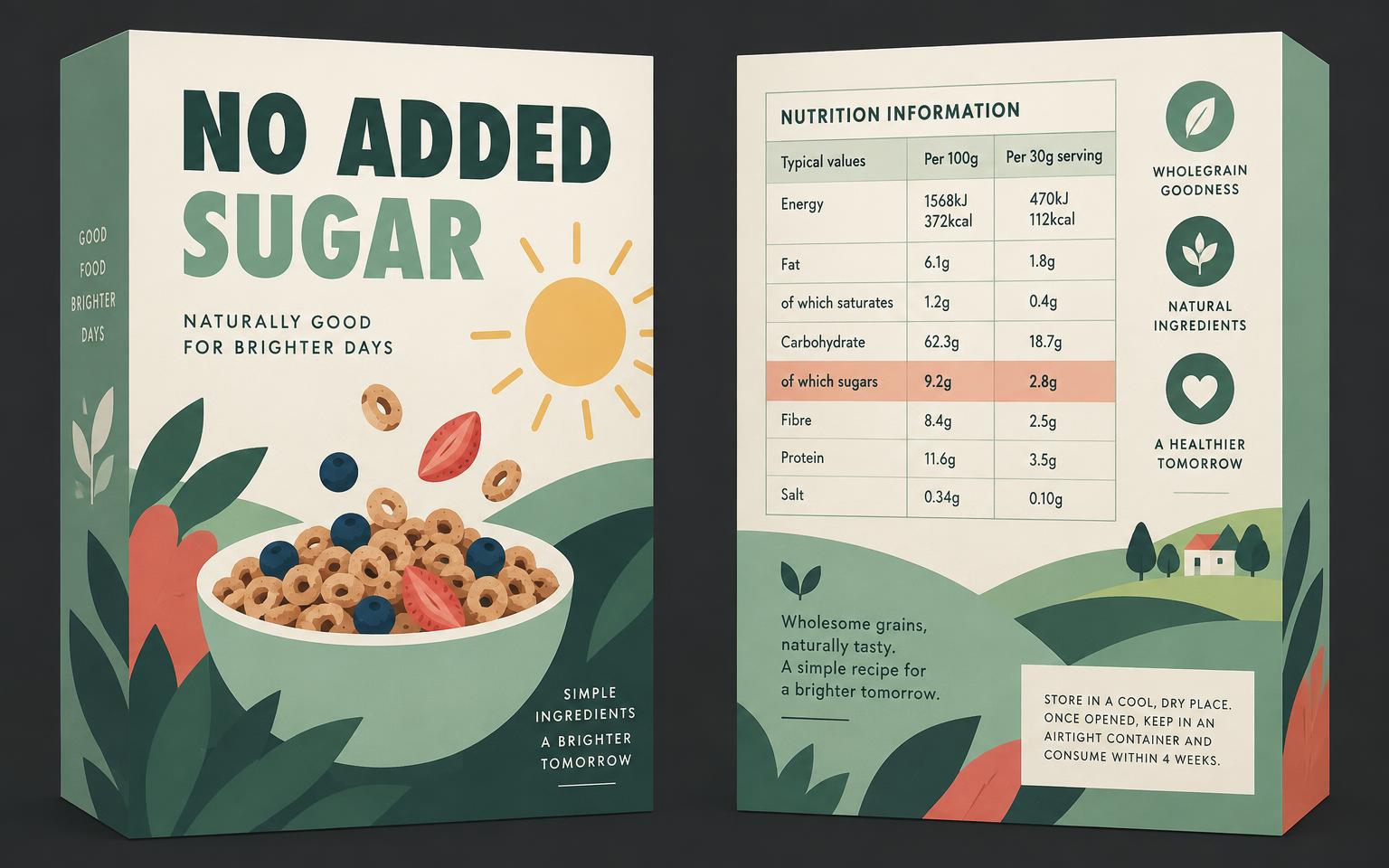
The nutrition table tells you the total amount of sugars. The ingredients list helps explain where they come from: sugar, glucose syrup, honey, fruit juice concentrate, malt extract and similar.
The table's "of which sugars" includes all sugars present, including naturally occurring ones. That's why plain milk contains sugars even when no table sugar has been added. So don't try to determine total sugar from the ingredients list alone. Use both parts of the label.
This is a regulated claim. A food cannot claim no added sugars if added mono- or disaccharides, or another food used for its sweetening properties, has been added. If sugars naturally occur in the food, the label should also state "contains naturally occurring sugars". So a food saying no added sugar can still show sugars in the nutrition table, and the two aren't contradictory.
Think of them as two halves of the same label. Neither replaces the other. A product can have ingredients you recognise and still contain a lot of sugar or saturated fat. Another can contain unfamiliar functional ingredients with a very different nutritional profile.
How much
Nutrition table: energy, fat, saturated fat, sugar, protein, salt
What
Ingredients list: what the product is made from
Together they explain the product.
Most mandatory nutrition declarations give values per 100 g or 100 ml. If Bar A weighs 45 g and Bar B weighs 60 g, comparing "per bar" is harder because the portions differ. Per 100 g puts both on the same basis, and you can then separately consider how much you actually plan to eat.
Use per 100 g first. Portion second.
What is the food actually being sold as?
What is it mainly made from?
How much of the promoted ingredient is actually present?
Look for emphasised ingredients and precautionary warnings.
What are they and what are they doing?
Now you have both composition and nutritional context.
Sláinte brings together nutrition, ingredients, additives and processing information, and the context behind them. The score is a shortcut. The useful part is being able to see why the product received it.
55%
30%
15%
Pick up two versions of the same product: two cereals, two yoghurts, two protein bars or two pasta sauces. Ignore the front for 20 seconds and turn them around. Read the first five ingredients, any ingredient percentages, the nutrition per 100 g and any additives you don't recognise. Then look at the branding again. You may see the product very differently.
Ingredients on prepacked foods are generally listed in descending order of weight as recorded when they are used in manufacture, subject to specific rules and exceptions.
Not necessarily. It is generally the individual ingredient present in the greatest amount, but it doesn't have to represent more than 50% of the entire product.
For prepacked food, mandatory allergens used as ingredients must be emphasised so they can be clearly distinguished from the rest of the ingredients list. Bold type is one common method.
Certain ingredients must have their quantity declared when, for example, they appear in the food's name or are emphasised through words, images or graphics. This is known as QUID.
Not automatically. The number of ingredients alone doesn't establish the nutritional quality of a food. What the ingredients are and the food's wider nutritional profile provide more useful information.
An E number identifies a food additive authorised for specified uses under European food-additive rules. The number itself isn't a health or danger rating.
The per-100g or per-100ml declaration provides a consistent basis for comparing products. Portion information can then help you consider how much you actually consume.