
Bulk
Adds volume without intense sweetness.
Published · Updated · Sláinte Editorial
A carbohydrate ingredient that the sugars line does not fully describe.
You pick up a protein bar. The front says LOW SUGAR. Then you turn it around and see maltodextrin near the top of the ingredients. So is maltodextrin just another name for sugar? Not quite.
Maltodextrin is a starch-derived carbohydrate made from chains of glucose units. Digestible maltodextrin can be broken down rapidly in the small intestine, yet under EU nutrition-labelling rules it does not necessarily appear entirely under “of which sugars”.
The ingredients list and nutrition table answer different questions. And despite the slightly chemical-sounding name, maltodextrin is not an E number.
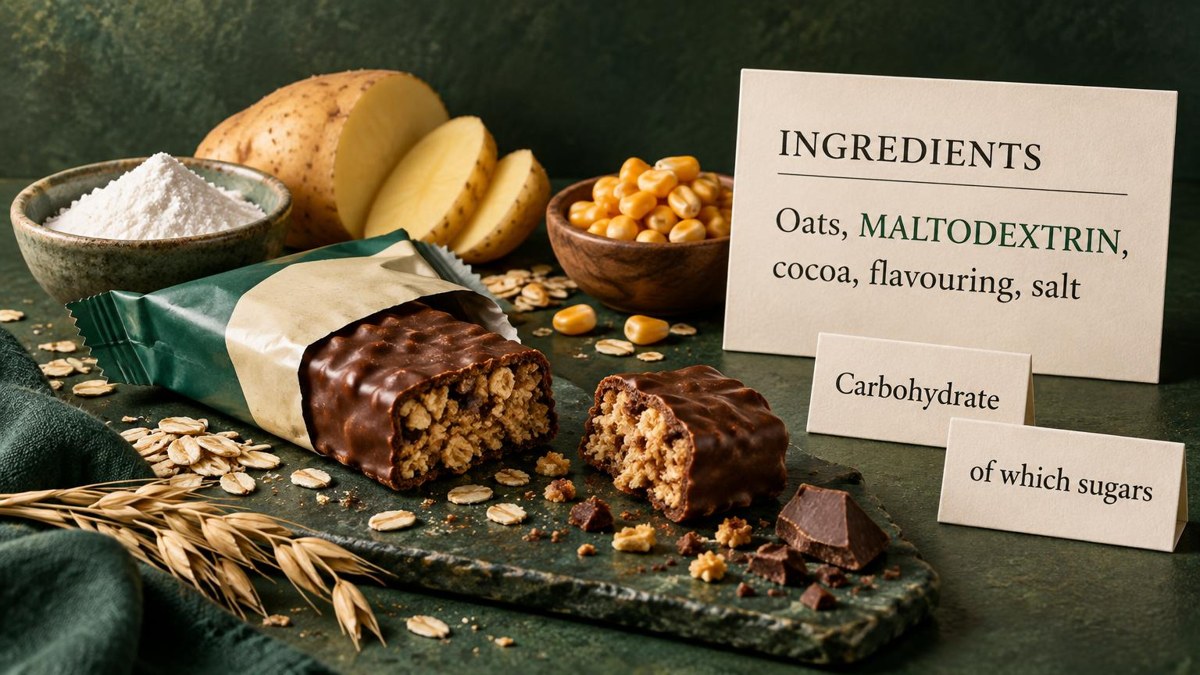
Maltodextrin is made by partially breaking down starch into shorter carbohydrate chains.
The US regulatory definition describes maltodextrin as a nutritive saccharide polymer made primarily of glucose units and produced by partial hydrolysis of starch.
In simple terms:
starch → partially broken down → shorter glucose chains → maltodextrin
It is usually sold as a white powder and has relatively little sweetness compared with table sugar.
Depending on the manufacturer, the original starch can come from sources including:
The finished ingredient behaves differently from the intact starch it started as.
Starch
Partial hydrolysis
Shorter glucose chains
Maltodextrin powder
This is worth making clear because Sláinte has spent a lot of time explaining E numbers.
Maltodextrin is normally listed simply as:
maltodextrin
in the ingredients.
You will not generally see:
E-something
beside it.
It is being used as a food ingredient rather than being identified through the EU E-number system.
So a long or unfamiliar ingredient name does not automatically mean:
food additive with an E number.
Because it is technically useful.
Maltodextrin can perform several jobs without adding the same intense sweetness you would get from ordinary sugar.
Food technology literature describes uses including:
That makes it useful across very different foods.
You may encounter it in products such as:
Its presence does not necessarily mean it is there to make the food sweeter.
Adds volume without intense sweetness.
Helps create the desired consistency.
Carries flavours and small amounts of other ingredients.
Helps powdered ingredients disperse.
Helps manage moisture and formulation.
This depends on what you mean by “sugar”.
Chemically, maltodextrin is built from glucose units.
But on an EU nutrition label, “sugars” has a specific legal definition.
EU food-information law defines sugars as the monosaccharides and disaccharides present in food. Carbohydrate is the broader category.
Maltodextrin contains longer chains of glucose units.
So it can contribute carbohydrate without all of that carbohydrate appearing under:
of which sugars
on the nutrition table.
This is why saying:
“The product only has 2g sugar, so there can't be much rapidly digestible carbohydrate in it.”
can be misleading.
Look at total carbohydrate as well.
Illustrative label · not a product result
Yes.
Those statements are not automatically contradictory.
A product could contain maltodextrin while still having a relatively low declared sugars value because EU labelling defines sugars specifically as mono- and disaccharides.
That does not mean the maltodextrin is metabolically invisible.
Digestible maltodextrin still provides carbohydrate.
This is exactly why it helps to read both:
the nutrition table
and:
the ingredients list.
Neither tells the whole story on its own.
This is where online discussions often become exaggerated.
Digestible maltodextrin is generally broken down quickly into glucose.
A scientific review of digestible maltodextrins notes that glucose released from them is rapidly absorbed in the small intestine and that replacing less processed starch with maltodextrin can increase post-meal glycaemia.
Controlled studies also commonly use maltodextrin as a rapidly digested carbohydrate comparator when testing slower-digesting carbohydrates.
So the useful conclusion is:
Digestible maltodextrin can raise blood glucose quickly.
Not:
Any food containing maltodextrin will automatically cause a dangerous blood-sugar spike.
The response depends on:
Digestible maltodextrin can be broken down quickly into glucose.
Amount, portion, formulation and your individual response matter.
You will often see very precise maltodextrin glycaemic-index numbers online.
Be careful with them.
Maltodextrin is not one single molecular product sold in exactly the same form everywhere.
Different maltodextrins can differ in their chain structure and degree of hydrolysis.
Food context also matters.
It is safer and more useful to say that digestible maltodextrins are typically rapidly digested carbohydrates rather than pretending one internet GI number describes every product.
Rapidly digestible carbohydrate
Dose + formulation + meal context matter
This distinction matters.
You may also see:
resistant maltodextrin
That is not metabolically identical to ordinary digestible maltodextrin.
Resistant maltodextrin is designed to resist digestion in the small intestine and behaves more like a fermentable fibre.
Human studies have investigated resistant maltodextrin separately; a systematic review and meta-analysis found increases in stool volume and bowel-movement frequency. Those findings should not be applied to ordinary digestible maltodextrin.
So do not take research on:
resistant maltodextrin
and apply it automatically to:
ordinary maltodextrin.
They need to be identified correctly.
Rapidly digested carbohydrate.
Designed to resist digestion in the small intestine; behaves more like fermentable fibre.
One reason is that powders contain more than protein.
A manufacturer may need:
Maltodextrin can help with some of those functions.
In some sports-carbohydrate products, the carbohydrate itself may also be intentionally included as an energy source.
Maltodextrin is also deliberately used in sports nutrition as a fast-digesting carbohydrate source during longer or high-volume training sessions.
That means seeing maltodextrin in a protein or supplement product does not tell you its purpose automatically.
Look at:
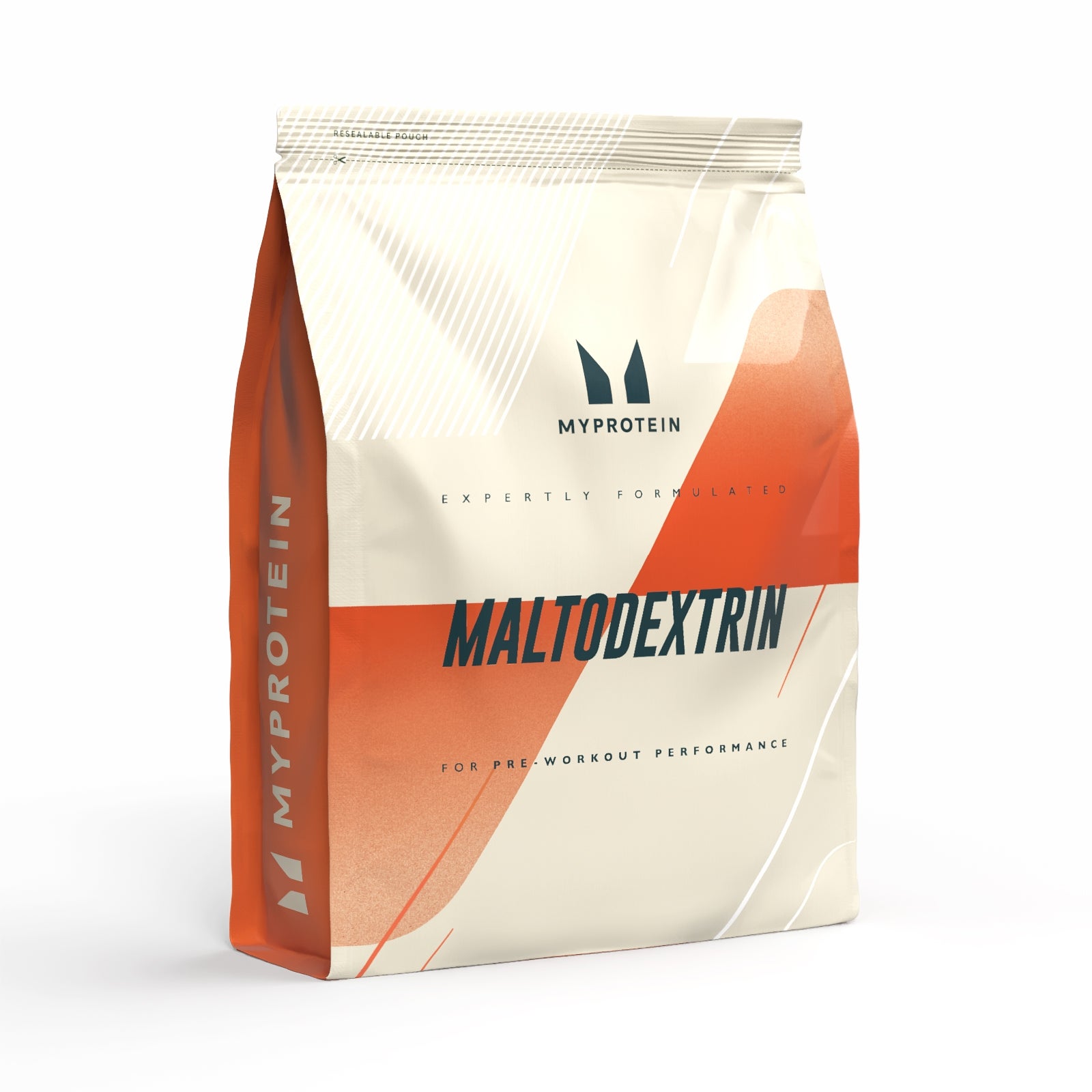
A real product · label checked 7 October 2026
This is a carbohydrate powder, not a protein powder. Its only listed ingredient is maltodextrin.
78
/100
Sláinte Score
Excellent
Training fuel, not a shortcut to a balanced diet.
Ingredients: Maltodextrin (100%). The manufacturer also states that it is produced in a facility that handles milk. Fibre is not declared; it has not been filled in as zero.
The current food formula gives this powder an Excellent band because its listed saturated fat and salt are zero, sugars are relatively modest, and no additives of concern are identified. It does not directly score rapidly digestible starch, glycaemic response or suitability for a particular training session. An Excellent score therefore does not mean this powder is a whole food or a good everyday choice for everyone.
The powder contains 95 g of carbohydrate per 100 g despite declaring only 7 g of sugars. It can have a deliberate fuelling role during prolonged or demanding exercise, but the amount, timing and your own needs matter. Its processing group has not been independently verified, so none has been assigned.
Manufacturer’s ingredients and nutrition label · How the food score is calculated
It gives you some information.
Under EU food-labelling rules, ingredients are generally listed in descending order of weight as used during manufacture.
So if maltodextrin is second on an ingredients list, it was generally used in a greater amount by weight than ingredients appearing much further down.
But the list does not normally tell you the exact percentage of maltodextrin unless specific quantitative declaration rules apply.
So:
high on the list = potentially significant ingredient
does not equal:
we know the exact grams.
Example ingredients list
Oats, Maltodextrin, Cocoa, Flavouring, Salt…
Yes.
This creates an interesting labelling point.
EU allergen rules specifically exempt wheat-based maltodextrins from the mandatory wheat-allergen declaration requirement.
FSAI explains that certain allergen-derived ingredients are exempt because the relevant protein components have been removed during processing.
That does not mean every food containing maltodextrin can automatically make a:
GLUTEN-FREE
claim.
In the EU, a food labelled gluten-free must contain no more than 20 mg/kg gluten in the food as sold.
Those are different regulatory questions.
This is another area where internet claims run ahead of simple answers.
A 2022 systematic review looked at human clinical trials in which maltodextrin had been used as a placebo or control and reported that physiological or microbiome changes were observed in a substantial proportion of the included studies.
However, the direction of those effects varied considerably between studies, as did:
That is not strong justification for telling every consumer:
Maltodextrin destroys your gut bacteria.
The evidence is more complicated.
It does mean maltodextrin should not always be assumed to be biologically inert simply because researchers have sometimes used it as a placebo.
Resistant maltodextrin again needs to be kept separate because it can have quite different effects on gut fermentation.
Maltodextrin is an industrially produced starch-derived ingredient.
That fact alone should not be turned into:
Any product containing maltodextrin is automatically unhealthy.
NOVA classification looks at the formulation and processing of the food as a whole.
Maltodextrin may be one marker of a highly formulated food, particularly alongside multiple flavourings, colours, sweeteners or other functional ingredients.
But one word in the ingredients list should not replace assessment of the complete product.
For most people, that is the wrong question.
Maltodextrin is a digestible carbohydrate ingredient.
The more useful questions are:
The ingredients order may give you a clue, but not always an exact amount.
Maltodextrin in a sports carbohydrate drink has a very different purpose from maltodextrin used as a small flavour carrier.
Check:
One ingredient should not be detached from the wider diet.
Then the fact that digestible maltodextrin can be rapidly converted to glucose may be more relevant.
This article is general food-information guidance, not personalised diabetes advice.
The comparison is useful, but they are not the same substance.
| Comparison | Maltodextrin | Table sugar |
|---|---|---|
| Built from | Glucose chains | Glucose + fructose |
| Taste | Usually mildly sweet or nearly neutral | Sweet |
| Main nutrition category | Carbohydrate | Carbohydrate |
| Entire amount counted as EU “sugars”? | No | Yes |
| Can raise blood glucose? | Yes | Yes |
| Used mainly for | Multiple technical/energy functions | Sweetening and other functions |
Do not turn this into:
Maltodextrin is worse than sugar
or:
Maltodextrin is better than sugar.
They have different structures and uses.
The line itself is not misleading.
The mistake is assuming it means:
all carbohydrate that eventually becomes glucose.
It does not.
EU law defines:
carbohydrate
more broadly than:
sugars.
So a product can legitimately show:
low sugars
while still containing a meaningful amount of rapidly digestible starch-derived carbohydrate.
That is why food labels work best when read together.
LOW SUGAR
Carbohydrate → of which sugars
Maltodextrin can still appear on the list.
All three can be true at once.
If you see maltodextrin on a label, you do not need to panic.
Use it as a prompt to look at the product more closely.
Ingredients are generally listed by descending weight.
Do not only read:
of which sugars.
A sports drink and a seasoning powder are using carbohydrate for very different reasons.
Maltodextrin is one ingredient.
They behave differently.
Amount, portion and the rest of the meal all influence the response.
Ingredients are generally listed by descending weight.
Do not only read the ‘of which sugars’ line.
A sports drink and a seasoning powder use carbohydrate for different reasons.
Maltodextrin is one ingredient, not a verdict on the whole food.
Resistant maltodextrin and ordinary maltodextrin behave differently.
Amount, portion and the rest of the meal influence the glucose response.
Maltodextrin is exactly the kind of ingredient that shows why a food scanner needs to do more than count sugar.
A product might say:
2g sugars
while the ingredients still contain maltodextrin.
Those statements are not necessarily contradictory.
Sláinte can help bring together:
So you can understand what the label is actually saying rather than judging one unfamiliar word.
Maltodextrin is a carbohydrate made by partially breaking down starch into shorter chains composed mainly of glucose units.
It is made from glucose units, but EU nutrition labelling defines “sugars” specifically as monosaccharides and disaccharides. Maltodextrin is therefore not simply equivalent to the “of which sugars” number on the label.
Digestible maltodextrin is rapidly digested and can produce a significant post-meal glucose response. The amount consumed and the rest of the food or meal matter.
No. Maltodextrin is generally declared by its ingredient name rather than an E number.
It can be used for functions including bulking, carrying flavours or other ingredients, texture, stability and powder formulation.
No. Resistant maltodextrin is designed to resist digestion and behaves more like a fermentable fibre.
Yes. EU rules specifically exempt wheat-based maltodextrins from mandatory wheat allergen declaration because of the degree of processing.
Wheat-based maltodextrins are exempt from mandatory wheat allergen labelling, but a finished food may only be labelled gluten-free in the EU if it meets the legal gluten threshold of no more than 20 mg/kg.
Human research has reported physiological and microbiome effects, but findings are variable and do not justify a blanket claim that maltodextrin “destroys the gut”.
Last reviewed: 7 October 2026