
- Source of protein
- At least 12% of energy from protein
- High protein
- At least 20% of energy from protein
Are Protein Bars Actually Healthy? What the Label Tells You
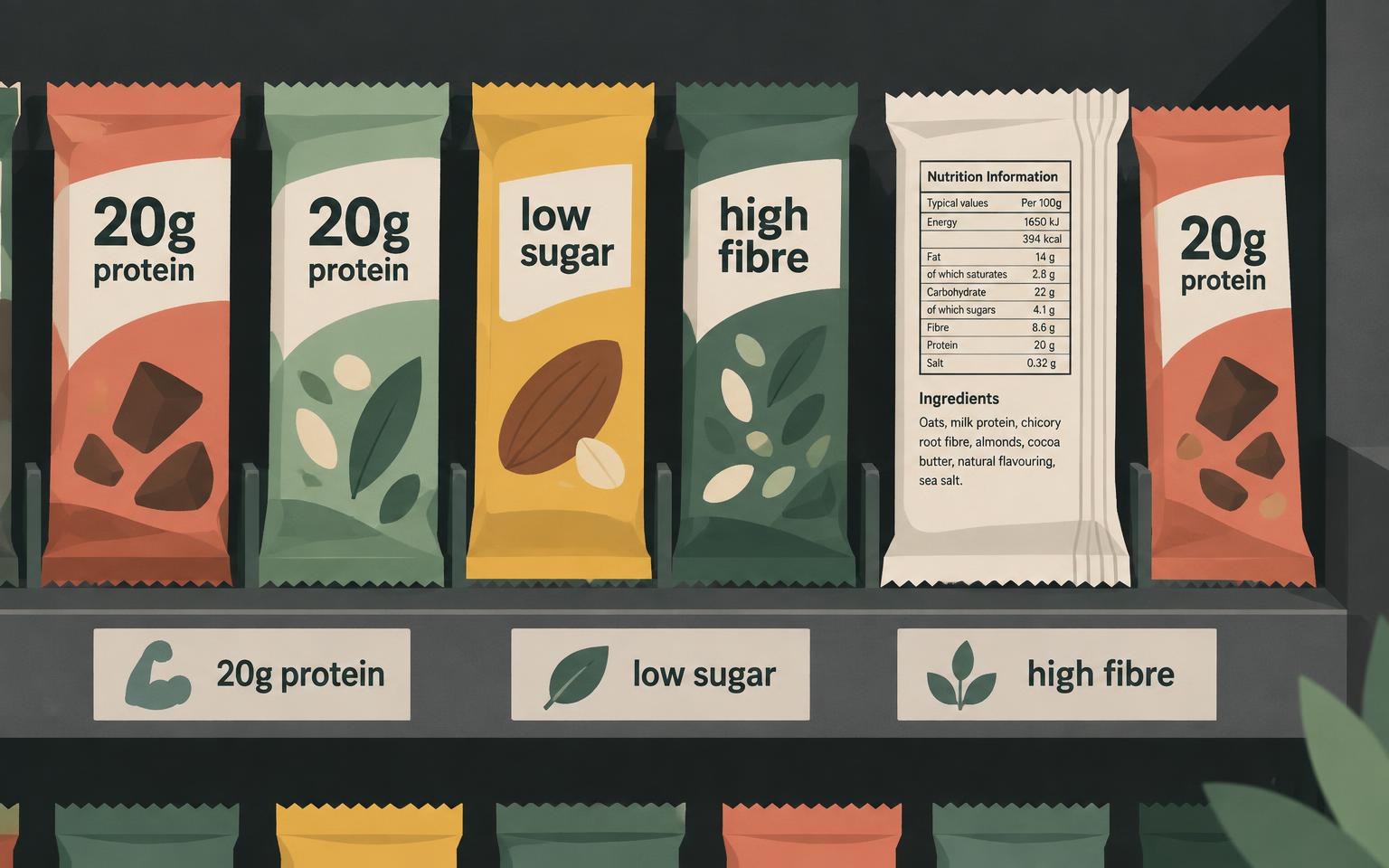
20g protein. High protein. Low sugar. High fibre.
Walk down almost any supermarket, gym or petrol station aisle in Ireland and you'll see protein bars covered in claims that make them look like an obvious healthy choice. But turn the packet around and things often become more complicated.
Some protein bars have relatively simple ingredient lists. Others contain protein isolates, sweeteners, polyols, flavourings, emulsifiers, chocolate coatings and a long list of other ingredients. The useful answer isn't simply yes or no. It depends on what's in the bar, what you're comparing it with, and why you're eating it.
What does "high protein" actually mean?
"High protein" isn't just a marketing phrase manufacturers can put on anything. Under EU rules that apply in Ireland, a food can only make a high protein claim when at least 20% of its energy value comes from protein. A source of protein claim has a lower threshold of at least 12%.
That distinction matters. A bar containing 20 g of protein may sound impressive, but the number on the front isn't the whole nutritional profile. You still need to look at everything else.
The claims on the wrapper, decoded
- Low sugar
- No more than 5 g per 100 g (solids)
- Sugars-free
- No more than 0.5 g per 100 g or 100 ml
- Source of fibre
- At least 3 g per 100 g or 1.5 g per 100 kcal
- High fibre
- At least 6 g per 100 g or 3 g per 100 kcal
Thresholds from the EU nutrition and health claims rules that apply in Ireland.
Start with the nutrition table
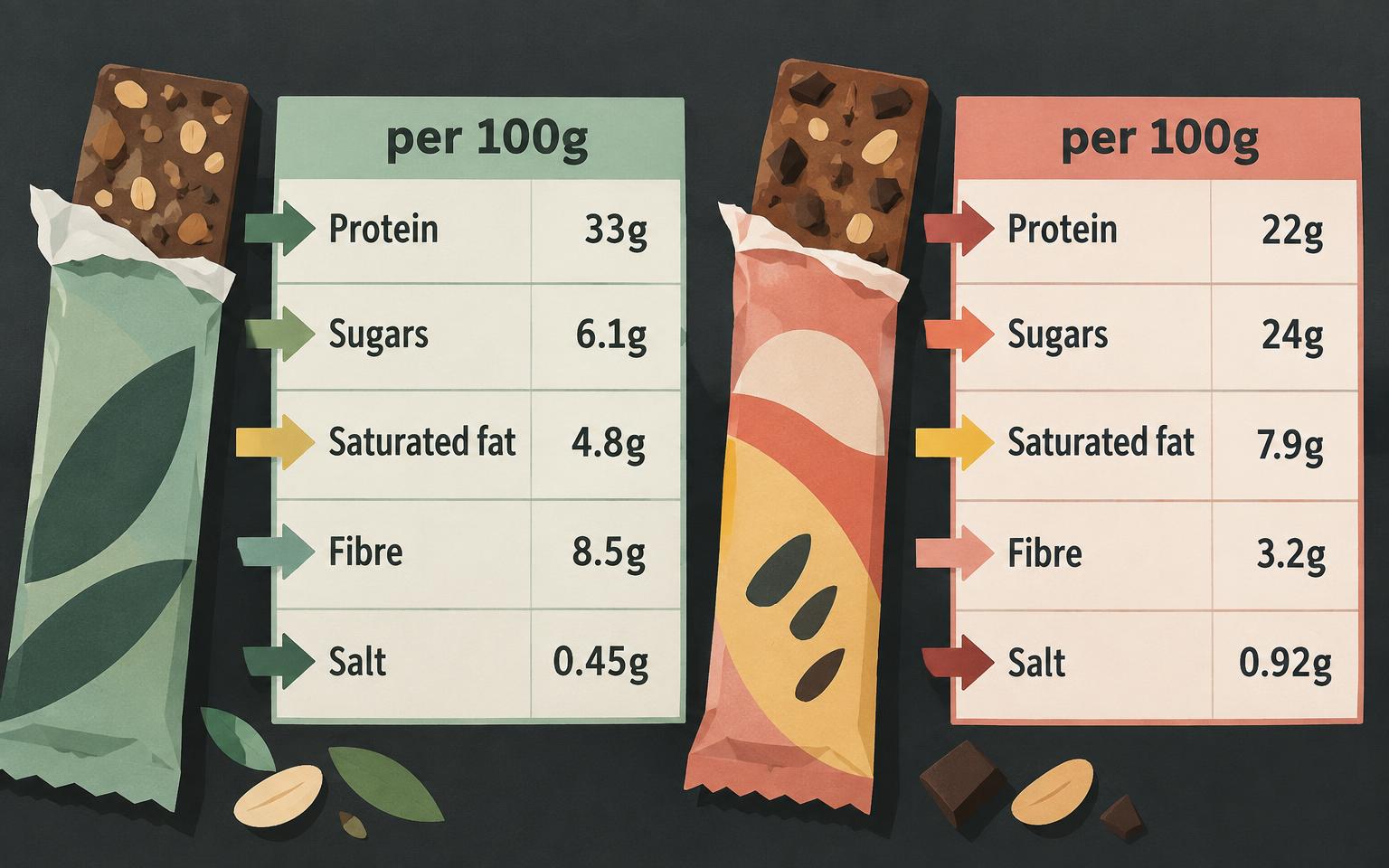
When comparing protein bars, don't begin with the branding. Turn them around. In Ireland and across the EU, the mandatory nutrition declaration on most prepacked foods is expressed per 100 g, which makes it much easier to compare two products of different sizes.
Look at energy, fat, saturated fat, carbohydrate, sugars, protein and salt. Fibre can also be declared voluntarily and is particularly useful when comparing this type of product. The front of the pack might focus on one number. The nutrition table shows you the wider picture.
Protein is useful. It isn't the whole score.
Protein is an essential nutrient. But adding protein to a food doesn't automatically make everything else about that food nutritionally favourable. Imagine two hypothetical bars.
Bar A
- 20 g protein
- Low sugar
- High fibre
- Contains sweeteners
- Chocolate coating
- Several functional ingredients
?
Bar B
- 12 g protein
- More sugar
- Shorter ingredient list
- Less fibre
Which is better? There isn't enough information yet. It depends on the quantities, ingredients, portion size, your reason for eating it and what the bar is replacing.
What does "low sugar" mean?
This is another regulated claim. For a solid food to describe itself as low in sugars, it must contain no more than 5 g of sugars per 100 g. A sugars-free claim requires no more than 0.5 g per 100 g or 100 ml.
So if a protein bar legitimately says low sugar, that claim tells you something real about its sugar content. But there is another question worth asking.
How did they make it sweet?
If the sugar is low, what replaced it?
Many low-sugar protein bars still need to taste sweet. Manufacturers can use ingredients such as maltitol, erythritol, sucralose, acesulfame K or other authorised sweetening ingredients. These don't all belong to the same category: maltitol and erythritol are polyols, while sucralose and acesulfame K are intense sweeteners.
Foods containing more than 10% added polyols must carry the statement "Excessive consumption may produce laxative effects." So "low sugar" doesn't mean nothing has replaced the sugar. It means you should look at what has.
Less sugarWhat replaced it?
Polyols
Maltitol · Sorbitol · Xylitol · Erythritol
Intense sweeteners
Sucralose · Acesulfame K · Aspartame
What are polyols?
Polyols are carbohydrates used as sweetening ingredients. Examples include maltitol, sorbitol, xylitol and erythritol. You'll often encounter them in protein bars, sugar-free sweets, chewing gum, reduced-sugar chocolate and other low-sugar products.
They are not the same as intense sweeteners such as aspartame or sucralose, and different polyols have different characteristics. From a shopping perspective, the most useful thing is simply recognising the word polyols when it appears on a label and understanding why it may be there.
What about fibre?
Protein bars often advertise fibre too, and again there are defined thresholds. A solid food can claim to be a source of fibre with at least 3 g per 100 g or 1.5 g per 100 kcal. A high fibre claim requires at least 6 g per 100 g or 3 g per 100 kcal.
Some protein bars reach a high fibre content using fibres added specifically during formulation. The fibre number still tells you something useful but, as with protein, it shouldn't be used as a shortcut for judging the entire product.
Read the first few ingredients
Ingredients on prepacked foods are generally listed in descending order by weight at the time they are used to make the food. That makes the beginning of the list particularly useful.
Starts with
Milk protein, peanuts, cocoa…
Starts with
Glucose syrup, sugar, milk chocolate…
Ingredients near the top aren't automatically bad. They are simply present in greater amounts. So rather than counting ingredients, ask: what is this bar mostly made from?
A long ingredient list doesn't automatically mean a bad product
Counting ingredients is a poor shortcut. A product can have a long list because it contains nuts, seeds, oats, cocoa, dried fruit and several other ordinary foods. Another product might have fewer ingredients but a nutritional profile that doesn't suit what you're looking for. And a complicated name doesn't automatically make an ingredient harmful.
Identify the ingredient. Understand its purpose. Look at the entire product.
What about the chocolate coating?
A product might contain a substantial amount of protein while also including a chocolate-style coating, fats, sweetening ingredients or other additions designed to improve taste and texture. That doesn't erase the protein, and the protein doesn't erase everything else. Both can be true.
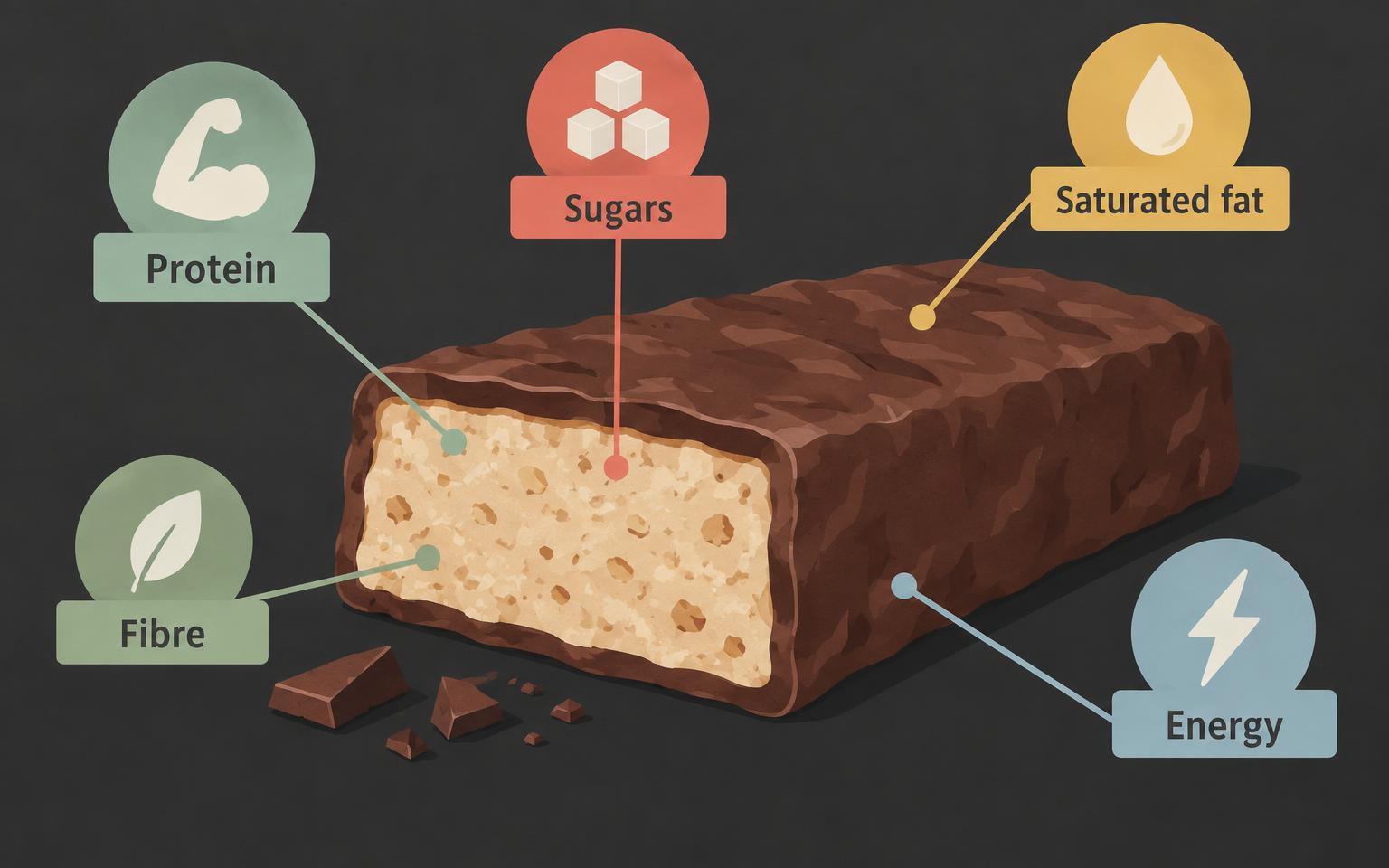
That's why comparing the nutrition table per 100 g is useful: you can see the relationship between protein, sugars, saturated fat, fibre and energy rather than judging the food from one number printed on the front.
Protein bar vs chocolate bar
This comparison gets made constantly, but you have to compare actual products. A protein bar may provide more protein and fibre and potentially less sugar than a particular chocolate bar. It may also contain sweeteners, polyols or a more complex formulation. Chocolate bars vary substantially too.
So "protein bar = healthy" and "protein bar = expensive chocolate bar" are both oversimplifications. The useful comparison is between specific products: look at the numbers, look at the ingredients, then look at what you actually want from the snack.
When can a protein bar make sense?
A protein bar is a packaged food designed around convenience, and for some people that convenience is the main benefit: something portable after training, during work, while travelling or when other food isn't practical. That doesn't mean you need protein bars, and it doesn't mean they're inherently unhealthy either.
Does this particular product suit what I'm looking for?

How Sláinte looks at protein bars
Sláinte doesn't automatically give a product a high score because it contains lots of protein. The food methodology looks at the wider product, and sweeteners are also considered separately within the final scoring rules.
55%
Nutrition
Protein, fibre, sugar, salt and saturated fat
30%
Ingredients
The ingredients and recognised additives present
15%
Processing and quality
Processing signals and the completeness of the product information
20 g protein is useful information. It just isn't the only information.
Five things to check before buying a protein bar
Protein
How much protein is actually in the product?
Sugar
Check the amount per 100 g and per bar.
Fibre
Does it contain a meaningful amount, and is fibre important to what you're looking for?
Ingredients
What is the product mainly made from?
Sweeteners and polyols
If it's very low in sugar but extremely sweet, check what's providing the sweetness.
Frequently asked questions
Are protein bars healthy?
There isn't a single answer for every protein bar. Their nutritional profiles and ingredients vary significantly, so individual products should be assessed rather than treating the entire category as healthy or unhealthy.
What does high protein mean in Ireland?
Under EU nutrition-claim rules, a food may claim to be high in protein when at least 20% of its energy value is provided by protein.
Is 20g of protein in a bar good?
It tells you the amount of protein supplied by that product, but it doesn't describe the rest of the product. Sugar, saturated fat, fibre, salt, ingredients and portion size can also be relevant.
Are low-sugar protein bars better?
Low sugar is one characteristic, not a complete assessment. Look at what provides the sweetness and consider the rest of the nutritional profile.
Why do some protein bars contain maltitol?
Maltitol is a polyol used to provide sweetness and other functional properties in foods. It is commonly found in reduced-sugar confectionery and protein products.
Why do protein bars contain so many ingredients?
Protein bars are often formulated to combine protein, texture, sweetness, flavour, shelf stability and convenience in one product. Formulations vary considerably between brands.
The short version
- "High protein" is a regulated nutrition claim.
- In the EU, at least 20% of a food's energy must come from protein to use the claim.
- More protein doesn't automatically mean a better overall food.
- Low sugar doesn't tell you what replaced the sugar.
- Polyols are common in reduced-sugar protein bars.
- A long ingredient list alone isn't a useful health test.
- Compare products per 100 g as well as per bar.
- Look at protein, fibre, sugar, saturated fat, salt and ingredients together.
- Sláinte assesses the whole product rather than one front-of-pack claim.