
01
Preservatives
Help protect food against deterioration caused by microorganisms.
E100. E300. E322. E950. They are identifiers, not warning symbols.
Turn over almost any packaged food and there is a good chance you will find an E number somewhere in the ingredients. They can look intimidating, especially when they are surrounded by names you have never heard of.
But an E number does not automatically mean an ingredient is artificial, harmful or something you should avoid. Vitamin C has one. So does a pigment found in turmeric. The useful questions are what the number identifies, why it is there and what it means in the context of the whole product.
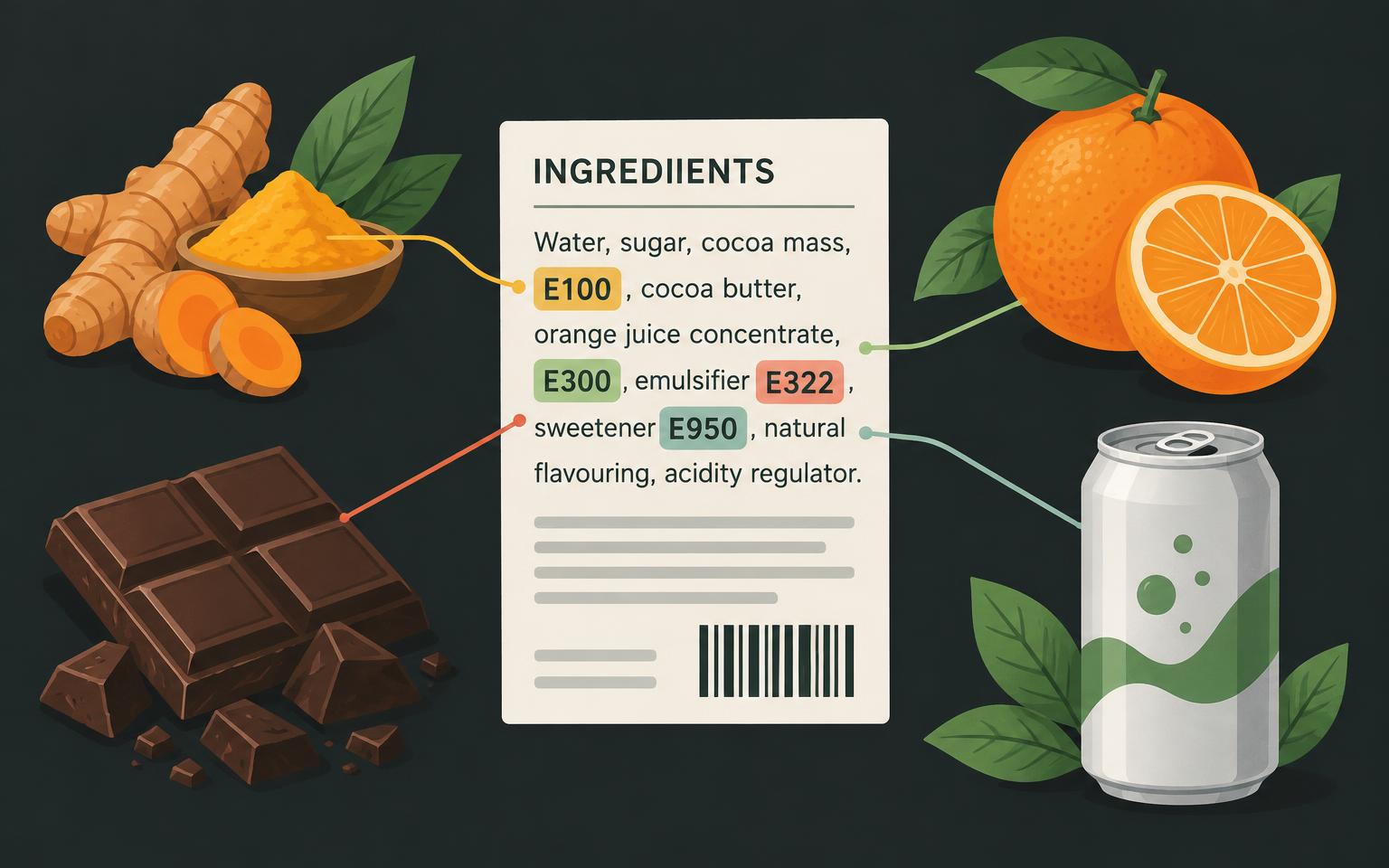
An E number is an identification number given to a food additive authorised for use in the European Union. The E stands for Europe.
Instead of manufacturers repeatedly printing complicated chemical names, an approved additive can be identified using its E number. For example, E300 is ascorbic acid, which is vitamin C.
An E number is not a warning symbol. It is an identifier.
One substance, three familiar names
E300
European identifier
Ascorbic acid
Specific name
Vitamin C
Familiar name
Orange
Familiar source
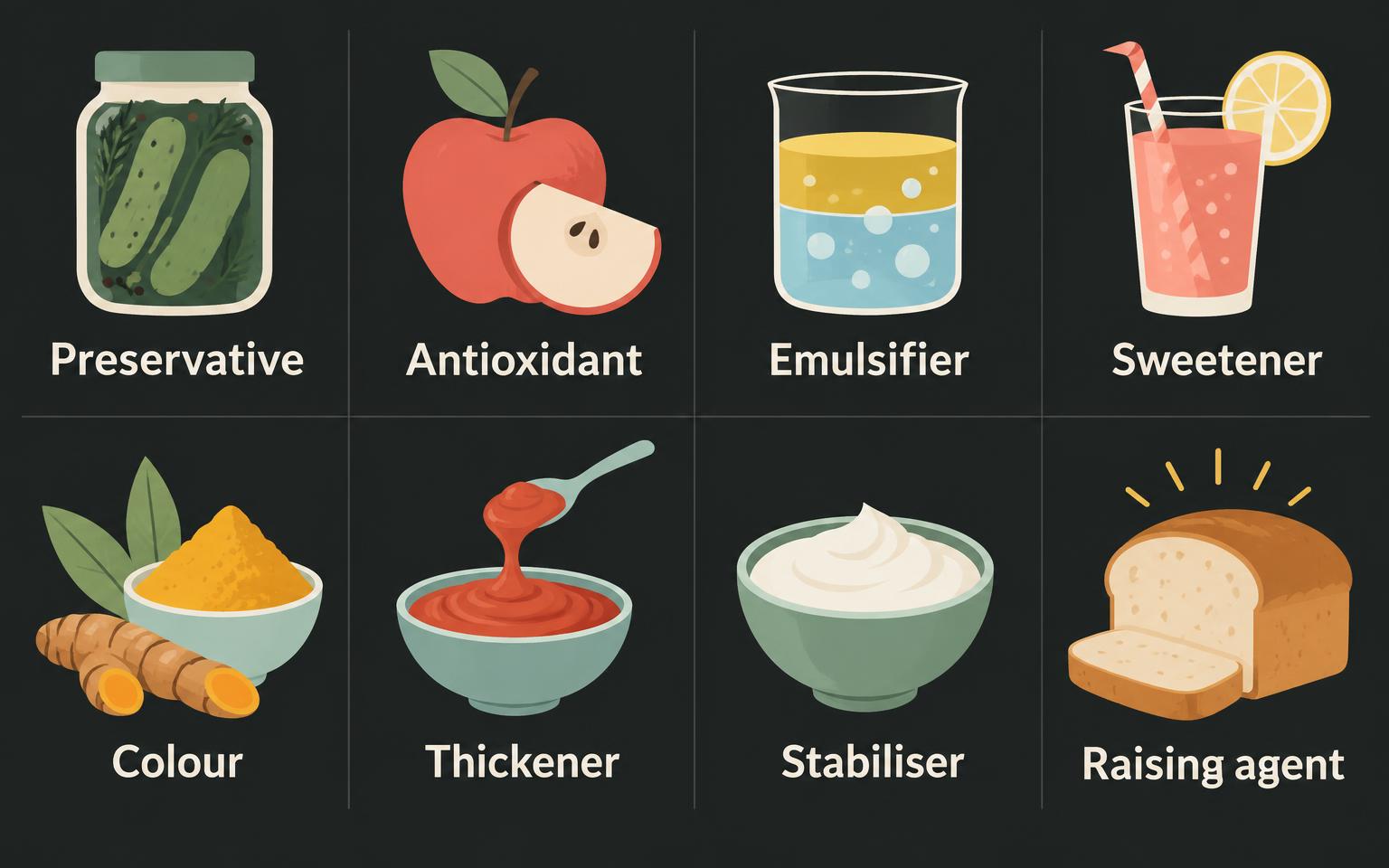
Food additives have many different jobs. Some help food last longer, stop ingredients separating or maintain texture. Others provide sweetness, colour or acidity.
Simply saying a product contains additives does not tell you very much. The more useful questions are which additives are present, why they are there and what they mean in the context of the whole product.
01
Help protect food against deterioration caused by microorganisms.
02
Help prevent oxidation that can cause food to deteriorate.
03
Help ingredients such as oil and water remain mixed.
04
Provide sweetness instead of, or alongside, sugars.
05
Add or restore colour.
06
Increase the thickness of a food.
07
Help maintain the physical characteristics of a food.
08
Release gas to increase the volume of doughs and batters.
Yes, but manufacturers cannot simply invent an additive and put it into food. Ireland follows EU food-additive legislation. An additive must be included on the EU authorised list and can only be used under the conditions specified for it.
Those conditions can include the types of food in which it can be used and maximum permitted levels. When you see an E number on an Irish label, you are looking at an additive operating within that regulatory system.
01
The evidence, dietary exposure and potential health effects are reviewed.
02
Permitted foods and maximum levels can be set for the additive.
03
The additive may then appear on an Irish food label by name or E number.
An Acceptable Daily Intake, where one is established, is an amount that can be consumed daily over a lifetime without appreciable health risk based on the available evidence.
Food additives authorised in the EU undergo safety assessment. Assessments consider evidence relating to the additive, dietary exposure and potential health effects. For some additives, an Acceptable Daily Intake is established.
This does not mean every additive is identical, that evidence can never change or that anyone needs to consume as much as possible. It means asking whether something has an E number is not enough to decide whether it should concern you. You need to know which substance you are looking at.
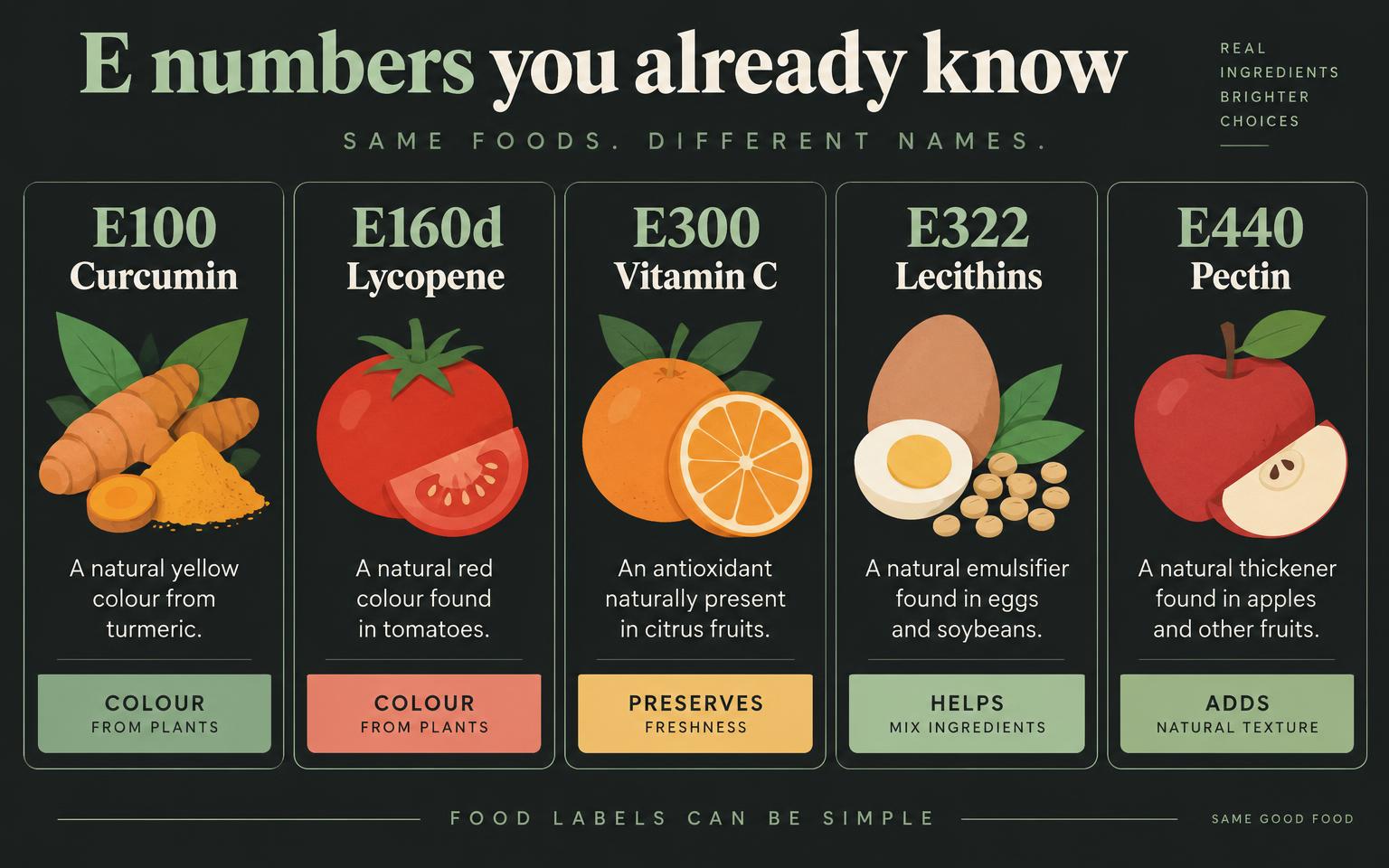
E100
Yellow pigment associated with turmeric
Colour
E160d
Red pigment naturally present in tomatoes
Colour
E300
Vitamin C
Antioxidant
E322
Found naturally in egg yolks and soya beans
Emulsifier
E440
Occurs naturally in fruit
Gelling agent
“E number equals artificial chemical” does not work as a rule.
Not every additive should be discussed as though it were vitamin C. Some additives have specific usage limits or additional labelling requirements. Others continue to be studied and periodically re-evaluated as evidence develops.
That is why it makes more sense to consider additives individually.
E950
Sweetener
Some sugar-free drinks, protein products and reduced-sugar foods
E951
Sweetener
Various sugar-free and reduced-sugar foods and drinks
E250
Preservative
Certain cured meat products under regulated conditions
E621
Flavour enhancer
Savoury foods; glutamate also occurs naturally in tomatoes and some cheeses
E415
Thickener and stabiliser
Sauces, dressings and some gluten-free foods
These additives do completely different things. Grouping them together simply because their names begin with E does not tell you much about the food.
Food additives used as ingredients generally appear in the ingredients list with their function, followed by either their specific name or E number. You might see preservative: sodium nitrite or preservative: E250. Similarly, a label may say antioxidant: ascorbic acid or antioxidant: E300.
The first part tells you what the additive does. The second tells you what it is.
Ingredients
Pork, salt, preservative: E250, spices
Preservative
The function: what it does
E250
The identity: what it is
Yes. Certain additives have additional labelling requirements. Foods containing certain colours, including E102, E104, E110, E122, E124 and E129, generally require an additional warning relating to possible effects on activity and attention in children.
Products containing aspartame also require specific information concerning phenylalanine. Different additives can therefore have different conditions of use and labelling requirements.
Example label wording
Colour: E102
May have an adverse effect on activity and attention in children.
Example label wording
Sweetener: aspartame
Contains a source of phenylalanine.
Examples of additional label information, not universal warnings for every E number.
Not necessarily. Imagine two drinks. Drink A contains water, sugar and flavouring but has a relatively high amount of sugar. Drink B contains considerably less sugar but uses an authorised sweetener identified by an E number.
You cannot decide which is healthier from the E numbers alone. You would need to consider the nutritional profile, ingredients, quantity consumed and what you are comparing it with. A short ingredient list does not automatically make a product nutritious, and an additive does not automatically make it unhealthy.
Drink A
More sugar
Water, sugar and flavouring. No E number decides the whole picture.
Drink B
Less sugar, sweetener used
An authorised E number is one fact among several, not an automatic verdict.
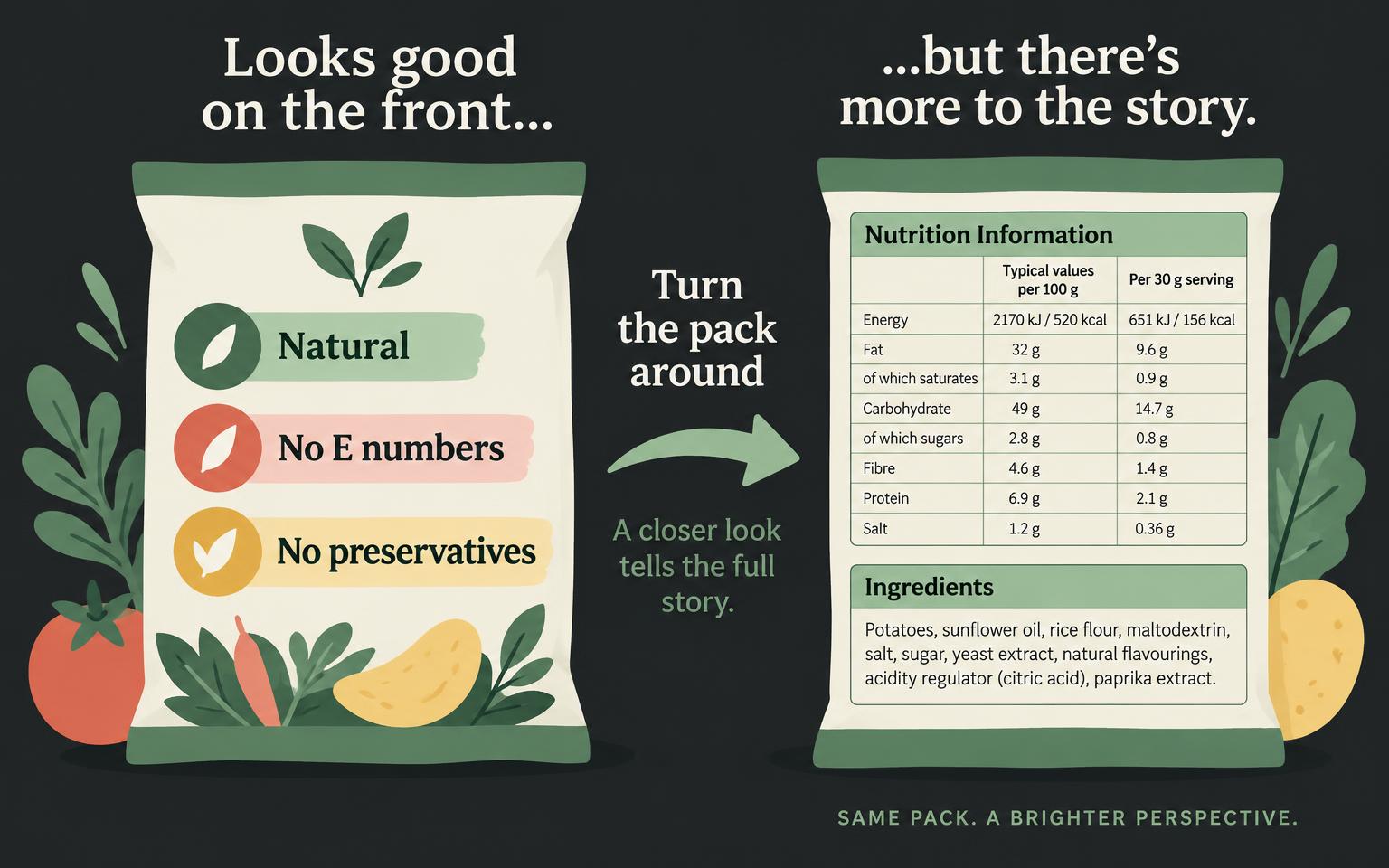
Food marketing increasingly uses phrases such as no artificial ingredients, no preservatives, 100% natural and no E numbers. Those statements can provide information, but they should not replace reading the rest of the label.
Removing an additive does not automatically improve sugar, salt, saturated fat, fibre or protein. Using the full name of an additive instead of its E number does not change the substance either. Ascorbic acid and E300 are the same additive.
The Sláinte method
Sláinte does not automatically penalise a product because it contains an E number. The individual additive is considered as part of the wider product.
55%
Sugar, salt, saturated fat, fibre and protein
30%
Ingredients and recognised additives in the product
15%
Processing signals and the completeness of the product information
Two products containing additives can receive very different scores. The aim is not to say E numbers are bad. It is to explain what is in the product and what it means.
An E number is an identifier, not a danger rating.
Approved additives have specific functions in food.
Different additives should be considered individually.
Some familiar substances, including vitamin C, have E numbers.
An additive is only one part of the product. Nutrition and the rest of the ingredients still matter.
The E refers to Europe. E numbers identify food additives authorised for use under the European food-additive system.
No. Some additives identified by E numbers occur naturally. Examples include ascorbic acid (E300), pectin (E440) and lycopene (E160d).
Food additives must be authorised for use under EU legislation and can only be used under specified conditions. Their safety is assessed before authorisation, and additives can be re-evaluated as scientific evidence develops.
E300 is ascorbic acid, better known as vitamin C. It is commonly used as an antioxidant in food.
E950 is acesulfame K, an intense sweetener commonly found in some sugar-free drinks and reduced-sugar products.
E951 is aspartame, an intense sweetener used in various reduced-sugar and sugar-free foods and drinks.
E250 is sodium nitrite, a preservative permitted for certain food uses including cured meat products under specified conditions.
The presence of an E number alone does not tell you the nutritional quality of a food. Look at the individual additive, overall ingredient list, nutrition information and the role the food plays in your diet.