
Can sugar-free food contain calories?
Yes.
Published · Updated · Sláinte Editorial
Sugar-free sounds like a verdict.
It is actually a description of one part of the food.
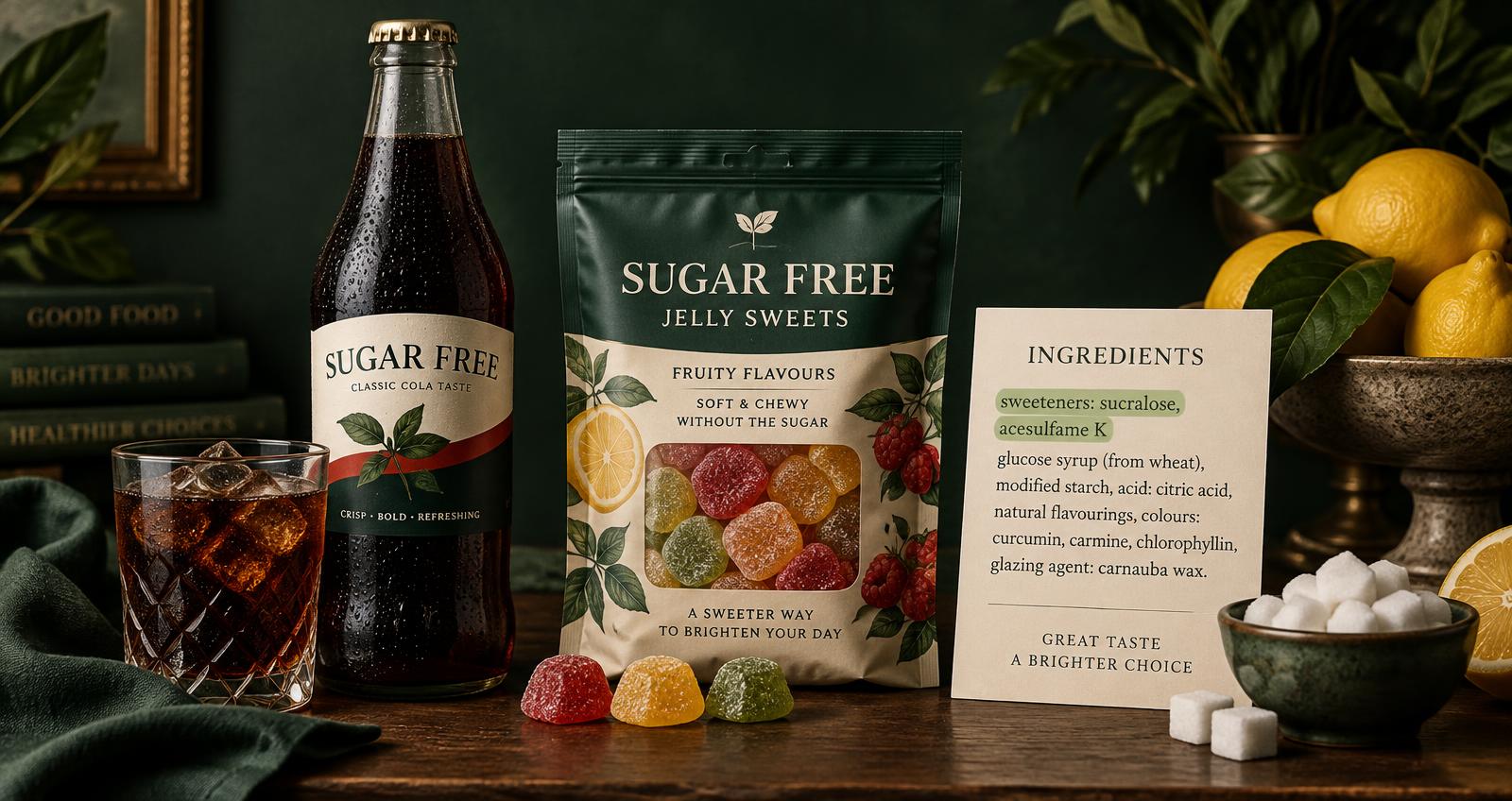
A sugar-free version of a drink may contain dramatically less sugar than the regular version. That can be useful.
It does not automatically tell you everything else you need to know about the product.
The most useful question is: Better than what, and for which outcome?
Under EU nutrition-claim rules, a product making a sugars-free claim must contain no more than 0.5g sugars per 100g or 100ml.
That is a precise regulated claim.
It does not mean zero calories, and it does not mean nutritionally perfect.
These claims are not the same.
Sugars-free refers to the total-sugars threshold.
No added sugar is about whether sugars or other foods used for their sweetening properties were added.
A no-added-sugar product can still contain naturally occurring sugars.
A product can also contain authorised sweeteners depending on its formulation.
There is no universal replacement.
Products may use:
That is why the ingredients list matters.
If a regular soft drink contains a large amount of sugar and the zero version contains almost none, the sugar difference is meaningful.
The sugar-free drink may also provide substantially less energy.
But neither statement tells you whether the drink contains caffeine, useful nutrients or different sweeteners.
Those are separate questions.
This is a perfect example.
Removing sugar does not necessarily change caffeine.
A zero-sugar energy drink can still contain the same caffeine concentration as the sugared version.
So the useful comparison depends on what you care about.
Yoghurt creates a different problem.
Plain yoghurt naturally contains lactose.
A “sugar-free” discussion that ignores naturally occurring milk sugar can become confusing quickly.
Always distinguish total sugars, added-sugar ingredients and regulated claims.
Protein bars may use polyols such as maltitol.
Polyols are not identical to intense sweeteners such as sucralose.
A low-sugar bar can still contain substantial energy.
Again: low sugar ≠ no calories.
If you replace a high-sugar product with a comparable sugar-free version, your sugar intake from that product can fall substantially.
That is straightforward.
What should not follow automatically is Therefore this product guarantees weight loss or Therefore this product is healthy.
Long-term diet outcomes involve more than one product characteristic.
WHO issued guidance in 2023 advising against relying on non-sugar sweeteners as a long-term weight-control strategy.
That recommendation has a specific scope and is not the same thing as a toxicological conclusion that authorised sweeteners are unsafe.
Safety assessments and dietary recommendations ask different questions.
This is the decision framework to keep.
Check sugar, energy, caffeine and sweeteners.
Check total sugars, ingredients, protein and portion.
Check sugars, polyols, protein, energy and saturated fat.
Do not stop at SUGAR-FREE.
Turn the product around.
Ask what changed. Then ask what did not.
Sláinte can help show the sweeteners, nutrition and ingredients in the context of the whole product.
The aim is not to turn sugar-free into a new health halo.
Yes.
No.
No. They are a distinct category.
No.
WHO’s dietary recommendation on non-sugar sweeteners should not be confused with the toxicological safety assessments performed by authorities such as EFSA and JECFA.
Yes.
Last reviewed: 5 October 2026