
Can no-added-sugar food still contain sugar?
Yes.
Published · Updated · Sláinte Editorial
A product says NO ADDED SUGAR.
Then you turn it around and the nutrition table still shows sugar.
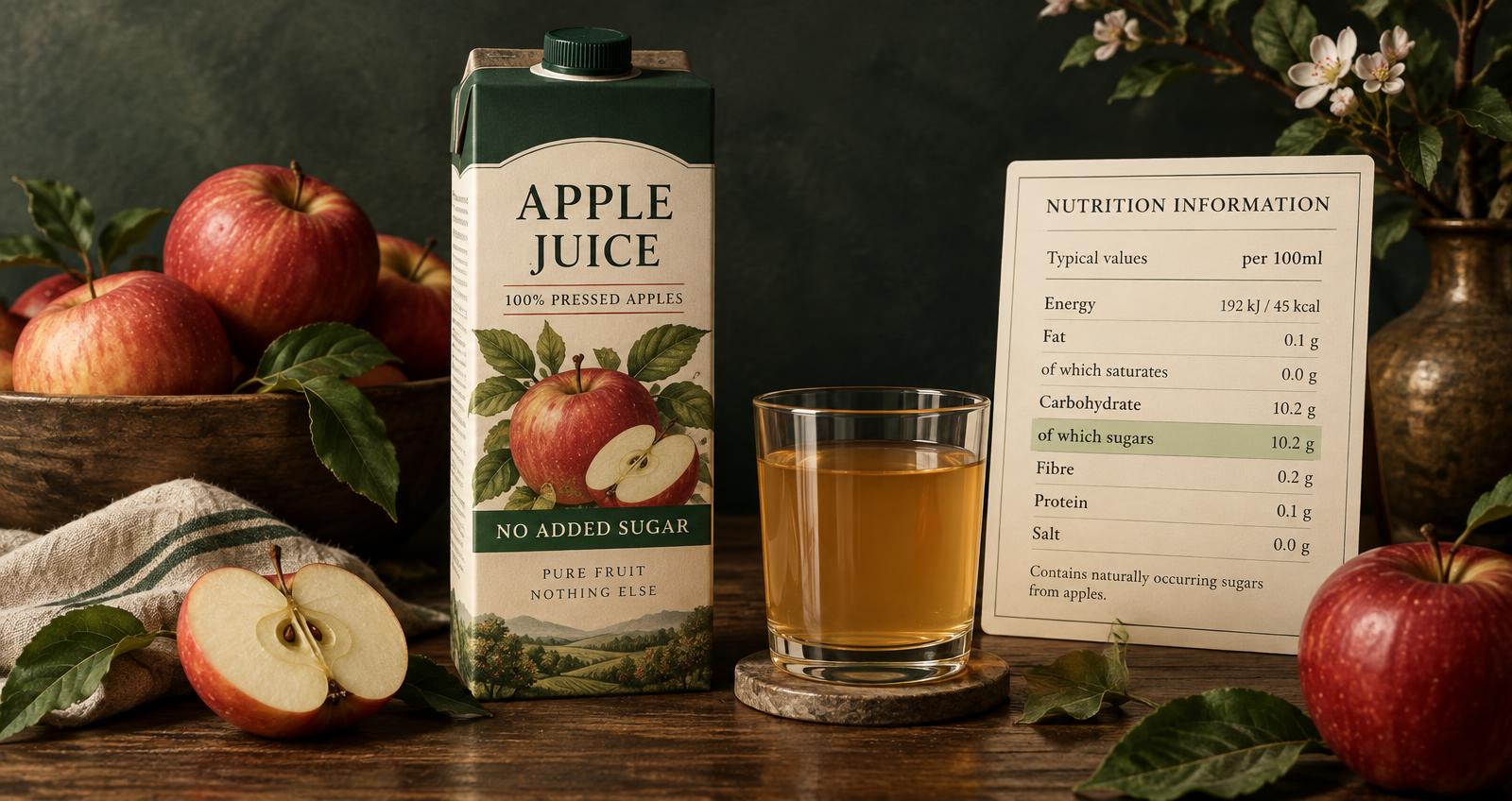
That is not automatically a contradiction.
“No added sugar” and “sugar-free” mean different things.
Understanding the difference makes food labels much easier to read.
Under EU nutrition-claim rules, a no-added-sugars claim can only be made when the product does not contain added monosaccharides or disaccharides, or another food used for its sweetening properties.
When sugars are naturally present in the food, the label should carry the appropriate indication that it contains naturally occurring sugars.
Yes.
Plain milk and yoghurt are obvious examples.
Milk naturally contains lactose.
So a food can contain sugars while having no sugar deliberately added during manufacture.
These claims answer different questions.
The EU claim is based on the amount of sugars in the product.
The claim focuses on whether sugars or foods used for sweetening were added.
A product with naturally occurring sugar can therefore potentially make a no-added-sugar claim while not being sugar-free.
FSAI guidance explains that the use of authorised sweeteners does not automatically prevent the claim where the conditions for “no added sugar” are otherwise met.
That is another reason no added sugar does not mean nothing sweet was added to the formulation.
The ingredients list tells you what was actually used.
This is where the wording foods used for their sweetening properties matters.
Replacing table sugar with honey or syrup does not automatically create a no-added-sugar product.
The legal conditions need to be applied to the actual formulation.
Usually not.
The standard nutrition table reports total sugars.
It does not generally give a separate mandatory “added sugars” line like some other countries use.
So do not take total sugar and invent an exact added-sugar value.
The Glenisk whole natural yoghurt lists 3.3g sugars per 100g.
That is a useful example of why seeing sugar in the nutrition panel does not itself prove added sugar.
The ingredients and product type add context.
Total sugar present. No need to assume it was added.
Could potentially meet the claim conditions while using an authorised sweetener.
Do not assume “no added sugar” simply because the sweetener is honey rather than sucrose.
When you see no added sugar:
Sláinte can bring the front claim, ingredients and nutrition into the same product view.
That makes it easier to see what the claim does and does not tell you.
Yes.
It can, where the applicable rules are met.
Honey is still a food used for sweetening. The exact claim conditions matter.
No.
Not reliably from the standard nutrition table alone.
Last reviewed: 5 October 2026