
Is a food scanner the same as a calorie tracker?
Not necessarily. A calorie tracker usually focuses on recording food intake. A food scanner may instead focus on understanding the product itself.
Published · Updated · Sláinte Editorial
A food scanner is a tool that helps you identify a packaged food and understand the information attached to it.
With a barcode-based scanner, you point your phone at the barcode printed on the pack. The important part is what happens next.
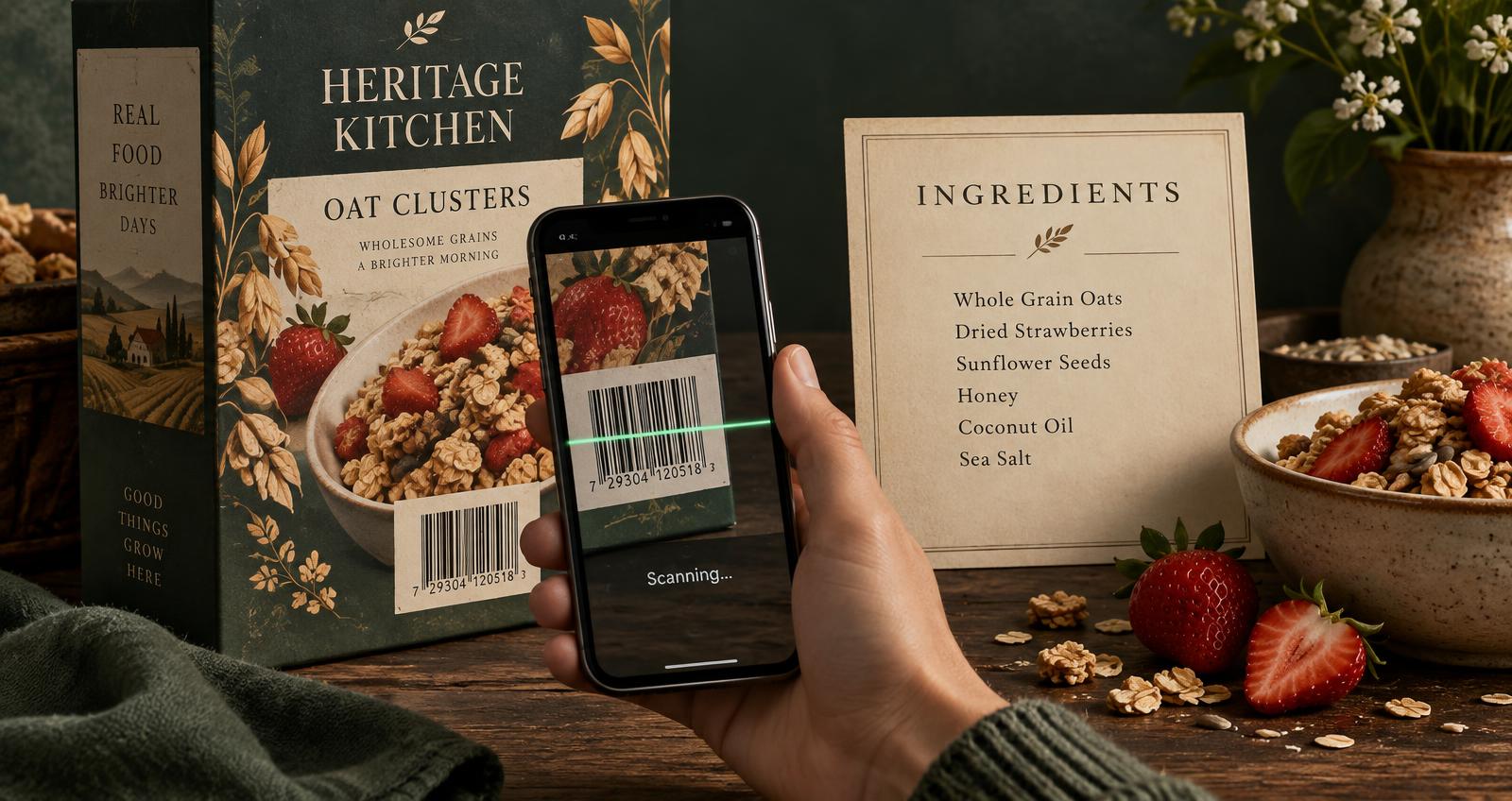
The barcode does not contain a secret nutritional analysis of the food. In a typical grocery scan, it identifies a trade item. The scanner can then use that identifier to find a product record containing information such as the product name, nutrition and ingredients.
A food scanner can make that information easier to understand.
A typical scan involves several separate steps.
First, the barcode is read. Then the identifier is matched against a product database. If a matching record exists, the scanner can retrieve the information associated with it.
Depending on the product and tool, that information may include:
A scanner may then add another layer of interpretation. That could mean explaining an ingredient, comparing nutrients or applying its own scoring methodology.
Those are separate steps.
Usually, no.
For ordinary packaged grocery products, the familiar barcode generally acts as an identifier. Think of it like a key. The scanner reads that key and looks for the product information stored elsewhere.
This is why a barcode can scan successfully while the food itself is missing from an app. The barcode was readable. The product record was not available.
The exact answer depends on the scanner.
A useful scanner can make values such as sugars, salt, saturated fat, protein, fibre and energy easier to compare.
The ingredients list tells you what has been used to make the product and, in some cases, the amount of particular emphasised ingredients.
Instead of expecting people to remember that E621 is monosodium glutamate or E955 is sucralose, a scanner can translate unfamiliar names and E numbers into plain language.
The most useful tools do not simply flag one ingredient and stop. A product needs to be understood as a whole.
This depends entirely on the methodology being used.
A score is not a physical measurement like weight or temperature. It is the output of a set of rules.
Two apps can take the same nutrition information and still produce different results because they may:
That does not automatically mean one app is broken. It means you need to understand what the number represents.
Sláinte publishes its methodology so the reasoning can be examined.
A missing product is a data problem. It is not evidence that the food is good or bad.
A scanner may recognise the barcode but have no matching product record. Or it may have a product record with missing fields.
A responsible system should distinguish between:
We have enough information to assess this product
and:
We do not currently have enough information.
Unknown information should not quietly become zero.
Trust the current physical product label for the product in your hand.
Recipes change. Pack sizes change. Products sold under similar names in Ireland and the UK may not always use the same formulation.
If the scanner shows one ingredients list and the current packet shows another, that mismatch needs to be resolved.
Before relying on the result, check:
A 55g protein bar and an 80g version are not automatically the same product record. Neither are two flavours simply because the packaging looks similar.
A barcode scan does not chemically analyse the food.
It cannot determine an undeclared ingredient by scanning the barcode. It cannot guarantee that every database entry is current. It should not replace the physical allergen information on the pack. And a general product score is not personalised medical advice.
Understanding those limitations makes the tool more useful, not less.
Sláinte is designed to make food and product information easier to understand.
Scan a supported product and Sláinte can bring the available product record, nutrition, ingredients and interpretation together in one place.
The point is not to make people memorise food regulations. It is to make the label easier to use.
Not necessarily. A calorie tracker usually focuses on recording food intake. A food scanner may instead focus on understanding the product itself.
For normal grocery barcode lookup, the barcode primarily identifies the product. The ingredients are generally retrieved from a matched product record.
A barcode scanner needs a suitable identifier. Loose foods without a consumer barcode require a different way of identifying the food.
The scanner may need a new or updated product record. Missing information should not be treated as zero.
A scanner can help present declared information, but the current physical pack remains important for allergy decisions.
Because their underlying product data, categories and scoring methodologies may differ.