
Are ingredients stored in the barcode?
Normally, the barcode identifies the product and the ingredients are retrieved from an associated record.
Published · Updated · Sláinte Editorial
A barcode scanner can identify a product in a fraction of a second.
That can make the process feel almost magical. It is not.
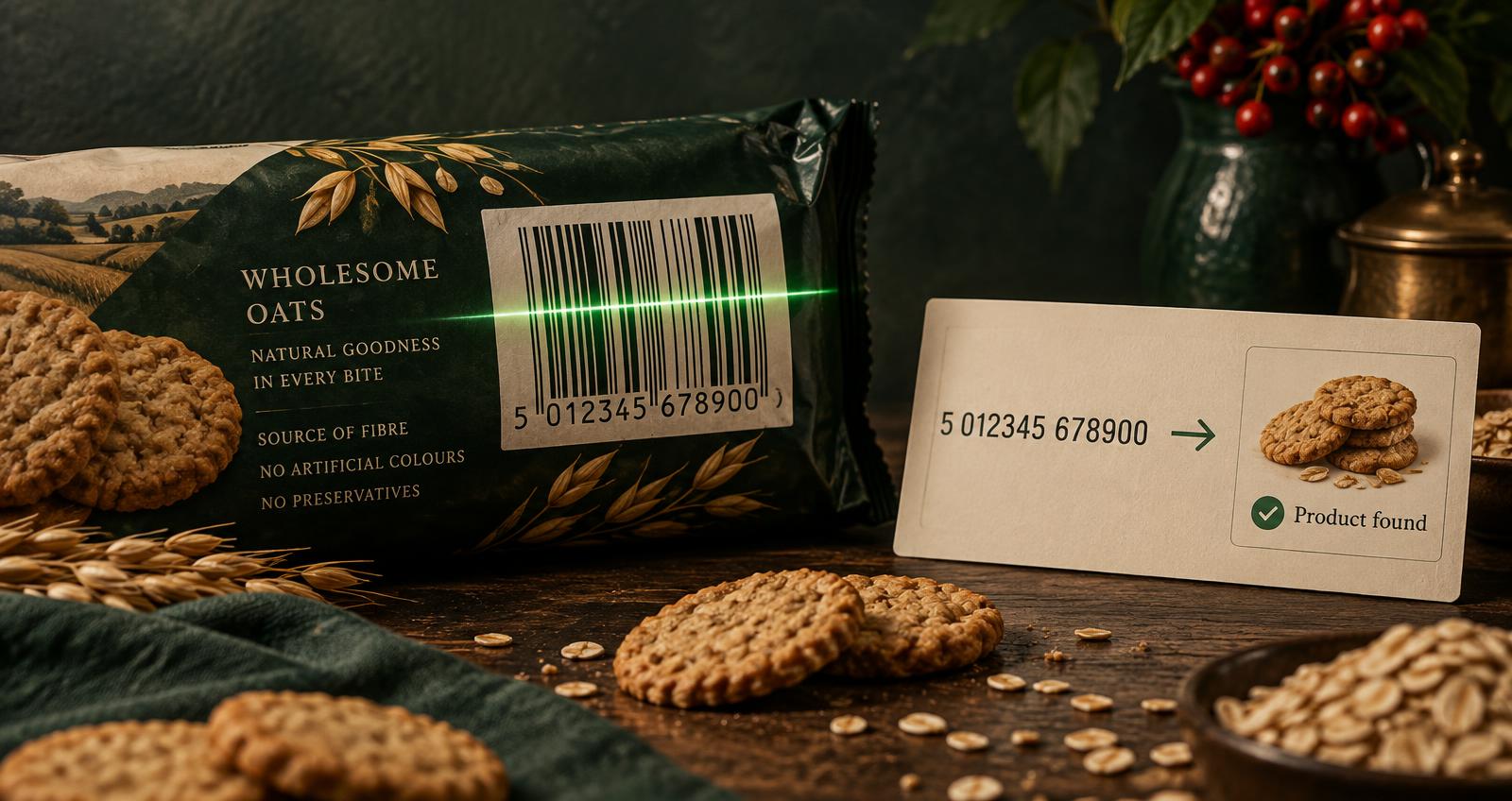
Understanding the steps behind a scan explains why a barcode can work while the result is missing, incomplete or even wrong.
For many supermarket products, the barcode represents a product identifier such as a GTIN.
GS1 describes the GTIN as an identifier for trade items.
The scanner first needs to read that identifier accurately. At this stage, it has not analysed the nutrition or ingredients.
The app searches its available data for the product associated with that identifier.
If a suitable product record exists, the app can retrieve it. If not, the barcode can be perfectly readable while the result is still Product not found.
A product record might include:
The barcode did not measure those values. They came from a stored source.
Nutrition labels do not always arrive in exactly the same structure.
A system may need to organise or normalise information so products can be compared on a consistent basis. For prepacked food, per-100g or per-100ml information is particularly useful for comparisons.
Only after the product has been identified and its information retrieved does an app have the inputs needed to apply a scoring or interpretation method.
That distinction matters:
Product data is the evidence.
The score is an interpretation of that evidence.
| Situation | What may have happened |
|---|---|
| Barcode will not read | Camera, print or barcode issue |
| Barcode reads but no product | Record missing |
| Wrong flavour appears | Incorrect product match |
| Right product, missing nutrition | Incomplete record |
| Ingredients differ from pack | Record may be outdated |
| Pack size differs | Wrong variant or old listing |
For ordinary grocery barcode lookup, think of the barcode as identifying the item rather than carrying the complete ingredients list.
The app then retrieves the associated information.
Other barcode standards can carry other types of information, so avoid claiming that every barcode in existence can contain only one identifier.
This depends on the nature of the change and applicable identifier-management rules.
From the consumer’s point of view, the important issue is simpler: does the database record still match the product in your hand?
A 330ml drink and a 500ml drink may be related products, but their barcodes and serving exposure can differ.
Likewise, two packets of the same branded snack may use different consumer identifiers.
Always match the exact item.
After scanning:
Sláinte uses the barcode as the starting point for understanding the product.
A successful scan is useful because it connects you to the product record. The useful part then becomes understanding what that record says.
Try the scanner →
Normally, the barcode identifies the product and the ingredients are retrieved from an associated record.
No.
The barcode may not yet have a suitable product record in that service.
The database match may be wrong, outdated or linked to a different product variant.
Do not assume so. Identifier-change rules depend on the situation.