Is one app wrong when the scores differ?
Not necessarily.
Published · Updated · Sláinte Editorial
You scan the same cereal in two apps.
One gives it a strong score. The other gives it an average one.
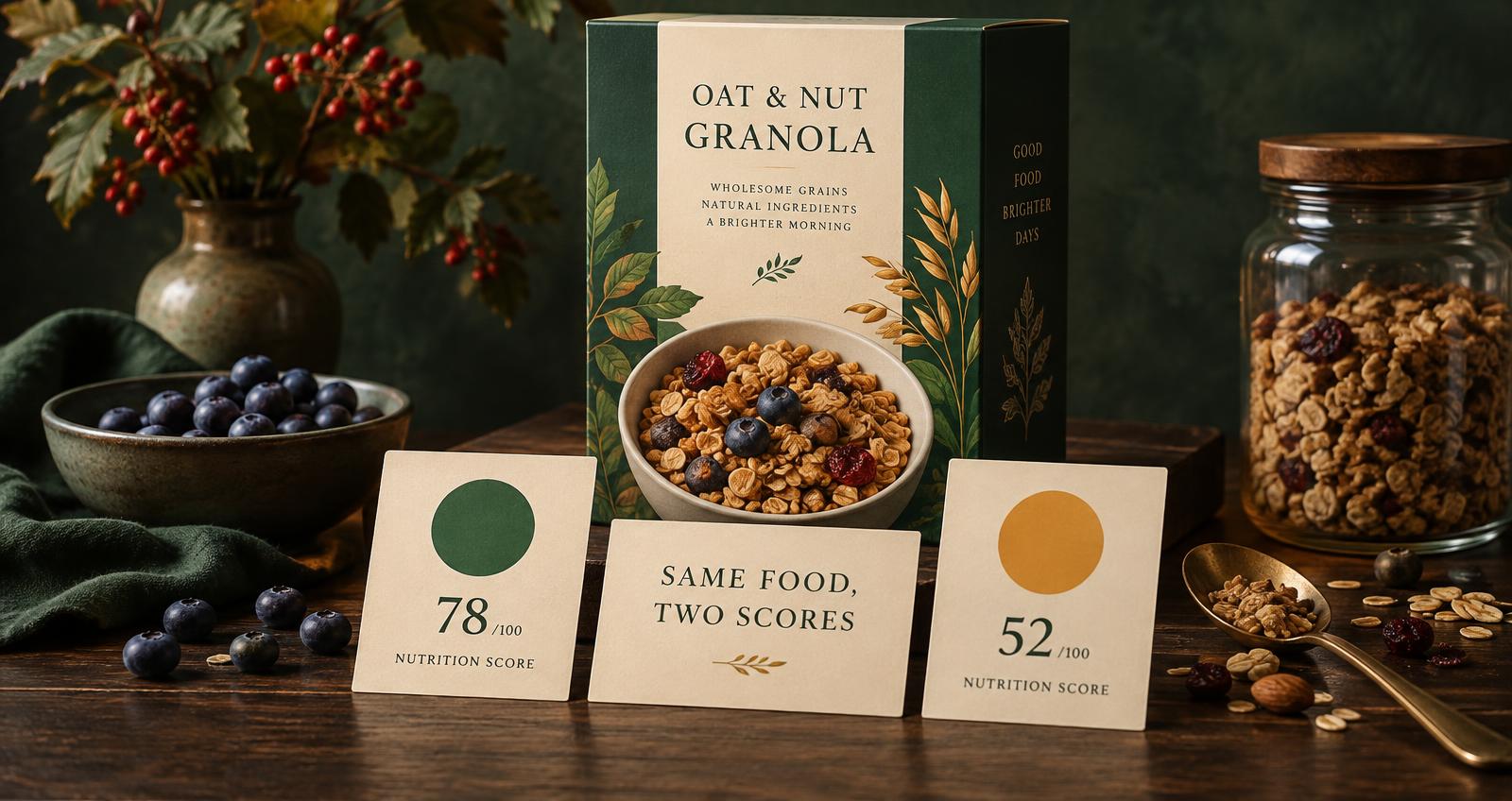
Which app is wrong?
Possibly neither.
Before treating the two numbers like competing measurements, it helps to understand where food scores come from.
This is the boring step, but it matters.
Check:
If one app has an older recipe, you are not really comparing two scoring systems anymore. You are comparing two different inputs.
Imagine one database says a product contains 1g salt per 100g. Another has an old entry showing 0.8g.
Even if the scoring formulas were identical, the outputs could differ.
Missing fibre is another example. “Not declared” does not automatically mean zero.
There is no law saying every private food scanner must weight sugar, salt, saturated fat, fibre, protein and energy in the same way.
Different methodologies can therefore disagree while using the same nutrition table.
One app may strongly penalise a particular additive. Another may focus on whether the additive is authorised and consider it in the wider product context.
Those are different methodological choices.
One methodology might incorporate processing directly. Another might primarily use nutrient composition. A third might show NOVA separately rather than mixing it into its main score.
Again, those numbers are not automatically measuring the same concept.
Suppose an app decides that certain confectionery products can never receive its highest rating even if individual nutrient values are relatively favourable.
That cap changes the result.
Another app without that rule may score the same numbers differently.
Weight is measurable in kilograms. Temperature is measurable in degrees.
A proprietary food score is different.
The score is produced by a method.
That does not make it meaningless. It means the methodology matters.
Yes.
One might be better at exposing raw data. Another might make the result easier to understand. Another may have stronger coverage of the products you buy.
The real mistake is treating a number as self-explanatory.
There are three common reasons.
A recipe is updated or corrected.
For example, fibre becomes available.
A scoring system may be revised.
If an app changes its rules, transparent versioning helps explain why historical results changed.
If two apps disagree, look underneath the numbers.
Check:
That will usually tell you more than arguing over whether 71 or 78 is the “real” score.
Sláinte’s methodology should remain public so users can understand what the result means.
Not necessarily.
Yes. They may interpret the same data differently.
Not automatically. Safety and nutritional scoring are different questions.
The product record or the methodology may have changed.
No private scanner score should be presented as a universal official health measurement.