What is in it?
The nutrition, ingredients and additives should be visible, not hidden behind one number.
Four popular tools, four different ways of turning a label into an answer.
Food scanner apps promise to make sense of a supermarket shelf in seconds. Point your phone at a barcode and you may get a score, an ingredient assessment, a nutrition lesson or the raw label data. Those are not the same thing.
This guide compares Yuka, Open Food Facts, Fooducate and Sláinte for shoppers in Ireland. It looks at what each app is best at, why their scores can disagree and what a result can never tell you on its own.
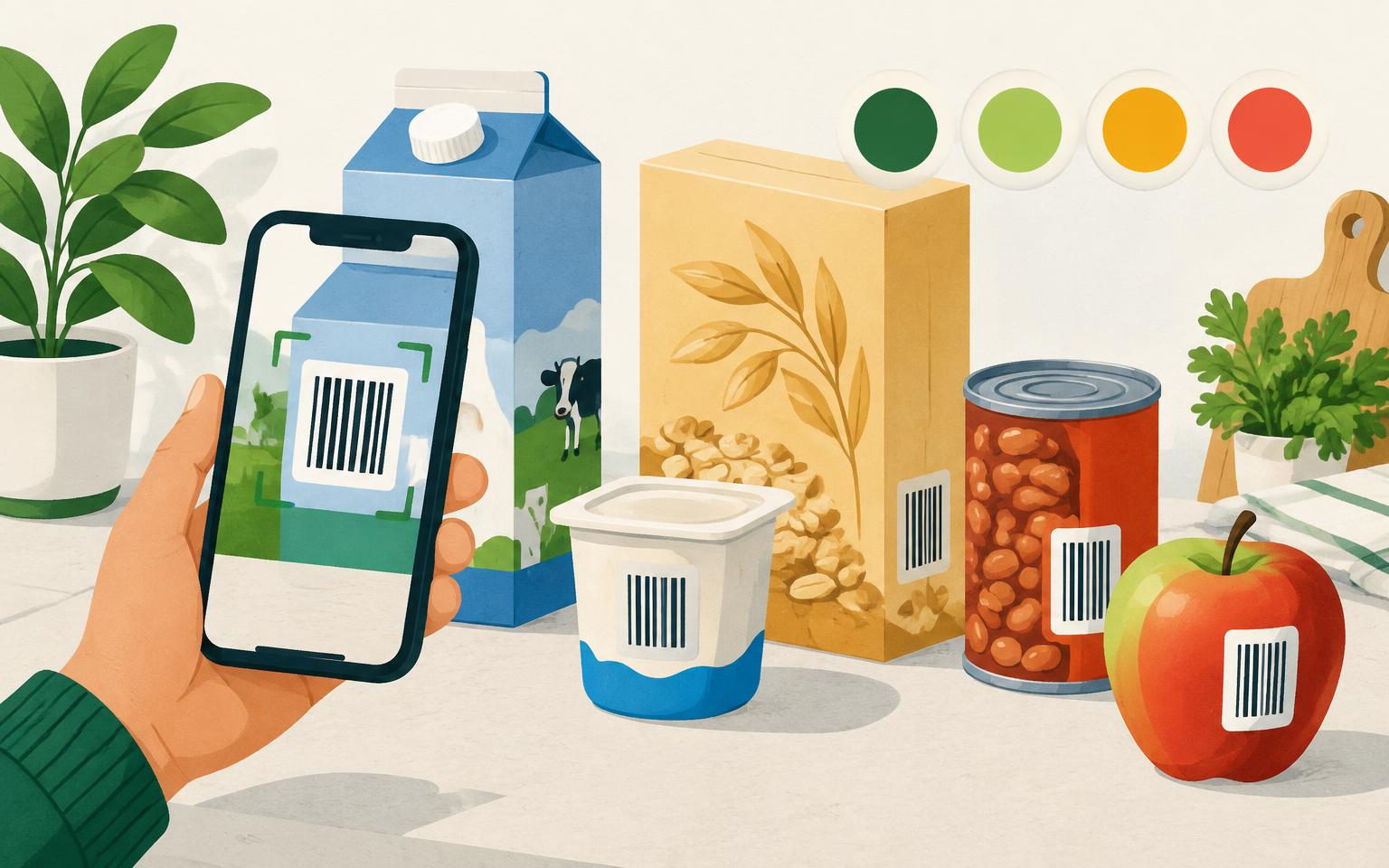
A food scanner app reads the barcode printed on a product and looks for the matching record in a database. The barcode itself contains an identifier, not a hidden nutrition report. Everything you see after the scan comes from data the app has matched to that identifier.
That distinction matters. A fast scan does not guarantee that the record is complete, current or even the right flavour. Packaging changes, recipes are reformulated and the same brand can sell similar products with very different labels. A responsible scanner makes uncertainty visible instead of filling gaps with a confident-looking score.
The best apps do more than repeat a nutrition table. They reduce the effort of reading the pack while preserving enough detail for you to understand the answer. In practice, a useful scanner should answer four questions.
The nutrition, ingredients and additives should be visible, not hidden behind one number.
A useful result names the factors that raised or lowered the rating in ordinary language.
Sugar, salt, saturated fat, sweeteners and ingredient concerns need context, not alarmism.
Comparisons should be within a useful category, not between foods that serve completely different purposes.
There is no universal winner because the four apps below were built for different jobs. A large product catalogue, open data, nutrition education and local relevance are all valuable, but they lead to different experiences and different answers.
Yuka is probably the best-known consumer barcode scanner in Europe. Its appeal is immediate: a scan produces a simple score, a colour and short reasons, with alternatives where the catalogue supports them. Its large international database makes it useful for travellers and for shoppers who regularly buy multinational brands.
Yuka uses its own scoring method, so its number should be read as Yuka's assessment, not as an official European health rating. Coverage can also vary by market. A familiar international product may be richly documented while an Irish own-brand line or a small local producer has limited data.
Open Food Facts is a collaborative, open database rather than only a consumer rating app. It exposes nutrition, ingredient lists, allergens, labels, packaging information and classifications contributed by its community. Researchers, developers and curious shoppers can inspect far more of the underlying record than most polished scanners show.
Openness is its great strength and its main consideration. Records are community-built, so completeness and freshness differ from one barcode to the next. It is excellent when you want raw data and provenance, but it can demand more interpretation than a shopper wants in the middle of a busy aisle.
Fooducate is designed to help people learn what nutrition labels mean. It combines product grades with explanations and food tracking, putting more emphasis on education and personal eating patterns than on a European supermarket catalogue alone.
Its roots and product coverage are more closely associated with the United States, where labels, serving conventions and available products differ from Ireland. It can still be useful as a learning tool, but shoppers should check that the scanned record matches the Irish or European pack in their hand.
Sláinte focuses on products Irish shoppers encounter, including Irish brands, UK imports, supermarket own labels and international staples. It scans food and drinks as well as cosmetics and household products, while keeping nutrition-only controls away from items where they do not belong.
Its method is published and each scored product explains what raised or lowered the result. The four bands run from Excellent to Bad, and products without enough reliable information remain unscored. The aim is not to replace the label with a verdict. It is to make the label quicker to understand and make alternatives easier to compare.
| App | Main focus | Strongest use | Consideration in Ireland |
|---|---|---|---|
| Yuka | Simple consumer rating | Large international branded-product catalogue | Local and own-brand coverage can vary |
| Open Food Facts | Open product database | Inspecting raw label data and provenance | Community records vary in completeness |
| Fooducate | Nutrition education | Learning how nutrition choices fit into a wider diet | More closely aligned with the US market |
| Sláinte | Ireland and UK focused explanations | Understanding scores and comparing familiar local products | A newer catalogue than the largest global databases |
Catalogue size changes constantly. Whatever app you use, confirm the product name, pack size and ingredient list before relying on the result.
Ireland shares EU food-labelling rules, but its supermarket shelves are a particular mix of Irish producers, UK brands, European imports and multinational products. A scanner built around another market may recognise the brand while matching the wrong recipe or missing the Irish variant entirely.
This matters for more than obscure products. Supermarket own labels account for a large part of an ordinary weekly shop. Milk, bread, butter, yoghurt, cereals, sauces and ready meals can change supplier or recipe while the front of the pack remains familiar. Smaller Irish producers may publish excellent label information without appearing in a global catalogue at all.
Units and wording matter too. Irish and EU labels standardise nutrition per 100 g or 100 ml, declare salt rather than sodium and emphasise regulated allergens in the ingredient list. An app designed around US serving sizes and sodium values has to translate that context correctly before the comparison is useful.
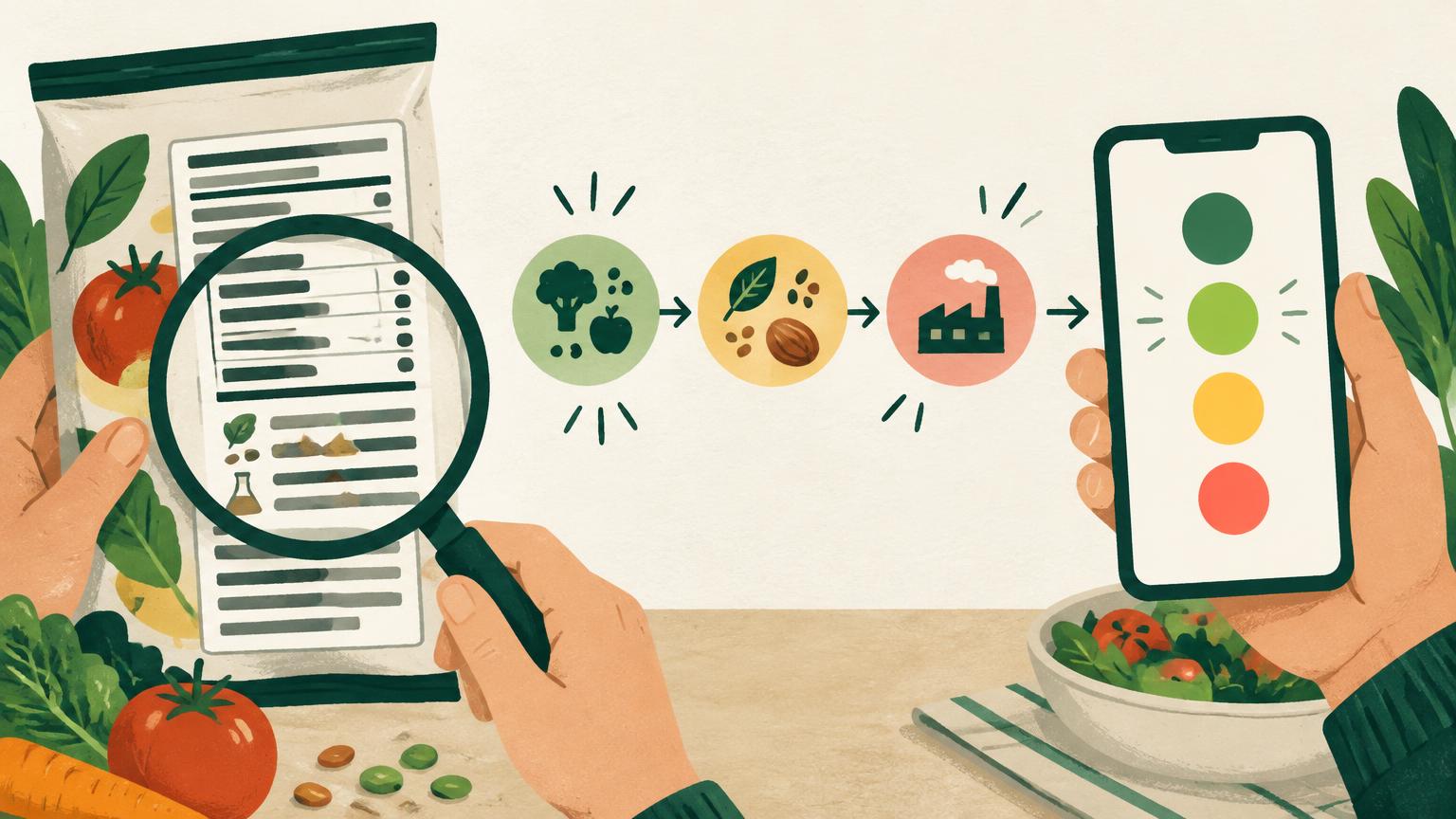
There is no universal food scanner score. Apps choose their own weighting, ingredient rules, additive classifications, processing criteria, category adjustments and cut-off points. Two methods can begin with the same label and reach different numbers without either app misreading the barcode.
One method may put most of its weight on sugar, salt and saturated fat. Another may apply a stronger penalty to additives or ultra-processing. A third may reward protein heavily, compare only within a product category or cap certain products so they cannot receive a top rating. Even the decision to score per 100 g rather than per serving changes how a product appears.
The important question is therefore not simply, "Which number is right?" Ask whether the method is public, consistent and suited to what you want to know. A transparent score can be challenged and understood. A hidden score asks you to trust the result without showing the judgement behind it.
Inside the Sláinte method
These values come directly from the same source used by the scoring engine.
55%
The declared nutritional profile, including sugar, salt, saturated fat, fibre and protein.
30%
The ingredient list and the level of concern attached to recognised additives.
15%
Signals such as processing level and how complete and verifiable the product record is.
75 to 100
Good for you.
A strong overall profile according to the Sláinte methodology.
50 to 74
Mostly good for you.
A generally favourable profile, with some characteristics worth understanding.
25 to 49
Best kept occasional.
A weak profile. Several characteristics pull the score down.
0 to 24
Avoid.
A poor profile according to the Sláinte methodology.
Trust it as a structured opinion, not as a medical fact. A good scanner can consistently process information that is tedious to compare by hand. It can point out a high salt level, show that sugar appears several times in an ingredient list, or distinguish a plain product from a heavily formulated one. That is useful evidence at the moment of choice.
It cannot know everything about your diet. A low-scoring food may still have a place in an overall eating pattern, and a high-scoring product is not permission to eat unlimited amounts. Scores also cannot account for allergies, coeliac disease, diabetes, kidney disease, pregnancy, medication or personal nutritional requirements unless the app has a specific, medically sound feature for that purpose.
Before acting on a result, check the product identity, the completeness of the record and the explanation. If the app cannot show why it reached the number, treat the number as a prompt to inspect the pack rather than the final word.
The honest answer depends on what you need:
You do not have to use only one. Open product data can be valuable for checking a label, while a locally focused app may make the result easier to apply in an Irish supermarket. The best scanner is the one that recognises the exact product, shows its working and helps you make a more informed choice without pretending the answer is universal.
Yes. Several international apps can recognise products sold in Ireland, while Sláinte is built specifically around Irish and UK shopping. Coverage still varies by product, so every app should show when its data is incomplete.
Yes. A food scanner uses your phone camera to read the barcode. The app then matches that barcode to a product record and presents the nutrition, ingredients or score it has available.
Yuka can be used in Ireland, although its coverage is strongest in the markets where its community and product catalogue are largest. Irish own-brand and smaller local products may be less consistently represented.
A score is only as reliable as the label data and method behind it. Check whether the product is the correct variant, whether the figures are current, and whether the app explains how nutrition, ingredients and processing affected the result.
No. Sláinte focuses on products Irish shoppers are likely to encounter, but it can also recognise many international foods, drinks, cosmetics and household products when reliable data is available.
No. A scanner is a shopping aid, not a diagnosis or a personalised nutrition plan. Allergies, medical conditions, pregnancy, medication and individual dietary needs should be discussed with an appropriate healthcare professional.