
Function
Sweetener
Tells you the job the ingredient is doing.
Published · Updated · Sláinte Editorial
E955. Sucralose. Zero sugar. Low calorie.
Sucralose appears in a wide range of reduced-sugar and sugar-free foods and drinks. It is also an ingredient that regularly attracts conflicting claims online. One source might tell you it is safe. Another might tell you never to heat it. Another might tell you that any product containing it should be avoided.
In February 2026, the European Food Safety Authority completed a major re-evaluation of sucralose. Its conclusion was more nuanced. EFSA found no safety concern for sucralose at its currently authorised uses and use levels, and retained the existing Acceptable Daily Intake. But it could not confirm the safety of a proposed expansion into some additional baked foods, because of uncertainties about what may happen during prolonged high-temperature processing.
Here is what that actually means.
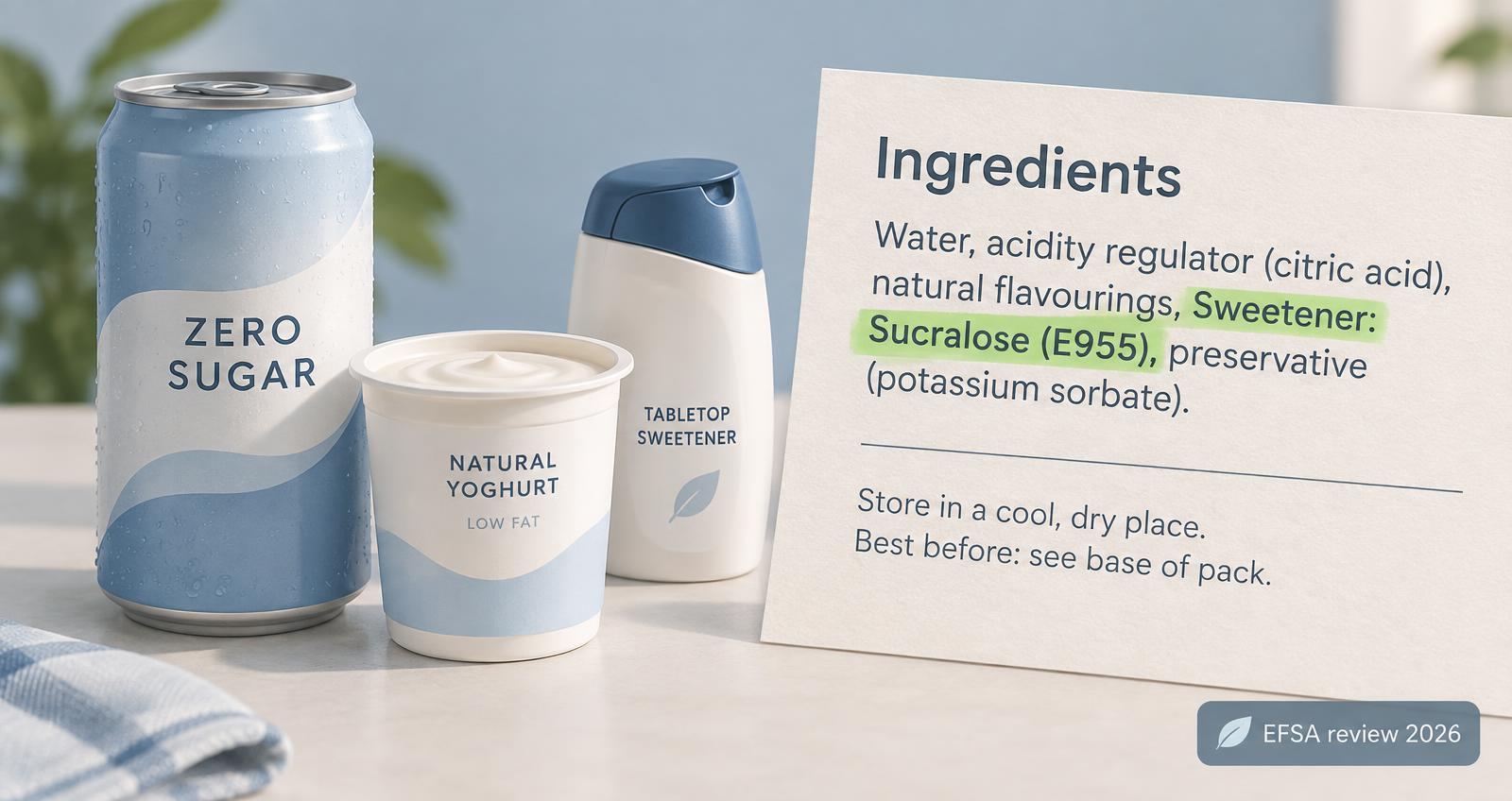
Sucralose is an intense non-sugar sweetener. Its European additive number is E955. EFSA describes it as approximately 600 times sweeter than sugar, so much smaller amounts can be used to provide sweetness compared with ordinary sugar.
Sucralose is authorised in the EU for specified uses in a range of reduced-sugar and sugar-free foods and drinks. On an ingredients list you may see Sweetener: sucralose or Sweetener: E955. They refer to the same food additive. If the numbers themselves are new to you, start with what E numbers are.
E955
Sucralose
Sweetener
~600× sweeter than sugar
The main reason is sweetness. Sucralose lets manufacturers make sweet products without relying on the same quantity of sugar. You may find it in reduced-sugar and sugar-free foods, drinks, desserts, dairy products, tabletop sweeteners and some sports-nutrition products.
Reducing sugar can materially change the sugar and energy content of a product. But that does not mean a product with sucralose is healthy, or that sugar-free means nutritionally complete. It tells you something specific about how the product was made. You still need the rest of the label. For the wider picture, see artificial sweeteners explained.
Sugar-sweetened product
Reformulation
Sucralose / E955
Reduced-sugar product
A change in how the product is made, not a verdict on it.
Irish food labelling follows EU rules. Additives used as ingredients are generally declared by their functional class and their specific name or E number, so you'll see Sweetener: sucralose or Sweetener: E955.
Foods containing authorised sweeteners must also generally carry the statement with sweetener(s) near the name of the food. If the product contains both added sugar and sweeteners, the wording is generally with sugar(s) and sweetener(s). More on this in how to read an ingredients list.
Function
Sweetener
Tells you the job the ingredient is doing.
Identity
E955 / sucralose
Tells you exactly which sweetener was used.
This is the most important current update. EFSA completed its re-evaluation of sucralose as a food additive in February 2026, weighing the available scientific evidence together. It concluded that:
The ADI remains 15 mg per kilogram of body weight per day. That is the current European food-safety position.
Current authorised uses
No safety concern
ADI unchanged
15 mg/kg/day
Estimated exposure
Below the ADI
EFSA, February 2026
ADI stands for Acceptable Daily Intake. It is a long-term safety benchmark: an amount that can be consumed daily over a lifetime without appreciable health risk, based on the available evidence.
It is not an amount you should aim to consume every day. And going slightly above it on one occasion does not automatically cause harm. Risk assessors use the ADI to compare estimated long-term dietary exposure against an established safety level.
An ADI is a safety benchmark, not a recommended intake.
No. The previous ADI was also 15 mg/kg body weight per day, and after its updated review EFSA concluded there was no need to revise it. The highest estimated exposure across EU population groups remained below that level. That is why the 2026 conclusion for currently authorised uses was no safety concern.
Previous ADI: 15 mg/kg/day
2026 re-evaluation
ADI stays 15 mg/kg/day
Because EFSA was answering two different questions. First: is sucralose safe under its currently authorised uses? EFSA concluded yes, at the assessed uses and exposure levels. Second: can its permitted use safely be expanded into more fine bakery products? Here EFSA could not reach the same conclusion, because of uncertainty around prolonged exposure to high temperatures.
Current authorised uses
No safety concern identified
Assessed uses and reported use levels.
Proposed extra bakery uses
Safety could not be confirmed
Uncertainty over prolonged high-temperature baking.
Evidence considered in the 2026 review indicated that at high temperatures for long periods, chlorine from sucralose could potentially move onto other molecules and form chlorinated compounds. The health effects of those compounds are not sufficiently understood.
Because that uncertainty could not be dismissed, EFSA could not confirm the safety of expanding sucralose into more fine bakery wares without limits on temperature and time. That is different from saying heating sucralose has been proven dangerous. What the evidence supports is narrower:
There is unresolved uncertainty around possible breakdown products under prolonged high-temperature conditions.
Sucralose
Prolonged high heat
Possible chlorinated compounds
Uncertainty remains
Potentially, which is why EFSA raised it. Temperature, cooking time and the amount of sweetener used vary a lot in home kitchens, so EFSA said the formation of chlorinated compounds during high-temperature home cooking with sucralose, including baking or frying, could not be excluded. It recommended that the European Commission consider the issue.
That still does not establish that ordinary home baking with sucralose causes harm. It identifies an area where the evidence does not yet allow the uncertainty to be dismissed.
That isn't what EFSA concluded. It said the high-temperature conditions behind this uncertainty are not expected during industrial processing of foods under the currently authorised uses of E955. Its conclusion for those uses remained no safety concern at the reported uses and use levels. The uncertainty relates to particular high-temperature conditions and the proposed new uses, not to every food that contains sucralose.
Cold drink
Current authorised use
No safety concern at reported use levels.
Long, hot baking
A different question
Where EFSA's uncertainty sits.
Yes. The re-evaluation was a broad safety assessment covering biological and toxicological evidence, exposure and the substance's technical specifications. As well as keeping the ADI, EFSA recommended tighter specifications for sucralose, including limits for certain impurities and lead.
That is another reason a regulatory conclusion shouldn't be squeezed into "safe" or "toxic". An assessment can find authorised exposure acceptable while still pointing out specifications that could be improved, or areas that need more evidence.
It depends on what you're comparing. Replacing sugar with sucralose can substantially reduce sugar, and potentially energy, in certain products. That's a meaningful difference. But a zero-sugar drink doesn't gain fibre, protein, fruit, vegetables or meaningful micronutrients just because the sugar has gone. "Less sugar" can be true without "nutritionally excellent" also being true.
| Sugar | Energy | Sweetener | Wider nutrition | |
|---|---|---|---|---|
| Regular drink | Substantial | Higher | None | Read the label |
| Zero-sugar drink | Virtually none | Lower | Sucralose / E955 | Read the label |
EFSA describes sucralose as a non-nutritive sweetener: it provides sweetness without adding calories or nutritional value. That's one reason it's used when manufacturers want sweetness without comparable amounts of sugar. But no calories from the sweetener is not a nutrition score for the whole product.
Sucralose and other non-sugar sweeteners have been studied for possible effects on the gut microbiome and metabolism. This research is still developing, and studies differ in design, dose, population and findings.
The current European assessment does not conclude that ordinary authorised exposure to sucralose damages the gut. Nor would it be accurate to say every possible biological effect has been ruled out for good. Individual studies can raise questions; regulatory assessment weighs the whole body of evidence together. In 2026, that assessment still found no safety concern for current authorised uses.
Individual studies
Wider body of evidence
EFSA 2026: no concern for current uses
No. It tells you the product meets the criteria behind that claim. It doesn't tell you the salt, saturated fat, protein, fibre, energy, ingredients or how processed it is. Different zero-sugar products can also use different sweeteners or combinations of them. So when you see ZERO SUGAR, turn the pack around and see how the product was actually made.
One claim is not the whole product.
No. Both are intense sweeteners, but they are different substances: sucralose is E955 and aspartame is E951. They have different chemical properties, different safety assessments and different labelling. Aspartame is a source of phenylalanine, so it carries extra labelling for people with PKU; sucralose doesn't carry that requirement. Read more in aspartame (E951) and the evidence.
E955
Sucralose
About 600 times sweeter than sugar. ADI 15 mg/kg/day.
E951
Aspartame
About 200 times sweeter than sugar. Phenylalanine labelling.
E955 = sucralose.
It provides sweetness without needing the same amount of sugar.
Is the product substantially lower in sugar than the alternative?
Look at the other figures that matter for that type of food.
A cold drink and something baked for a long time at high heat raise different questions after EFSA's 2026 assessment.
The rest of the food still matters.
You shouldn't need to memorise E950, E951, E955 and every other additive number to understand a label. Sláinte translates E955 into Sucralose, sweetener and shows it alongside the rest of the product, so you see the ingredient in context rather than judging from the number alone.
For more, see artificial sweeteners explained, what are E numbers? and 10 common food additives on Irish labels.
Sucralose is an intense non-sugar sweetener. Its European food-additive number is E955, and EFSA describes it as approximately 600 times sweeter than sugar.
EFSA's 2026 re-evaluation concluded that sucralose presents no safety concern at its currently authorised uses and reported use levels. It retained the existing ADI of 15 mg per kg of body weight per day.
E955 is the European food-additive number for sucralose.
The current Acceptable Daily Intake is 15 mg per kilogram of body weight per day. An ADI is a long-term safety benchmark, not a recommended intake.
EFSA could not confirm the safety of a proposed expansion of sucralose use into additional fine bakery products because uncertainty remains around possible chlorinated compounds formed during prolonged high-temperature processing. EFSA also noted that this uncertainty may be relevant to high-temperature home baking and frying. This is not the same as concluding that harm from normal home use has been demonstrated.
EFSA describes sucralose as a non-nutritive sweetener that provides sweetness without adding calories or nutritional value.
No. Sucralose is E955 and aspartame is E951. They are different sweeteners with different properties and regulatory assessments.
No. Zero sugar describes one characteristic of the product. The rest of its nutrition, ingredients and overall formulation still matter.
E955 = Sucralose
Sweetener
~600× sweeter than sugar
ADI 15 mg/kg/day
High-heat use: uncertainty remains
Understand the ingredient. Then look at the whole product.
Last reviewed: 3 October 2026