
Listed as E number
Sweetener: E951
Label must state: contains aspartame (a source of phenylalanine).
Published · Updated · Sláinte Editorial
E951. Aspartame. Diet. Zero sugar.
Aspartame is one of the most recognisable and most debated food additives in the world. You'll find it in some sugar-free and energy-reduced drinks, chewing gums, desserts and other sweetened products. You'll also find very different claims about it online.
One person will tell you it is one of the most studied food additives available. Another will tell you that the World Health Organization classified it as a possible carcinogen. Both statements can be connected to real evidence, but without context they can leave shoppers more confused than informed.
So what is aspartame, why is it used, what does E951 mean, and what do European and international authorities actually say about it in 2026?
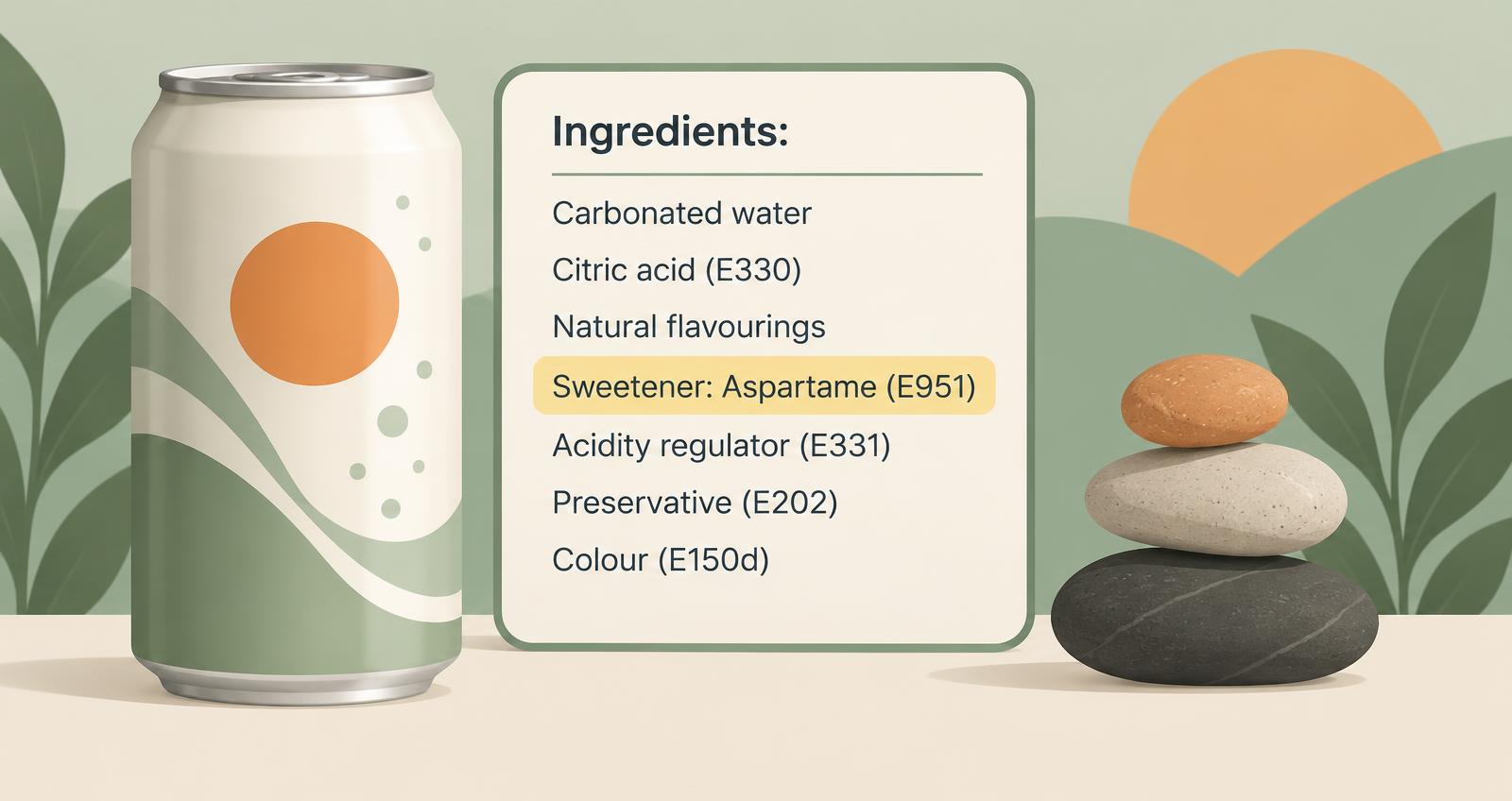
Aspartame is an intense, low-calorie sweetener. Its European additive number is E951. EFSA describes aspartame as approximately 200 times sweeter than sugar. Because it is so sweet, relatively small quantities can provide the sweetness required in a food or drink.
In Europe, aspartame is authorised for use in specified food categories, including products such as certain drinks, desserts, sweets, dairy products, chewing gum and tabletop sweeteners.
So when you see Sweetener: aspartame or Sweetener: E951, you're looking at the same additive. More on how the system works in our guide to E numbers.
E951
Aspartame
Sweetener
Found in some zero-sugar drinks and chewing gums.
The main reason is straightforward: sweetness without needing the same quantity of sugar. Because aspartame is much sweeter than sugar, manufacturers can use a much smaller amount. That makes it useful when formulating certain:
That doesn't mean replacing sugar with aspartame automatically turns a food into a nutritious product. It tells you what changed in the formulation. A zero-sugar soft drink, for example, can contain considerably less sugar than its standard equivalent while still providing little fibre, protein or other nutritional value.
What did the sweetener change about this particular product?
For the wider comparison, see artificial sweeteners explained.
Sugar-sweetened version
Replace some or all sugar
Aspartame / E951
Lower-sugar formulation
A change in formulation, not a health badge.
There are specific labelling rules. Food containing an authorised sweetener must generally carry with sweetener(s) near the name of the food. If the product contains both added sugar and a sweetener, the wording is generally with sugar(s) and sweetener(s).
Aspartame has an additional requirement because it is a source of phenylalanine. FSAI explains that where aspartame is listed only by its E number, the label must state contains aspartame (a source of phenylalanine). Where it is listed by its specific name, the required wording is contains a source of phenylalanine.
These statements are particularly important for people with phenylketonuria, or PKU. See also how to read an ingredients list.
Listed as E number
Sweetener: E951
Label must state: contains aspartame (a source of phenylalanine).
Listed by name
Sweetener: aspartame
Label must state: contains a source of phenylalanine.
Phenylalanine is an amino acid. For most people, the phenylalanine associated with aspartame does not create the same issue that it does for someone with phenylketonuria (PKU). PKU is an inherited metabolic condition in which phenylalanine needs to be carefully controlled.
EFSA specifically notes that the general Acceptable Daily Intake for aspartame does not apply to people with PKU because they require a diet restricted in phenylalanine. This is why the warning on the packet isn't optional decoration. It provides information needed by a specific group of consumers.
Aspartame
Source of phenylalanine
Specific importance for PKU
The current Acceptable Daily Intake, or ADI, for aspartame is 0–40 mg per kilogram of body weight per day. An ADI is an estimate of the amount of a substance that can be consumed daily over a lifetime without presenting an appreciable health risk, based on the available evidence.
It is not a recommended amount to consume. And it isn't the point at which one extra milligram suddenly causes harm. It's a long-term safety benchmark used in risk assessment.
EFSA's 2013 full re-evaluation retained the 40 mg/kg body-weight ADI and concluded that estimated consumer exposure was below it. Importantly, that number is still current. In September 2026, EFSA reassessed newer evidence while evaluating the related sweetener E962, the salt of aspartame-acesulfame, and reconfirmed the existing 40 mg/kg body-weight ADI for aspartame.
Aspartame ADI
0–40 mg/kg
body weight per day
Long-term safety benchmark, not a recommended intake.
This is worth highlighting because the evidence has not simply been left untouched since 2013. On 10 September 2026, EFSA completed its re-evaluation of the salt of aspartame-acesulfame, E962. Because E962 separates into aspartame and acesulfame after ingestion, EFSA considered relevant new evidence relating to both components.
EFSA reported no safety concerns at the currently reported uses and use levels for E951, E950 or E962. The existing aspartame ADI of 40 mg/kg body weight per day was reconfirmed. EFSA did make recommendations around updating certain technical specifications, including limits for some contaminants in EU specifications.
That's a useful example of how food-safety assessment works. A conclusion isn't necessarily reviewed once and never examined again. Evidence, specifications and exposure estimates can continue to be reassessed.
2013: EFSA full aspartame assessment
2023: JECFA and IARC reviews
2026: EFSA E962 assessment, E951 ADI reconfirmed
This is where most of the confusion comes from. In July 2023, the International Agency for Research on Cancer, or IARC, classified aspartame as possibly carcinogenic to humans, Group 2B. IARC said there was limited evidence for carcinogenicity in humans.
At the same time, the Joint FAO/WHO Expert Committee on Food Additives, or JECFA, completed its own assessment. JECFA concluded that the evidence did not provide sufficient reason to change the existing ADI and retained 0–40 mg/kg body weight per day.
Those findings can look contradictory. They're answering different questions.
IARC
Hazard identification
Could this agent have the potential to cause harm under some circumstances?
JECFA
Risk assessment
How likely is harm at the level and conditions of exposure people actually experience?
This distinction is essential. IARC's cancer classifications are hazard classifications. WHO itself explained that they reflect the strength of evidence that an agent can cause cancer, not the probability of developing cancer at a particular exposure. JECFA evaluates dietary exposure and risk.
So IARC Group 2B does not mean aspartame has been shown to cause cancer at ordinary dietary exposure. It means IARC judged the evidence sufficient for its "possibly carcinogenic" hazard category, while describing the human evidence as limited. At the same time, JECFA retained its existing intake limit.
This distinction is important well beyond aspartame.
IARC uses several hazard categories. Group 2B means possibly carcinogenic to humans. The classification reflects the evidence available for a potential cancer hazard. It is not a ranking of how dangerous everyday exposure is, and it doesn't tell you how much exposure someone would need before risk changes.
In its 2023 evaluation, IARC described the evidence for carcinogenicity in humans as limited. That's important context. The responsible interpretation isn't that WHO proved aspartame causes cancer. That isn't what happened. It's also not useful to pretend the IARC classification doesn't exist.
IARC identified a possible hazard based on limited evidence, while JECFA separately assessed exposure and retained the established ADI.
IARC Group 2B
Possibly carcinogenic
Hazard classification ≠ estimate of risk at normal exposure
The answer depends on body weight and the amount of aspartame in each product. Product formulations also differ, so there isn't one universal number of drinks that applies to everyone.
WHO gave an illustrative example in 2023. For an adult weighing 70 kg, WHO said that a can of diet soft drink containing around 200–300 mg of aspartame would require consumption of more than roughly 9–14 cans per day to exceed the ADI, assuming no aspartame was being consumed from any other source.
That example should not be interpreted as a suggestion to drink 9 cans every day. It's simply an illustration of how dose and exposure relate to the ADI. The actual aspartame content of a particular product can differ.
70 kg
Illustrative adult
200–300 mg
Aspartame per can (WHO example)
9–14+ cans
To exceed the ADI
Illustrative only. Formulations vary and this is not a recommended intake.
No. Safety assessment and dietary strategy are different questions. A food additive can be authorised within established intake limits without being something you need to actively include in your diet.
Likewise, reducing sugar using a sweetener can substantially alter the sugar and energy content of a product without automatically making that product nutritionally complete. So rather than asking only "aspartame: safe or unsafe?", it can be more useful to ask:
What did it replace?
How much does the product contain?
What does the rest of the product look like?
There isn't one universal answer. They're different ingredients. Replacing sugar with aspartame can allow a manufacturer to significantly reduce the amount of sugar and energy in certain products. That's a real nutritional difference.
But it doesn't mean aspartame is nutritious. And it doesn't mean a sugar-free product is automatically a good overall choice.
Imagine two drinks. One contains a substantial amount of sugar. The other contains virtually no sugar but uses aspartame. Their sugar and energy profiles may be very different. Neither fact tells you whether either drink provides fibre, protein or significant micronutrients. You need to define what you're comparing.
| Sugar | Energy | Sweetener | Wider nutrition | |
|---|---|---|---|---|
| Regular drink | Substantial | Higher | None | Read the label |
| Zero-sugar drink | Virtually none | Lower | Aspartame / E951 | Read the label |
This is where study design matters. Observational research can identify associations between dietary exposure and health outcomes. Those studies can be important. But an association does not automatically establish that one ingredient caused the outcome. Researchers have to consider issues such as:
This doesn't mean observational evidence should be dismissed. It means claims should match what the study design can actually establish. That's one reason regulatory assessments generally consider multiple types of evidence together, rather than drawing conclusions from a single study.
Observed association
Investigate confounding, exposure and design
Wider evidence assessment
Aspartame = E951.
It's being used to provide sweetness.
Is the product lower in sugar than the alternative you're comparing it with?
Sugar, energy, saturated fat, salt, protein and fibre, where relevant to the food.
Is aspartame one ingredient in an otherwise very different formulation?
Products containing aspartame require phenylalanine labelling for this reason.
Sláinte is designed to make this interpretation easier without turning one ingredient into the whole verdict. If a label contains E951, Sláinte can identify it as aspartame and explain that it is a sweetener. The ingredient is then considered alongside the wider product.
As of 2 October 2026, the live Sláinte methodology weights food scores as follows. It also applies a published guardrail that prevents artificially sweetened products from scoring above 74, meaning they cannot enter the Excellent band.
That is a Sláinte scoring decision. It should not be confused with an EFSA or WHO safety threshold. The point of the score is to consider the product across several dimensions rather than allowing one characteristic, whether positive or negative, to determine the entire result. See also common food additives.
55%
30%
15%
Sláinte's methodology is separate from regulatory safety assessment.
Aspartame is an intense low-calorie sweetener used in authorised food categories. Its European food-additive number is E951.
EFSA and JECFA maintain an Acceptable Daily Intake of up to 40 mg per kg of body weight per day for the general population. In September 2026, EFSA reconfirmed the existing aspartame ADI while assessing the related sweetener E962. People with phenylketonuria require different dietary management because aspartame is a source of phenylalanine.
IARC classified aspartame as “possibly carcinogenic to humans”, Group 2B, in 2023 based on limited evidence. This is a hazard classification and does not estimate the probability of cancer at a particular exposure level. JECFA separately assessed dietary risk and retained the existing ADI.
E951 is the European additive number for aspartame.
Aspartame contains phenylalanine. This information is particularly important for people with phenylketonuria, or PKU, who need to restrict phenylalanine.
The current ADI is 0–40 mg per kilogram of body weight per day for the general population. An ADI is a long-term safety benchmark, not a recommended amount to consume.
They have different properties. Replacing sugar with aspartame can substantially reduce sugar and energy in some foods or drinks, but that does not automatically determine the overall nutritional quality of the product.
No. Sláinte considers sweeteners within its broader published scoring methodology. The current methodology does, however, cap artificially sweetened products at 74, preventing them from entering the Excellent band.
E951 = Aspartame
Sweetener
ADI 0–40 mg/kg/day
Phenylalanine warning
Hazard ≠ exposure risk
Understand the ingredient. Then look at the whole product.
Last reviewed: 2 October 2026