
What changes
Sugar ↓ Energy ↓
The figures a sweetener swap is designed to move.
Published · Updated · Sláinte Editorial
Zero sugar. Sugar-free. No sugar.
Those words can make two versions of the same product look very different. Take a regular soft drink and its zero-sugar equivalent. One might contain a significant amount of sugar. The other might contain almost none. But sweetness has to come from somewhere, and one ingredient you may find instead is acesulfame K, or on some labels, E950.
So does replacing sugar with a sweetener automatically make the product better for you? Not necessarily. It can make a major difference to the product's sugar and energy content, but that is not the same as giving the entire product a nutritional pass.
Here's what E950 actually is, why manufacturers use it and what the latest European safety assessment says.
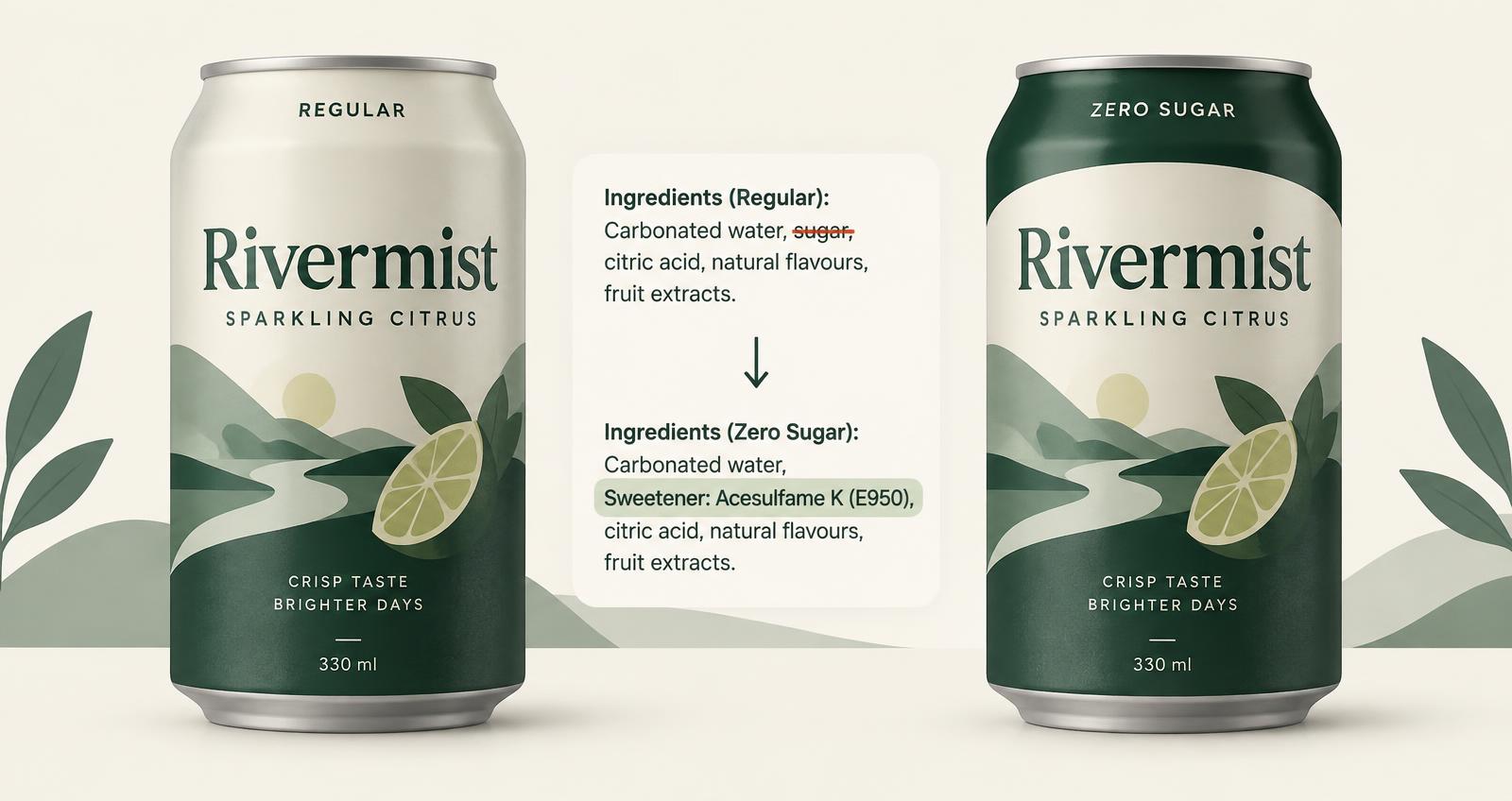
There is no single answer. Different sugar-free products use different formulations. Some use acesulfame K, aspartame, sucralose, other authorised sweeteners, or combinations of several. So the words ZERO SUGAR on the front of the pack don't tell you exactly how the sweetness was created. For that, you need the ingredients list.
In this article we're looking at one common example: acesulfame K, or E950.
ZERO SUGAR on the front
Ingredients on the back
One or several sweeteners
Same claim. Different ingredients.
Acesulfame K is a non-nutritive sweetener. Its European food-additive number is E950. EFSA describes it as an additive that provides sweetness without adding calories or nutritional value, and it is authorised for specified food uses in the EU.
On an ingredients list you may see Sweetener: acesulfame K or Sweetener: E950. They identify the same additive. The E number is simply an identifier, not a danger score. More on that in what E numbers are.
E950
Acesulfame K
Sweetener
Sweetness, not nutrition
Because manufacturers can create sweetness without needing the same amount of sugar. In a soft drink, replacing sugar with intense sweeteners can greatly reduce sugars and energy. That is a real nutritional difference.
But it doesn't automatically change everything else. A zero-sugar drink may still have little or no fibre or protein, limited micronutrients, other additives and a highly formulated ingredients list. So there are really two different questions:
Is the sugar content lower? It may be dramatically lower.
Is the whole product automatically healthy? That doesn't follow from the sugar claim alone.
What changes
Sugar ↓ Energy ↓
The figures a sweetener swap is designed to move.
What doesn't
Protein, fibre, ingredients
The wider nutrition still has to be read separately.
EFSA published a major re-evaluation of acesulfame K on 30 April 2025. It looked at laboratory studies, toxicological animal studies, human intervention studies and epidemiological studies, weighed together using a weight-of-evidence approach.
EFSA set a new Acceptable Daily Intake of 15 mg per kilogram of body weight per day. The highest estimated exposure for European consumers was generally below that ADI across the population groups assessed, which EFSA concluded indicated no safety concern at the assessed exposure levels.
ADI
15 mg/kg/day
Estimated EU exposure
Generally below the ADI
Conclusion
No safety concern at assessed exposure
EFSA, April 2025
Before the 2025 re-evaluation, the European ADI for acesulfame K was 9 mg/kg body weight per day. The new assessment replaced it with 15 mg/kg. That doesn't mean anyone is being encouraged to consume more E950. An ADI isn't a nutritional target; it's a long-term safety benchmark, and the change reflects EFSA's updated assessment of the evidence.
Previous ADI: 9 mg/kg/day
2025 reassessment
Current ADI: 15 mg/kg/day
A safety benchmark, not an intake target.
ADI stands for Acceptable Daily Intake. EFSA defines it as an estimate of the amount of a substance that can be consumed daily over a lifetime without an appreciable health risk. For E950 that's 15 mg/kg body weight a day, so the figure scales with body weight.
It isn't the amount you should consume every day, and it isn't a cliff edge where one extra milligram suddenly becomes dangerous. It's a risk-assessment tool used to compare estimated long-term exposure against a safety level.
An ADI is a long-term safety benchmark, not a recommended intake.
Not quite. EFSA based the new ADI on a no observed adverse effect level(NOAEL) of 1,500 mg/kg body weight per day from a two-year study in rats, the highest dose tested in that study, and then considered it alongside the wider evidence. So the move from 9 to 15 mg/kg/day doesn't mean the ingredient changed. The scientific assessment did.
Updated evidence
Toxicological reference point
Uncertainty factors
ADI 15 mg/kg/day
Yes. In September 2026, EFSA completed its re-evaluation of E962, the salt of aspartame-acesulfame, which separates into its components, including acesulfame, once consumed. EFSA reported no safety concerns for the currently reported uses and use levels of E950, E951 or E962. So the E950 benchmark set in 2025 stands.
No, and the distinction matters. A food-safety assessment asks whether exposure to an additive raises a toxicological concern. A nutrition assessment asks whether the food provides useful nutrition. Those aren't interchangeable.
A zero-sugar drink with E950 could sit well within safety limits while giving you very little nutritionally. Likewise, a food with no sweeteners at all can still be high in sugar, salt or saturated fat. Safe doesn't mean nutritious, and natural doesn't automatically mean better.
Food safety
Exposure and ADI
Is the amount people eat within a safe long-term level?
Nutrition
The whole product
Does this food give you anything useful?
Different questions.
Sometimes, for the specific thing you're comparing. On sugar, a zero-sugar version can contain dramatically less. On energy, it may contain substantially less too. Those are meaningful differences.
But "better" needs context. If one drink has 35g of sugar and another has essentially none, the sugar difference is obvious. It still doesn't tell you which is more nutritious overall, whether either provides useful nutrients, how often you drink it or what else is in it. A claim can be useful without telling you the whole story.
| Regular drink | Zero-sugar drink | |
|---|---|---|
| Sugar | Substantial | Virtually none |
| Energy | Higher | Lower |
| Sweeteners | None | e.g. E950 |
| Protein | Little or none | Little or none |
| Fibre | Little or none | Little or none |
| Ingredients | Read the label | Read the label |
In the EU the regulated claim is generally "sugars-free", and a food can only make it when it contains no more than 0.5g of sugars per 100g or 100ml. So a qualifying product can technically contain a very small amount of sugar. Marketing wording looks simple; the legal definitions behind it are more precise.
That's a different claim. A product labelled no added sugar can't contain added mono- or disaccharides or any other food used for its sweetening properties, but it may still contain naturally occurring sugars. Where it does, the label should also say contains naturally occurring sugars. It may also use an authorised sweetener where the rules allow.
Sugars-free
≤ 0.5g per 100g/ml
EU nutrition-claim threshold.
No added sugar
Nothing added to sweeten
Natural sugars may still be present.
With sweeteners
Sweetness from additives
Declared near the name of the food.
Different claims. Different meanings.
Additive labelling in Ireland follows EU rules. An additive is generally identified by its functional class followed by its specific name or E number, so you might see Sweetener: acesulfame K or Sweetener: E950.
Foods with authorised sweeteners must also generally carry with sweetener(s) near the name of the food, or with sugar(s) and sweetener(s) when they contain both. So you can often tell a lot about the recipe before you reach the nutrition table. See how to read an ingredients list.
Read enough zero-sugar drink labels and you'll notice E950 often doesn't appear alone. You might see acesulfame K + aspartame, or another combination, used to get a particular sweetness profile. But they stay separate substances, each with its own identity, properties, safety assessment and conditions of use. Being listed together doesn't turn them into one ingredient.
Sweeteners: acesulfame K, aspartame
E950
E951
Listed together, assessed separately.
No. Acesulfame K is E950, with a current EFSA ADI of 15 mg/kg body weight a day. Aspartame is E951, with an ADI of 40 mg/kg. Aspartame is a source of phenylalanine, so products containing it carry information for people with PKU; acesulfame K doesn't have that requirement. Both are sweeteners, but they aren't the same substance. Read more in aspartame (E951) and the evidence.
Sucralose is E955, and its ADI is also 15 mg/kg body weight a day. The numbers happen to match, but that doesn't make the two interchangeable. EFSA assesses each additive on its own; its 2026 sucralose review raised a specific uncertainty about prolonged high-temperature processing, which isn't the central issue for E950. See sucralose (E955) and EFSA's 2026 review.
E950
Acesulfame K
ADI 15 mg/kg/day. Reassessed April 2025.
E955
Sucralose
ADI 15 mg/kg/day. Reassessed February 2026.
Same numerical ADI. Different additives.
A safety assessment doesn't have to answer every possible question. EFSA flagged an impurity called 5-chloro-acesulfame, noting the lack of experimental genotoxicity data for it, and recommended either a maximum limit of 0.1 mg/kg in E950 or suitable genotoxicity data. It also recommended a maximum limit for acetylacetamide and lower specification limits for lead and mercury.
Importantly, EFSA said these uncertainties did not affect its overall safety conclusion.
Overall assessment
No safety concern
At estimated exposure levels.
Recommendations
Tighter specifications
For certain impurities, lead and mercury.
No. EFSA was talking about regulatory specification limits. It noted that the permitted maximums for lead and mercury in the EU specifications were higher than the levels actually reported in commercial samples, and recommended tightening them. That's not the same as finding that ordinary products with E950 expose people to dangerous levels.
Regulatory maximum
Commercial samples measured lower
Recommendation to tighten
Researchers keep studying non-sugar sweeteners in relation to body weight, appetite, glucose regulation, metabolic health and the gut microbiome. Findings vary with the sweetener, dose, duration, population, study design and what the comparison group consumed, so one observational link or short experiment can't settle long-term questions.
EFSA's 2025 assessment weighed human evidence alongside animal and laboratory data. Its conclusion at the assessed exposure levels remained no safety concern. That's the current European position; it doesn't mean research has stopped.
Individual study
Multiple study types
Weight of evidence
EFSA assessment
This is another place where two questions get mixed up. In 2023 WHO recommended that people not rely on non-sugar sweeteners as a long-term way to control body weight or reduce the risk of non-communicable diseases. That was a nutrition guideline, not a finding that authorised sweeteners like E950 are toxic within their ADIs.
So both can be true: EFSA finds no safety concern at estimated E950 exposure, and WHO doesn't recommend relying on sweeteners for long-term weight control. They're answering different questions.
EFSA
Toxicological safety
Is exposure within a safe level?
WHO guidance
Long-term diet strategy
Should you rely on sweeteners for weight control?
Different questions.
"Natural" isn't enough information to answer that. Sugar in whole fruit comes with fibre, water, vitamins, minerals and plant compounds. Added sugar in a soft drink doesn't. Comparing an apple with a zero-sugar fizzy drink only on whether either contains a sweetener misses most of what matters. And swapping the sugar in a drink for E950 lowers its sugar without turning it into fruit. The whole food matters.
It depends on what you're trying to achieve. If you're asking which of two otherwise similar drinks has less sugar, the sugar-free one is likely the obvious answer. If you're asking which drink gives you the most nutrition, you may need to compare completely different products. And if you're having a lot of sweet products every day, switching the sweetener may not answer the bigger question.
Sugar-free is useful information. It just isn't a complete food philosophy.
Want less sugar?
Compare the sugar figures
Sugar-free versions usually win this one.
Want better nutrition?
Compare the whole product
That may mean a different product altogether.
Turn the pack around and look at the ingredients.
If you see E950, that's acesulfame K.
Did the alternative genuinely reduce it?
Lower sugar can also change total energy, depending on the product.
Protein, fibre, saturated fat and salt still matter where relevant.
Don't let one ingredient, present or absent, be the final verdict.
You shouldn't need to memorise codes to read a label. When you see E950, Sláinte identifies it as acesulfame K, a sweetener, and shows it alongside the product's wider nutrition and ingredients, so one E number isn't treated as the whole story.
For the wider topic, see artificial sweeteners explained. For the other sweeteners, read about aspartame (E951) and sucralose (E955). For additives more broadly, there's 10 common food additives on Irish labels.
A sugar-free version can contain substantially less sugar and sometimes less energy than a comparable sugar-sweetened product. That doesn't automatically make the entire product nutritionally better. The rest of its nutrition, ingredients and how it fits into the diet still matter.
Acesulfame K is a non-nutritive sweetener authorised in the EU as food additive E950.
EFSA's 2025 re-evaluation established an ADI of 15 mg/kg body weight per day. Estimated EU exposure was generally below this level across the populations assessed, indicating no safety concern at the assessed exposure levels.
E950 is the European food-additive number for acesulfame K.
The current EFSA Acceptable Daily Intake is 15 mg per kilogram of body weight per day.
EFSA's 2025 re-evaluation replaced the previous European ADI of 9 mg/kg/day with 15 mg/kg/day after reviewing the available evidence and updating its toxicological assessment.
Under EU rules, a food can make a sugars-free claim when it contains no more than 0.5g of sugars per 100g or 100ml.
No. E950 is acesulfame K, E951 is aspartame and E955 is sucralose. They are separate additives and are assessed individually.
Is sugar-free really better?
Less sugar? Often.
Automatically nutritious? No.
E950 = Acesulfame K
ADI 15 mg/kg/day
Read beyond the front of the pack.