
Natural food
Naturally occurring glutamate
Tomatoes, soy sauce and mature cheese. No E number on the label.
Published · Updated · Sláinte Editorial
E621. Monosodium glutamate. Flavour enhancer.
MSG has a reputation. For years, monosodium glutamate has been blamed for everything from headaches to feeling flushed after eating. At the same time, glutamate itself occurs naturally in foods such as tomatoes, soy sauce and certain cheeses.
So is MSG something to avoid, or has its reputation drifted away from the evidence? The answer is more useful than either extreme. MSG, or E621, is an authorised flavour enhancer. EFSA has established a group Acceptable Daily Intake for glutamates, but it has also identified situations where estimated exposure can exceed that level.
Here's what that actually means when you're reading a food label.
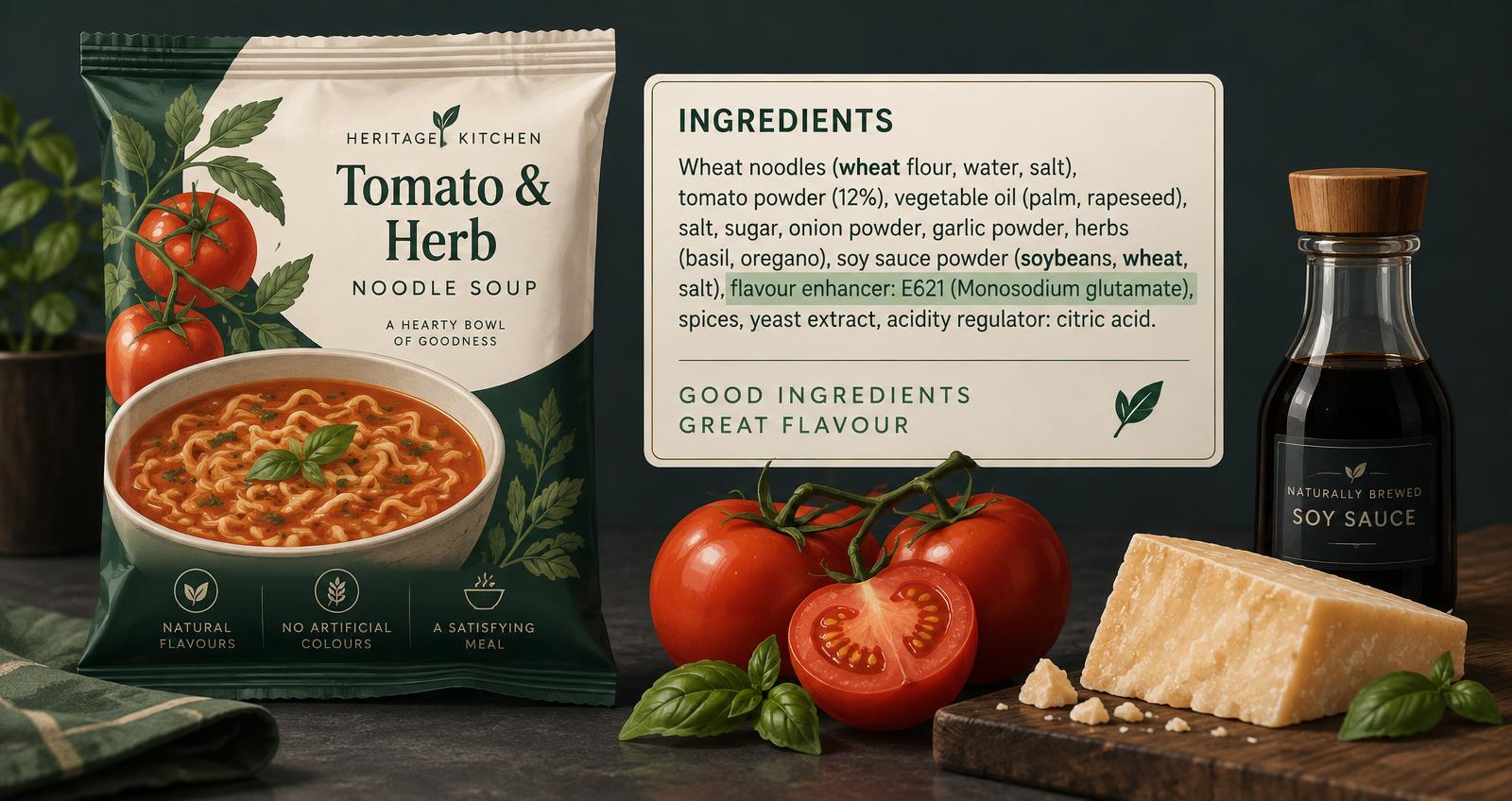
MSG stands for monosodium glutamate. Its European food-additive number is E621. It is the sodium salt of glutamic acid, an amino acid and a normal component of proteins. Glutamic acid is also naturally present in foods, and EFSA gives tomatoes, soy sauce and certain cheeses as examples.
MSG is added to food because it can enhance savoury flavour. On an Irish ingredients list you may see Flavour enhancer: monosodium glutamate or Flavour enhancer: E621. If the numbers are new to you, start with what E numbers are.
E621
Monosodium glutamate
Flavour enhancer
Tomatoes, soy sauce and cheese contain glutamate naturally, without any E number.
MSG is used as a flavour enhancer. It doesn't necessarily create a new flavour. It strengthens the savoury character a food already has. EFSA describes glutamates as being added to provide or enhance a savoury or meaty taste, the taste commonly called umami.
You'll often find flavour enhancers in highly seasoned foods such as:
That doesn't mean every product in those categories contains MSG. The ingredients list tells you whether a specific product does.
They are closely connected, but the label treats them differently. Glutamate occurs naturally in food. MSG is monosodium glutamate deliberately added as an ingredient.
Glutamic acid in tomatoes or cheese doesn't appear on the label as E621. When monosodium glutamate is added to enhance flavour, it has to be declared as an additive. So seeing E621 doesn't mean glutamate only exists in manufactured food. It means MSG was deliberately used in that product.
Natural food
Naturally occurring glutamate
Tomatoes, soy sauce and mature cheese. No E number on the label.
Food formulation
Added MSG / E621
Declared on the ingredients list as a flavour enhancer.
Both end up as glutamate. Only one is declared as an additive.
Yes, for authorised uses. E621 appears on the EU list of permitted food additives, and food sold in Ireland follows the European food-additive framework. The specific conditions of use depend on the type of food.
So an E number isn't a code a manufacturer invents. It identifies an additive inside the EU authorisation system. For other numbers you'll meet on the same labels, see 10 common food additives.
EU authorised additive
Permitted conditions of use
Irish food label
There isn't good reason to treat every amount of MSG in food as automatically harmful. But it would also be wrong to say there's no intake level worth thinking about.
EFSA re-evaluated glutamic acid and glutamates used as food additives and set a group Acceptable Daily Intake covering E620 to E625, which includes MSG. The ADI is 30 mg per kilogram of body weight per day. EFSA considered this level protective of consumer health. Its exposure assessment also found that some people, particularly those eating a lot of foods with added glutamates, could exceed it.
The evidence supports neither "any MSG is dangerous" nor "quantity never matters". Exposure matters.
ADI means Acceptable Daily Intake: an estimate of the amount of a substance that can be consumed daily over a lifetime without an appreciable health risk. For glutamates, EFSA set 30 mg/kg body weight/day, expressed as glutamic acid.
It's a group ADI because it covers several related additives:
It isn't a target you need to reach. It's a long-term risk-assessment benchmark.
E620 to E625
Group ADI
30 mg/kg/day
EFSA's exposure modelling said they can. In its 2017 assessment, EFSA estimated that intake of glutamates used as additives could exceed the group ADI in people whose diets are high in foods with added glutamates, in toddlers and children at some estimated exposure levels, and in other highly exposed groups.
That was enough for EFSA to recommend reviewing permitted levels in:
"Authorised additive" and "unlimited intake doesn't matter" are not the same thing.
As of 5 October 2026, the 2017 group ADI is still the published EFSA benchmark for glutamates. EFSA has kept gathering updated analytical and use-level data for E620 to E625, and its latest public data call, which included MSG, asked for submissions by 30 June 2026.
So the area is still being followed. That alone doesn't mean EFSA has reversed its earlier conclusion. Until a completed updated assessment says otherwise, the published group ADI is the relevant reference point.
2017 EFSA re-evaluation
Group ADI 30 mg/kg/day
2024–2026 follow-up data
The assessment continues to be updated.
This is where the evidence gets more complicated. Some human challenge studies have reported symptoms after relatively large doses of MSG, including headache, flushing, tingling or numbness, muscle tightness and weakness.
EFSA considered this human evidence and deliberately set the group ADI below doses linked to effects such as headache, raised blood pressure and raised insulin levels. That doesn't mean every headache after a meal containing MSG was caused by E621.
The evidence is inconsistent. A systematic review of human studies found an important difference between MSG eaten with food and relatively high concentrations taken in liquids without food.
When MSG was eaten with food, most studies found no significant increase in headaches. Some studies using concentrated MSG without food did report more. The review also pointed to small study sizes, inconsistent results, unusually high doses and the difficulty of blinding strong MSG solutions, which taste distinctive.
The authors concluded the evidence wasn't strong enough to show that ordinary MSG consumption causes headaches. That's more accurate than "MSG causes headaches", and more accurate than "nobody can ever react to MSG".
With food
No clear effect in most studies
Results were inconsistent and mostly showed no significant rise in headaches.
Concentrated, without food
Symptoms in some studies
High doses in liquid on an empty stomach, often hard to blind.
Study conditions matter.
Possibly. In controlled studies, some people who described themselves as MSG-sensitive reported symptoms after large doses, especially without food. Those responses weren't always consistent or repeatable.
So individual reports shouldn't be brushed aside, and they also can't be applied to everyone who eats MSG. If you keep noticing the same symptom after a particular food, look at the whole product and the circumstances rather than assuming E621 is the cause.
MSG is not one of the 14 allergens that must be emphasised under EU food-information rules, such as milk, eggs, peanuts, nuts, gluten-containing cereals and soybeans.
That doesn't mean nobody ever reports symptoms after eating it. It means MSG sits outside the mandatory allergen-labelling system. An adverse reaction and a legally defined allergen aren't automatically the same thing.
E621
Flavour enhancer
Listed by name or number in the ingredients.
EU mandatory allergens
Separate labelling category
The 14 allergens are emphasised, usually in bold.
Not necessarily. Picture two sauces. Sauce A contains E621 and is lower in salt and sugar. Sauce B has no E621 but more salt and more sugar. Which is better? You can't tell by looking for MSG alone.
Removing one additive doesn't improve everything else about a product, and the presence of E621 doesn't cancel out everything else either.
No MSG is not a complete nutrition score.
It tells you something true about the recipe. But like "zero sugar", "high protein" or "no preservatives", it describes one thing. It doesn't tell you:
Front-of-pack claims are useful. The mistake is treating one claim as the whole product. Our guide to reading an ingredients list covers the back of the pack.
E621 = monosodium glutamate.
It's a flavour enhancer.
The number just identifies the additive.
EFSA has set a group ADI for glutamates.
Salt, saturated fat, energy, fibre and protein, where relevant.
Two soups or sauces? Compare the whole label, not just which says No MSG.
Nobody should have to remember what every additive number means. If a product contains E621, Sláinte names it as monosodium glutamate, a flavour enhancer, and shows it alongside the product's nutrition and full ingredient list. That keeps E621 in context instead of turning it into the whole verdict.
MSG stands for monosodium glutamate. It is a flavour enhancer authorised as food additive E621 in the European Union.
E621 is the European food-additive number for monosodium glutamate.
The evidence does not support treating every dietary exposure to MSG as inherently harmful. EFSA has established a group ADI of 30 mg/kg body weight per day for glutamic acid and glutamates used as additives, including E621. EFSA has also found that some higher-exposure groups may exceed that level.
Some high-dose studies have reported headaches and other symptoms, particularly when large amounts of MSG were consumed without food. Human study results are inconsistent, and systematic review evidence has not established a clear causal relationship between ordinary MSG consumption with food and headache.
EFSA established a group ADI of 30 mg/kg body weight per day, expressed as glutamic acid, covering glutamic acid and glutamates E620 to E625.
Yes. EFSA notes that glutamic acid occurs naturally in foods including tomatoes, soy sauce and certain cheeses.
MSG is not one of the 14 allergens subject to mandatory emphasis under EU food-information rules.
No. That claim tells you something about one ingredient. Sugar, salt, saturated fat, fibre, protein, energy and the rest of the formulation still need to be considered.
Last reviewed: 5 October 2026