
Preservative
Against microorganisms
Example on a label: Preservative: E250.
Published · Updated · Sláinte Editorial
Preservative: E250. Preservative: E202. Preservative: sodium benzoate.
Turn over a packaged food and you've probably seen something similar. For some people, the word preservative immediately sounds negative. But preservation itself isn't unusual. Humans have been trying to stop food spoiling for thousands of years through drying, salting, fermenting, cooling and smoking.
Modern food preservatives are another way of helping protect certain foods. But they're not all the same. So what exactly is a preservative, why is it added, and should its presence change how you judge a product?
Under EU food-additive rules, preservatives are substances that help prolong the shelf life of foods by protecting them against deterioration caused by microorganisms, such as certain bacteria, yeasts and moulds.
Help keep food from spoiling or becoming unsafe as quickly.
But there isn't one substance called "preservative". Preservative describes a function. Different preservatives are different substances with different permitted uses.
Microorganisms
Preservative
Slower spoilage
Food changes over time. Microorganisms can grow, flavour can deteriorate and texture can change. Some microorganisms can present a food-safety risk. Depending on the food, manufacturers can use refrigeration, freezing, drying, heating, fermentation, salt, acidity or authorised preservatives. Often several hurdles work together rather than one method doing everything.
Preservation isn't automatically unnecessary processing.
For some foods, controlling microbial growth is an important part of keeping them safe and stable.

You'll see both words on ingredient labels. They're separate functional categories.
Preservative
Against microorganisms
Example on a label: Preservative: E250.
Antioxidant
Against oxidation
Such as fat turning rancid or colours changing. Example: Antioxidant: E300.
Food additives used as ingredients must generally be listed by their functional class followed by their specific name or E number. For example, Preservative: sodium nitrite or Preservative: E250.
The label tells you two things. Preservative tells you what the ingredient is doing. E250 tells you which additive it is. Once you understand that system, a long ingredients list becomes much easier to decode.
Sodium nitrite is one of the preservatives people most commonly hear about. It's authorised for specified uses including certain cured meat products.
Importantly, it can help inhibit the growth of Clostridium botulinum, the bacterium associated with botulism. It also contributes to the characteristic colour and flavour of cured meat and can help reduce deterioration during storage. So sodium nitrite isn't present simply to make an ingredient list longer. It has a genuine technological and food-safety function.
Because there is another side to the chemistry. Nitrite can be involved in the formation of compounds called nitrosamines, and some nitrosamines are carcinogenic. That's why nitrite and nitrate use isn't treated casually. Their permitted uses and levels are regulated.
EFSA's assessment of nitrites and nitrates added to food concluded that exposure from their authorised use as food additives was generally within established safe levels, while also identifying uncertainties and the need to consider other dietary sources. EU conditions governing their use have also been revised over time.
So the accurate conclusion isn't "nitrites are harmless". Nor is it "any food containing E250 is dangerous". Nitrites have useful preservation functions and potential risks that are managed through restrictions, exposure assessment and regulation.
Benefit
Microbial control
Controlled use and regulation
Concern
Nitrosamine formation
Botulism is rare but potentially very serious. It's caused by toxins produced by Clostridium botulinum. In certain cured meat systems, nitrite works alongside other factors such as salt and acidity to inhibit the growth of the organism.
That's why simply asking "can we remove this additive?" isn't always enough. The next question has to be: what function was it performing, and how will that function be replaced safely? Food formulation involves trade-offs.
Nitrite + salt + pH + processing
Control of C. botulinum
In cured meat, several hurdles work together.
You'll also encounter E251: sodium nitrate and E252: potassium nitrate. Nitrates and nitrites are related but not identical. Nitrate can be converted into nitrite, which then performs important functions during curing. Their authorised uses depend on the type of food and applicable conditions.
This is another reason not to assume all preservatives work in exactly the same way. They don't.
Nitrate (E251, E252)
Nitrite (E249, E250)
Curing role
Potassium sorbate belongs to the sorbate group of food additives and is authorised in the EU for specified food uses and conditions. Seeing E202 tells you something about how the product has been formulated. It does not, by itself, tell you whether the entire product has a good or poor nutritional profile. You still need the rest of the label.
E211 belongs to the benzoate group of authorised additives. The useful approach isn't "E211 = bad". It's "E211 identifies sodium benzoate, which is being used here for a permitted technological purpose". Then continue reading. What is the product? What else is in it? What does the nutrition table say? How often are you consuming it?
One additive shouldn't replace the rest of the analysis.
Sulphur dioxide and sulphites are particularly interesting because they also interact with allergen labelling rules. The group includes E220: sulphur dioxide, E221: sodium sulphite, E223: sodium metabisulphite and others.
When sulphur dioxide or sulphites are present above 10 mg/kg or 10 mg/litre expressed as SO₂, they must be declared in accordance with allergen-information requirements. Hiding them behind an E number isn't enough; their presence must be made clear. That matters for people who are sensitive to sulphites.
Not necessarily. It tells you the product isn't using preservatives in the way covered by that claim. It doesn't tell you about sugar, salt, saturated fat, fibre, protein, calories or the rest of the ingredients.
Product A: no preservatives
Product B: contains a preservative
Which one is healthier? "No preservatives" isn't enough to answer.
Because foods are different. A dry product may naturally make microbial growth difficult. A frozen product relies on low temperature. A canned food can be made shelf-stable through heat treatment and packaging. A fermented food may rely partly on acidity. Other foods may use preservatives. Composition, manufacturing, packaging and storage all matter.
No. Foods can last longer because of drying, freezing, fermentation, heat treatment, packaging, salt, acidity or preservatives. Processing classification and shelf life overlap in some cases, but they aren't the same thing, and one preservative is not enough on its own to tell you the degree of processing. Read more in our guide to ultra-processed foods.
Food preservatives authorised in the EU fall under the EU food-additive safety and authorisation system. An additive can only be used where it is authorised and subject to specified conditions of use. Safety assessments consider the evidence for the individual substance and expected exposure.
That's more accurate than saying "all preservatives are safe", and more accurate than "preservatives are toxic". The relevant unit of assessment is the individual additive, its use and exposure.
Natural and artificial can become shortcuts for good and bad. Food science isn't that simple. Salt has been used for preservation for centuries, but adding more salt to everything wouldn't improve its nutritional profile. Likewise, an E number doesn't automatically make an additive harmful.
The better questions are: what is the substance, why is it being used, how much is permitted, and what does the rest of the product look like?
Knowing a product contains E202 tells you potassium sorbate is present. It doesn't tell you how much sugar or salt it contains, how much fibre or protein it provides, what the main ingredients are, or what portion you'll eat.
One ingredient is information. It isn't the entire product.
Sláinte doesn't apply one blanket judgement to every food containing a preservative. Our food methodology looks at three wider areas, so a preservative can be identified, explained and considered without pretending it determines the entire score.
55%
Sugar, salt, saturated fat, protein and fibre.
30%
Individual ingredients and recognised additives, including preservatives.
15%
Processing signals and how complete the product information is.
Part of the sorbate group, authorised for specified uses.
Part of the benzoate group, authorised for specified uses.
Used in certain cured meats, including to help inhibit C. botulinum.
Part of the sulphites group, with special allergen labelling rules.
Different substances, different uses. Recognising the number is only the first step.
Which preservative is it?
What function is it serving?
A preservative doesn't tell you the entire nutritional profile.
Look at sugar, saturated fat, salt, fibre, protein and energy in context.
Could another product meet what you're looking for with a different overall formulation?
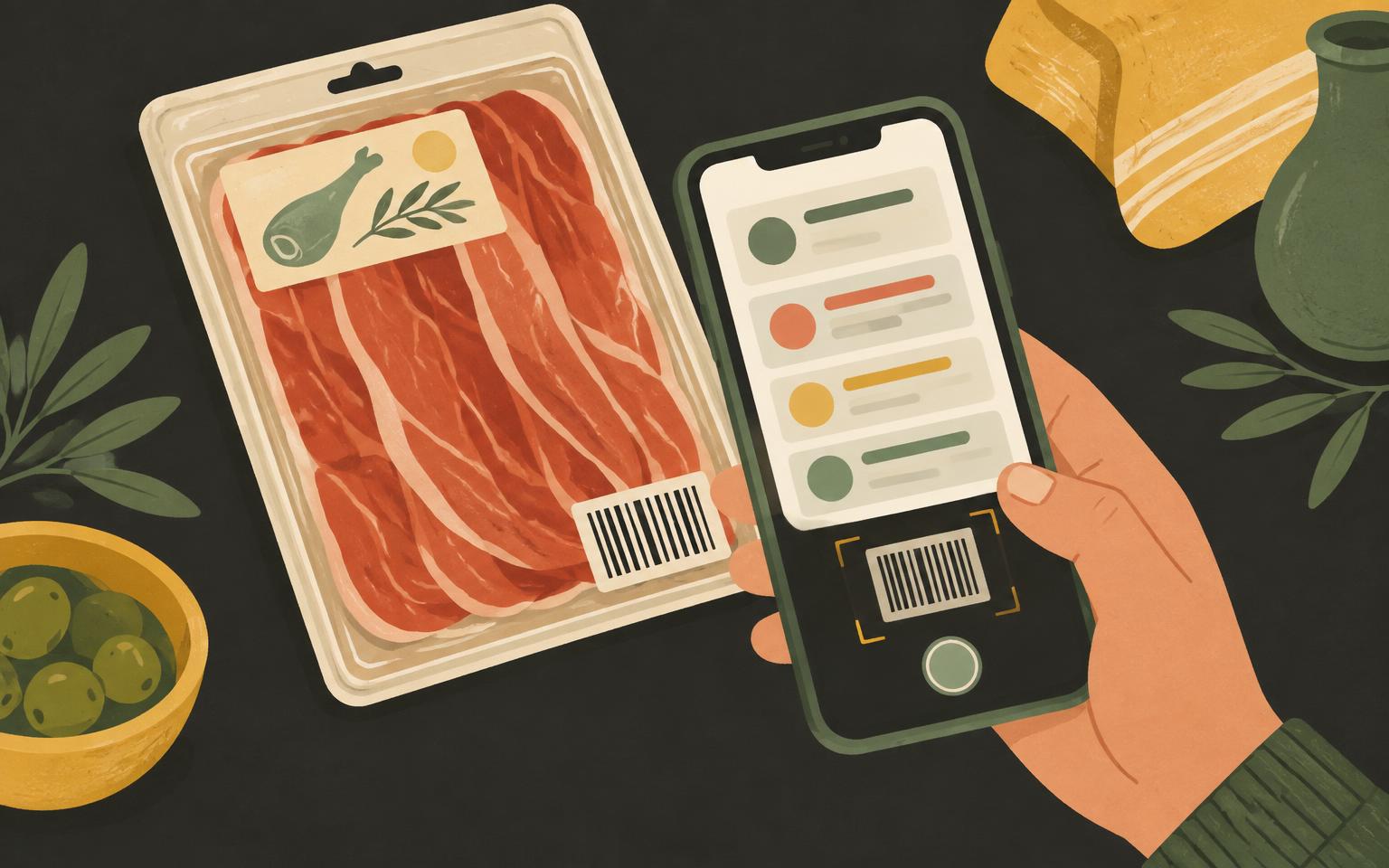
Nobody needs to memorise E202, E211, E220, E250 and hundreds of other additive numbers. Scan the barcode and Sláinte can identify a preservative and show it alongside the product's nutrition, ingredients, additives, processing information and overall Sláinte Score. The point isn't to make preservatives frightening. It's to make the ingredient list understandable.
A food preservative is an additive used to prolong the shelf life of food by protecting it against deterioration caused by microorganisms.
"Preservatives" is a broad functional category containing different substances. EU-authorised preservatives are assessed and subject to specified conditions of use. The presence of a preservative alone doesn't determine the nutritional quality of the entire food.
E250 is sodium nitrite. It is authorised for specified food uses, including certain cured meat products, and plays an important role in inhibiting microorganisms including Clostridium botulinum under appropriate curing conditions.
E202 is potassium sorbate, an authorised food additive used as a preservative under specified conditions.
E211 is sodium benzoate, an authorised food additive used as a preservative under specified conditions.
Sulphites are a group of substances that can perform preservative functions. When sulphur dioxide and sulphites exceed the specified threshold in food, special allergen declaration requirements apply.
Not automatically. A preservative-free claim tells you about the presence or use of preservatives, not the overall nutritional composition of the food.
No. Preservatives protect against deterioration caused by microorganisms, while antioxidants protect against oxidation. Both can help extend shelf life but perform different functions.