
Rapeseed
Higher in monounsaturated fat; included in Irish healthy-eating guidance.
Published · Updated · Sláinte Editorial
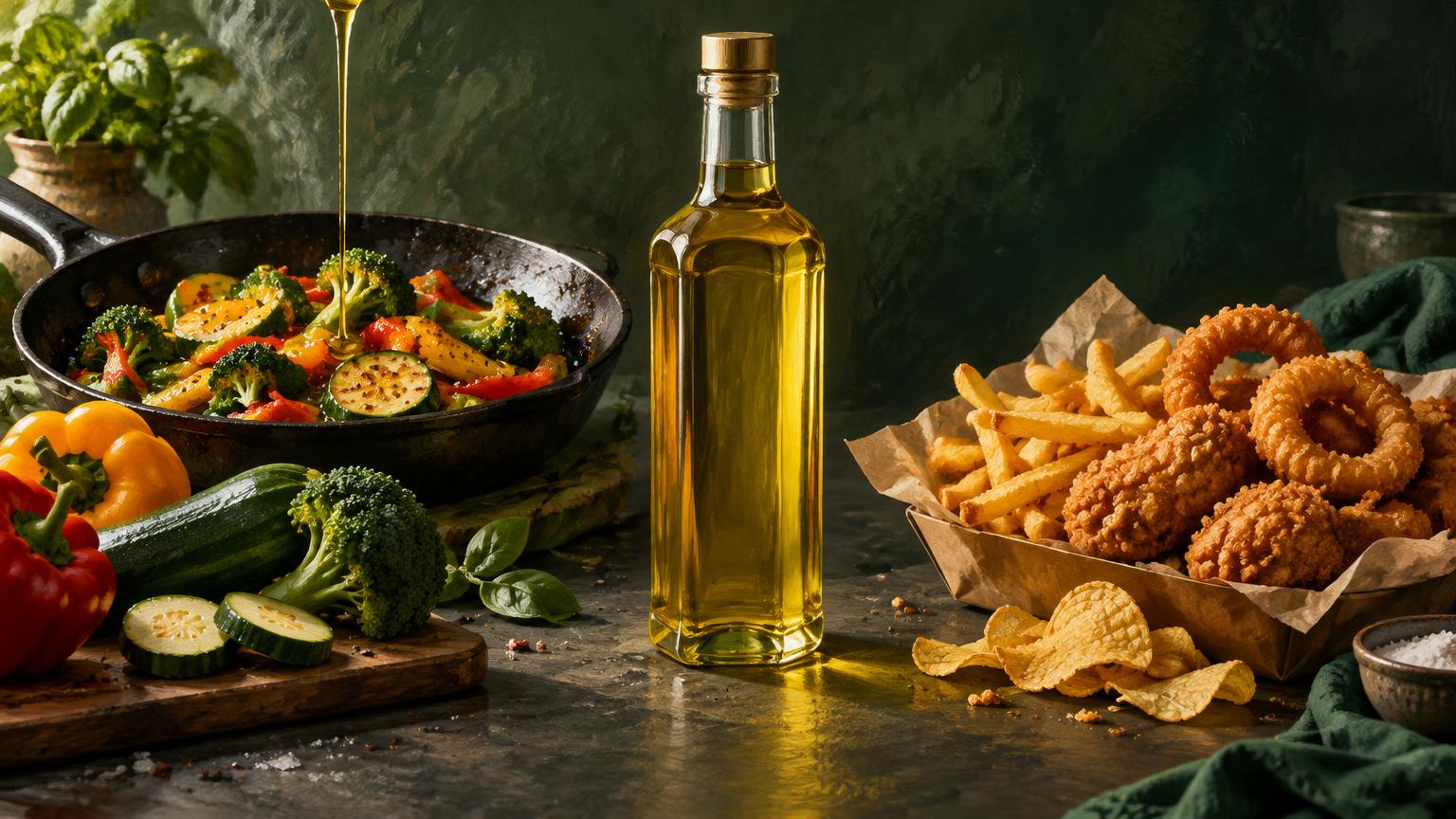
Same ingredient category. Very different food context.
Seed oils have somehow become one of the most controversial ingredients in food. Sunflower oil. Rapeseed oil. Soybean oil. Corn oil.
You will hear that they are inflammatory, toxic, destroying our metabolism, or even the real reason ultra-processed food is unhealthy. That is a much stronger claim than the human evidence currently supports.
It also misses an obvious problem. Seed oils are found in everything from a spoonful of rapeseed oil used to cook vegetables to crisps, biscuits, deep-fried takeaway food and heavily formulated snacks. Those foods are not nutritionally identical just because some contain oil from a seed.
So the useful question is not “Seed oil: good or bad?” It is: which oil, how is it being used, what is it replacing and what does the rest of the food look like?
“Seed oils” is a convenient internet term. It is not one single nutritional ingredient.
Common examples include oils produced from:
Different oils contain different proportions of monounsaturated fat, polyunsaturated fat, saturated fat, omega-6 fatty acids and omega-3 fatty acids.
Even two sunflower oils may differ because high-oleic sunflower oil has a different fatty-acid profile from conventional sunflower oil.
Putting every oil made from a seed into one nutritional category already loses useful information.
Higher in monounsaturated fat; included in Irish healthy-eating guidance.
Conventional versions are richer in omega-6; high-oleic versions differ.
Contains both omega-6 and some omega-3.
Rich in omega-6 polyunsaturated fat.
Among the highest in linoleic acid.
Distinctive flavour; a different fatty-acid mix again.
Seed oils are not one oil.
Most of the argument centres on omega-6 fat.
Many seed oils contain substantial amounts of an omega-6 polyunsaturated fatty acid called linoleic acid.
Linoleic acid is not a toxin. It is an essential fatty acid, meaning the human body cannot make enough of it and it must come from the diet. Irish healthy-eating guidance recognises linoleic acid as one of the essential fatty acids.
The controversy comes from what happens after linoleic acid enters the body. Some of it can ultimately contribute to pathways involving arachidonic acid and signalling molecules associated with inflammation.
That biochemical pathway is real. The leap is assuming that eating more linoleic acid therefore causes chronic inflammation in humans. That question has to be tested in people.
This is one of the most repeated seed-oil claims. Human intervention evidence does not support the simple version of it.
A systematic review of 15 randomised controlled trials found virtually no evidence that increasing dietary linoleic acid increased commonly measured inflammatory markers in healthy people.
A later systematic review and meta-analysis included 30 randomised trials involving 1,377 participants. It found no significant overall increase in major inflammatory markers including CRP, TNF and IL-6 when linoleic acid intake increased.
That does not prove that every quantity of every omega-6-rich oil in every situation is ideal. It does mean the common statement — “omega-6 seed oils cause inflammation” — is far too confident.
Claim vs evidence
The claim
More omega-6 automatically increases inflammation.
Human trial evidence
No consistent overall increase in common inflammatory markers.
Parts of the pathway can be. But human metabolism is not a single-arrow diagram.
The body tightly regulates fatty-acid metabolism, and consuming more linoleic acid does not simply translate into a proportional increase in chronic systemic inflammation.
This is a recurring problem in online nutrition arguments: a plausible biochemical mechanism is treated as if it already proves a real-world health outcome.
Mechanisms matter. Human outcomes matter more.
You will often hear that the modern diet has too much omega-6 relative to omega-3.
There is a useful idea buried inside that argument: many people could benefit from eating more sources of omega-3 fats.
That does not automatically mean the solution is to aggressively remove linoleic acid. The evidence base generally focuses more usefully on whether people are getting enough of the relevant fatty acids and what fats are replacing one another.
Increasing oily fish, nuts, seeds and other omega-3 sources can make sense without treating sunflower oil as a poison.
This is one of the most important pieces of context missing from seed-oil debates. Foods do not exist in a nutritional vacuum. If you remove one fat, something usually replaces it.
WHO's current guidance recommends replacing saturated fat with polyunsaturated fats from plant sources, monounsaturated fats from plant sources, or suitable high-fibre carbohydrate foods rather than treating all fats as equal.
The evidence informing WHO's recommendation found that replacing saturated fat with polyunsaturated fat reduces LDL cholesterol, with WHO describing the recommendation to replace saturated fat with plant-source PUFA as strong. Its evidence review also reports that replacing 5% of energy from saturated fat with linoleic acid was associated with lower coronary heart disease risk in large cohort analyses.
So asking “is sunflower oil healthy?” is often less informative than asking “what is it replacing?” Replacing some butter or lard with an unsaturated plant oil is a different nutritional comparison from adding more oil to an already energy-dense diet.
Ireland's official guidance does not tell people to eliminate seed oils.
Healthy Ireland's Food Pyramid recommends using fats and oils in small amounts and specifically lists rapeseed oil, olive oil, canola oil, sunflower oil and corn oil as options.
The HSE similarly recommends replacing some saturated fats with unsaturated fats and includes rapeseed, olive, canola, sunflower and corn oils among its examples.
That does not mean unlimited oil is recommended. Oils are energy-dense. The Irish guidance is essentially: choose unsaturated fats more often, but use them in modest amounts.
Official Irish guidance
Again, context matters.
WHO recommends replacing saturated fats with unsaturated plant fats in part because of cardiovascular evidence. The American Heart Association likewise supports omega-6 polyunsaturated fats and rejects the blanket idea that seed oils should be avoided because they are inherently inflammatory.
That does not turn a packet of deep-fried crisps into a heart-health food because sunflower oil appears in the ingredients. It means the oil itself should not automatically receive the blame for everything about the food containing it.
This is probably the most useful point in the whole article.
Take sunflower oil. It could appear in homemade stir-fried vegetables, hummus, crisps, biscuits or deep-fried takeaway food. All five examples contain oil. They do not have the same nutritional profile.
If someone finds that people eating lots of ultra-processed fried food have worse health outcomes, that does not automatically prove the seed oil caused the outcome. This is exactly why ingredient-level conclusions need caution.
A small amount of oil used to stir-fry vegetables.
Oil forming part of a food containing chickpeas and other ingredients.
Oil used in an energy-dense salty snack.
Oil combined with refined flour, sugar and other ingredients.
Oil exposed to high frying temperatures and potentially repeated use.
Same oil category. Different food.
This is where the criticism has more legitimate chemistry behind it.
Unsaturated fats can oxidise. Heat accelerates oxidation. During prolonged or repeated high-temperature frying, oils can undergo oxidation, polymerisation, loss of some unsaturated fatty acids and formation of various degradation products.
A recent review of vegetable oils used for frying describes thermoxidation and polymerisation as major degradation pathways and notes that oil composition influences how an oil behaves during frying. A 2026 laboratory study also found substantial compositional changes and oxidation products when seed oils were subjected to prolonged heating at very high temperatures.
That is real. But there is an important distinction between using a fresh oil once to cook dinner and repeatedly heating the same oil at frying temperatures for long periods. Those should not be presented as the same exposure.
The available evidence does not justify telling people that ordinary household use of these oils is inherently toxic. Ireland's own healthy-eating guidance includes rapeseed and sunflower oil as cooking options.
A more sensible rule is:
The internet version — never heat seed oils — is too simplistic.
Yes. Repeated frying is a different question from ordinary cooking.
Research shows that repeated or prolonged high-temperature heating changes vegetable-oil composition and increases oxidation and degradation.
This is one reason a takeaway fryer that has been running oil through repeated heating cycles should not be used as evidence for what happens when you add a teaspoon of rapeseed oil to a pan at home.
Fresh oil → cook → eat
Heat → cool → reheat → prolonged frying → degradation increases
These are not the same exposure.
Oxidation chemistry is real. But the statement “seed oils oxidise inside you and poison your cells” is not a clinically useful description of eating food.
The human body has metabolic pathways, antioxidant systems, repair systems and regulated lipid transport.
Health outcomes need to be assessed using human evidence rather than extrapolated directly from what happens to isolated oil under extreme laboratory heating conditions. That distinction applies to many online nutrition claims.
Many commercial oils are refined. Typical industrial production can involve steps such as crushing, extraction, refining and deodorisation. Some oils are instead cold-pressed or mechanically extracted.
Processing is worth understanding. But processed does not automatically mean harmful.
The relevant questions are what the process changes, what residues remain and what the final evidence says about exposure.
This is one of the more legitimate questions hidden inside the seed-oil debate.
Hexane can be used as an extraction solvent during production of some vegetable oils. In the EU, hexane is authorised for specified extraction uses, including production or fractionation of fats and oils. EU legislation currently sets a maximum residue limit of 1 mg/kg in the extracted fat or oil.
However, the story does not stop there. EFSA concluded in 2024 that the safety of technical hexane as an extraction solvent should be re-evaluated. A formal reassessment is now underway, including work to better understand technical hexane composition, impurities, real food residues, exposure and toxicology. EFSA held a stakeholder meeting on the assessment in March 2026, and the reassessment remains ongoing.
So the responsible wording is not “hexane makes seed oils toxic.” And it is not “hexane is irrelevant and completely settled.” The accurate current position is: hexane is legally controlled as an extraction solvent in the EU, with residue limits, and EFSA is actively re-evaluating its safety. That is worth following.
Some oils
Extraction solvent may be used
Solvent largely removed
EU residue limit
EFSA reassessment underway
Do not confuse refined seed oil with the old process of partial hydrogenation.
Industrially produced trans fats were historically associated heavily with partially hydrogenated oils. They are a separate issue.
Very high-temperature processing and frying can cause some fatty-acid isomerisation, but that does not mean a modern bottle of sunflower or rapeseed oil is equivalent to an old partially hydrogenated shortening.
WHO strongly recommends avoiding industrially produced trans fat and supports replacing saturated and trans fat with healthier unsaturated fats.
We do not have evidence that lets us reduce the entire ultra-processed-food question to seed oils.
Foods high in ultra-processed ingredients may differ in energy density, fibre, salt, sugar, texture, eating rate, protein, food structure, portion size, palatability, additives and overall dietary displacement.
Seed oil can be one component. Calling it the cause goes beyond what the evidence demonstrates.
This is a useful Sláinte example.
If a packet of crisps contains potatoes, sunflower oil, salt, the ingredients list is relatively short. That does not automatically make the crisps nutritionally equivalent to boiled potatoes.
The frying process changes energy density, fat content and water content. Salt also matters.
The useful analysis is therefore not “sunflower oil = bad” but “what has the complete product become?”
This is worth highlighting in Ireland.
Rapeseed oil is one of the cooking oils specifically included in Irish healthy-eating guidance. It is also, literally, an oil produced from a seed.
So when someone says “avoid all seed oils”, they are making a much broader claim than they may realise.
“Seed oil” itself tells you the source. It does not tell you the complete fatty-acid profile, manufacturing process or health effect.
Olive oil has a strong evidence base and can be an excellent choice. That does not mean every other plant oil needs to be banned from the kitchen.
Taste matters. Cooking method matters. Price matters. Availability matters. The food you are cooking matters.
A person using a teaspoon of rapeseed oil to cook vegetables is not creating an obvious health problem that needs to be “fixed” by internet nutrition rules.
This comparison is especially important.
If someone stops using rapeseed oil and replaces it with butter, they have not simply removed a processed oil. They have changed the fatty-acid composition of the diet. Butter contains considerably more saturated fat.
WHO's current guidance supports replacing saturated fat with unsaturated plant fats rather than moving in the opposite direction.
So any advice to remove seed oils needs to answer: what are you replacing them with?
The presence of seed oil alone does not establish that a product is unhealthy.
Check saturated fat, salt, sugars, fibre, protein, energy density, ingredients and portion.
A salad dressing and a deep-fried snack are different foods.
Repeated high-temperature frying deserves different consideration from ordinary cooking.
Human randomised-trial evidence does not support the simple claim that more linoleic acid automatically raises inflammatory markers.
Replacing saturated animal fats with unsaturated plant oils is supported by current cardiovascular guidance.
All oils are energy-dense. Irish guidance recommends using them in small amounts.
Seed oils are exactly the kind of topic where one ingredient can dominate the conversation.
Sláinte should not flag sunflower oil and stop. A useful product explanation asks:
That gives you context instead of another ingredient blacklist.
Current human evidence does not support treating all seed oils as inherently harmful. The type of oil, amount, food context, cooking method and what the oil replaces all matter.
Randomised controlled trials and meta-analysis have not found a consistent overall increase in common inflammatory markers when dietary linoleic acid is increased.
Linoleic acid, an omega-6 fat, is an essential fatty acid. The body needs it from food. The issue cannot be reduced to omega-6 being “bad”.
Yes. Rapeseed oil comes from rapeseed. Irish healthy-eating guidance includes rapeseed oil among recommended unsaturated cooking-oil options used in small amounts.
The evidence does not support classifying sunflower oil as inherently unhealthy simply because it is a seed oil. Its use, amount, heating conditions and the overall food matter.
All oils can degrade with sufficient heat and time. Prolonged or repeated high-temperature heating increases oxidation and other degradation reactions. That is different from claiming ordinary home cooking with seed oils is inherently toxic.
Some vegetable-oil production can use hexane extraction. EU law permits specified uses and currently sets a maximum residue limit of 1 mg/kg in extracted fats and oils. EFSA is also actively re-evaluating technical hexane.
Current WHO guidance supports replacing saturated fats such as those found in butter with unsaturated plant fats rather than the reverse.
An oil can be refined, but NOVA classification applies to foods and formulations more broadly. The presence of a seed oil alone does not settle the classification or the nutritional quality of the finished product.
Last reviewed: 8 October 2026