
E249
Potassium nitrite
A nitrite salt used in curing.
Published · Updated · Sláinte Editorial
E250. Sodium nitrite. Preservative.
Look at the ingredients on bacon, ham or another cured meat and you may find Preservative: Sodium Nitrite or Preservative: E250. That can sound alarming if you only know nitrites from headlines about processed meat.
But sodium nitrite isn't added simply to make meat look pink. It helps control dangerous bacteria, particularly Clostridium botulinum, while also giving cured meat its colour, flavour and shelf life. At the same time, nitrites need careful control because they can contribute to the formation of nitrosamines, some of which are carcinogenic.
So the accurate story isn't "E250 is dangerous", and it isn't "E250 is irrelevant". Dose, processing, exposure and the reason it's being used all matter.
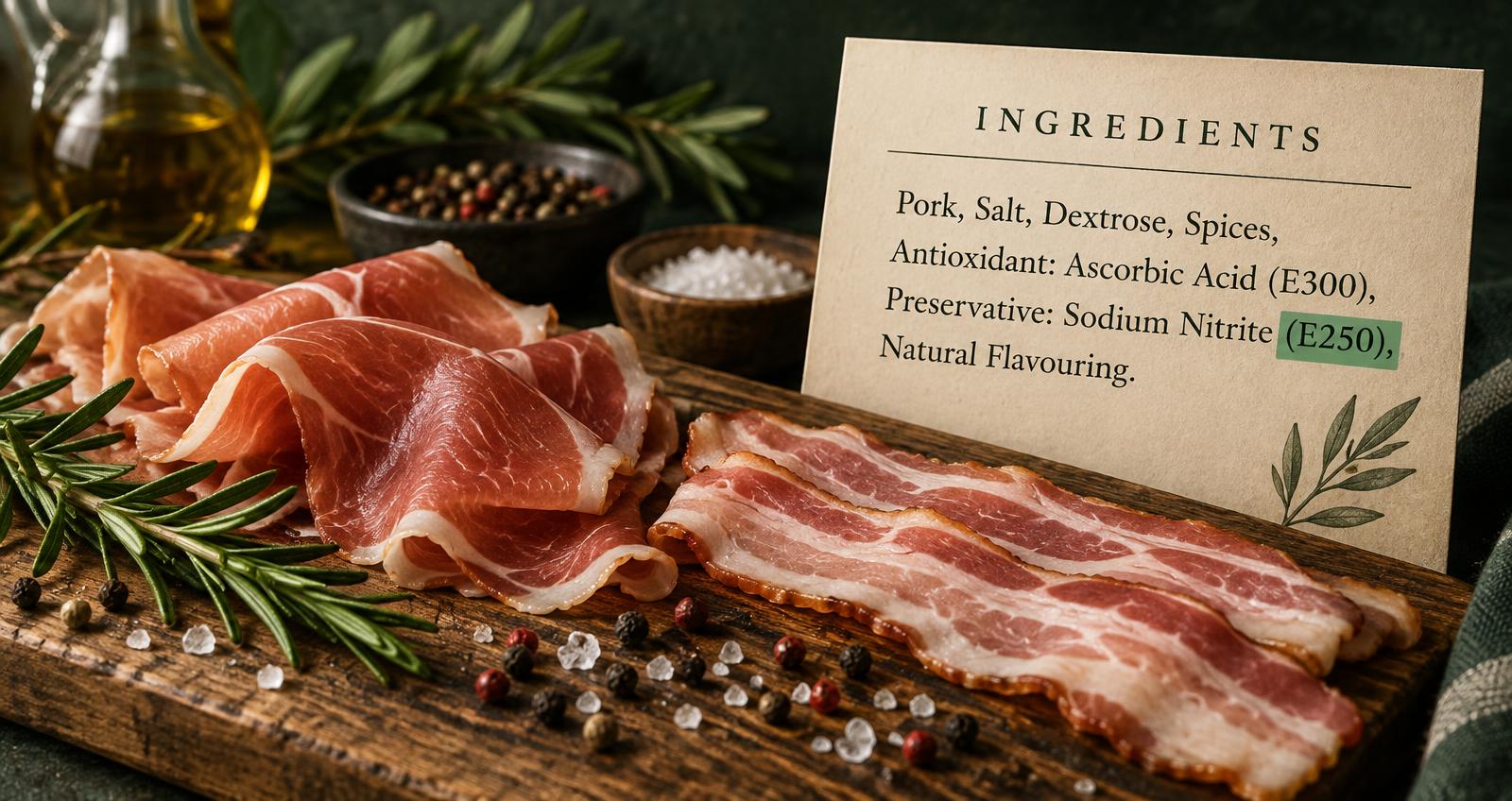
Sodium nitrite is a food additive used mainly as a preservative. Its European additive number is E250, and it belongs to a small group of related nitrite and nitrate additives. In Ireland and across the EU, these can only be used under specified conditions, and they're mostly associated with cured meat. If the numbers are new to you, start with what E numbers are.
E249
Potassium nitrite
A nitrite salt used in curing.
E250
Sodium nitrite
The focus of this guide.
E251
Sodium nitrate
Can be converted to nitrite.
E252
Potassium nitrate
Can be converted to nitrite.
This is the most important one. Nitrite helps prevent the growth of Clostridium botulinum, a bacterium that can produce botulinum toxin, which causes botulism, a serious and potentially life-threatening illness. In cured meat, nitrite works alongside salt, acidity, temperature and processing conditions. So removing it isn't a simple ingredient swap: the new recipe still has to stay safe for its whole shelf life.
Nitrite gives cured ham its familiar pink or reddish look. Without the curing reaction, meat looks quite different.
Part of what makes ham taste like ham, rather than roast pork, comes from the curing reaction.
FSAI notes that nitrite can help reduce rancidity and off odours and flavours during storage.
Controls C. botulinum
Cured colour
Cured flavour
Limits rancidity
Four jobs at once. Food safety is the one that matters most.
Clostridium botulinum is a bacterium capable of producing botulinum toxin. Botulism is rare but potentially severe. The bacterium forms spores that survive in the environment and, under the right conditions, can germinate and produce toxin.
FSAI states that nitrite has a concentration-dependent antimicrobial effect and is particularly important in controlling the outgrowth of C. botulinum spores. That's why curing exists for more than shelf life or looks.
Removing the preservative doesn't automatically make the food safer. The alternative has to work too.
Cured meat
Preservation controls
Less chance for C. botulinum to grow
They're related, but not identical. Nitrite is the more directly active curing ingredient. Nitrate acts more like a reservoir: it can be converted to nitrite before it has its preservative effect. That's why labels may show either, depending on the food and the curing process. Similar names don't make them interchangeable.
| Additive | E number |
|---|---|
| Potassium nitrite | E249 |
| Sodium nitrite | E250 |
| Sodium nitrate | E251 |
| Potassium nitrate | E252 |
Yes. Sodium nitrite is an authorised food additive in the EU, and Ireland applies the EU food-additive framework. That legislation sets:
So E250 can't simply be added to any food at whatever amount a manufacturer chooses.
Authorised additive
Specific food uses
Maximum levels
Label declaration
Official controls
The European Commission amended the rules for nitrites and nitrates through Regulation (EU) 2023/2108. For many meat categories, stricter maximum levels began applying from 9 October 2025.
The aim was to cut nitrite and nitrate use where possible while keeping their protection against dangerous bacteria. Too much nitrite is undesirable. Too little preservation in a product that depends on it creates a different food-safety problem. FSAI updated its official control guidance in January 2026 to reflect the revised limits.
Use enough to do the safety job, and keep exposure and nitrosamine formation as low as reasonably possible.
2017: EFSA re-evaluates nitrites
2023: EU adopts tighter rules
9 Oct 2025: lower limits apply
2026: updated FSAI guidance
EFSA set an Acceptable Daily Intake (ADI) for nitrite of 0.07 mg of nitrite ion per kilogram of body weight per day. An ADI is an estimate of the amount that can be eaten daily over a lifetime without appreciable health risk. It isn't a target.
For a hypothetical 70 kg adult: 70 × 0.07 mg = 4.9 mg nitrite ion per day. That explains the unit. It doesn't mean anyone should eat 4.9 mg a day, and you can't turn it into a number of bacon rashers. An ingredients list tells you E250 is present, not how much remains in the product.
Body weight
× 0.07 mg/kg/day
Safety benchmark, not a target
The main issue isn't the word "nitrite" on a label. It's nitrosamines: compounds that can form under certain conditions when nitrites react with particular nitrogen-containing compounds. Some nitrosamines are genotoxic and carcinogenic, meaning they can damage DNA and cause cancer. That's why regulators try to keep their formation down.
No. Sodium nitrite is E250. Nitrosamines are different compounds. Nitrite can take part in reactions that lead to nitrosamines under certain conditions, so it acts as a precursor. It's wrong to call E250 a carcinogenic nitrosamine, and just as wrong to ignore the link entirely.
Nitrite (E250)
+ reacting compounds
+ certain conditions
Possible nitrosamines
E250 is not itself a nitrosamine.
In its 2017 re-evaluation, EFSA concluded that nitrites and nitrates added to food at permitted levels were safe for consumers. It also judged the contribution to nitrosamine formation from authorised nitrite use to be of low concern at that time.
In 2023, EFSA published a broader assessment of nitrosamines occurring in food. It concluded that dietary exposure to the carcinogenic nitrosamines it considered raised a health concern across all EU age groups, with meat and meat products the largest contributing food category.
These findings don't contradict each other. One looked at nitrites used as additives; the other at overall nitrosamine exposure across food. The later evidence is one reason the EU moved to tighter nitrite and nitrate controls.
2017 question
Are authorised nitrite additives safe at permitted levels?
EFSA re-evaluation of E249 to E252.
2023 question
What's the risk from nitrosamines across food?
EFSA opinion on N-nitrosamines in food.
Different assessments, different questions.
"Sodium nitrite causes cancer" is too simple. So is "there's nothing to think about". Sodium nitrite is an authorised preservative with a real food-safety role. Nitrites can also contribute to nitrosamine formation, and some nitrosamines are known genotoxic carcinogens. That's why EU regulation tries to:
It's a risk-management problem, not something a one-line social media claim can settle.
Because it's doing something useful. A ban would remove one of the tools that control dangerous bacteria in certain cured foods. A product can use a different preservation method where that method is proven to work, but it has to keep the food safe for its whole shelf life. FSAI explicitly tells businesses removing nitrites or nitrates that they're still responsible for showing the new product is microbiologically safe.
Fewer additives doesn't automatically mean safer food.
One side
Minimise unnecessary nitrite exposure
Lower limits, lower residues, less nitrosamine formation.
Other side
Keep cured meat microbiologically safe
Control C. botulinum throughout shelf life.
The balance point: the lowest effective, legally permitted use.
It can be more complicated than the front of the pack suggests. Some products use ingredients naturally rich in nitrate or nitrite, such as certain vegetable-derived ingredients. FSAI states that ingredients used as nitrate or nitrite sources for preservation or colouring can't be used to get around food-additive rules. If their job in the finished food is effectively that of a preservative, the additive rules still matter.
So "from celery" doesn't make nitrite chemically irrelevant, and "natural source" doesn't automatically mean lower risk. Vegetables aren't the problem; what matters is the job the ingredient is doing in the recipe.
Yes, it contributes to the pink colour of cured meats, which is why cured ham doesn't look like an ordinary cooked piece of pork. But calling E250 "just a colouring chemical" would be misleading. Its preservation and safety role matters more.
FSAI explains that additives are generally declared by their functional class plus the specific name or E number. So you might see Preservative: Sodium Nitrite or Preservative: E250. Both mean the same additive. Our guide to reading an ingredients list covers the rest of the back of the pack.
Preservative: Sodium Nitrite
Preservative: E250
Same additive, two valid ways to write it.
No. Depending on the product and the legal conditions, nitrites can appear in:
Permissions and maximum levels depend on the food category and production method. Not every bacon, ham or sausage contains E250, so check the ingredients list.
Not necessarily. It tells you something about the recipe, not the whole nutritional picture. A cured meat without added nitrite can still be:
Read the whole product. For the wider picture, see preservatives in food and spotting ultra-processed foods.
E250 = sodium nitrite.
It's usually working as a preservative in cured food.
It's an authorised additive with a real microbiological role.
Nitrite can contribute to nitrosamine formation, which is why levels are tightly controlled.
Salt, saturated fat, portion, how often you eat it and the full ingredient list.
Put two hams or two bacons side by side, not cured meat against an unrelated food.
Nobody should need to remember what E250 means while standing in a supermarket. When a product contains E250, Sláinte names it as sodium nitrite, a preservative, explains why it's used, and shows it alongside the product's salt, saturated fat and full ingredient list. That keeps one ingredient from becoming the whole verdict. For other numbers you'll meet, see 10 common food additives.
E250 is the European food-additive number for sodium nitrite, a preservative commonly associated with cured meats.
It helps control dangerous bacteria including Clostridium botulinum, contributes to cured colour and flavour and can help reduce rancidity during storage.
Sodium nitrite is authorised for specified food uses in the EU. EFSA established an ADI of 0.07 mg nitrite ion per kg body weight per day. Its use is subject to product-specific legal limits.
Sodium nitrite is not itself a nitrosamine. However, nitrite can contribute to chemical reactions that form nitrosamines, some of which are genotoxic and carcinogenic. This is one reason EU use levels are tightly controlled and were recently reduced.
They are related compounds. Nitrite is the more directly active curing ingredient, while nitrate can be converted to nitrite before exerting a preservative effect.
No. E249 and E250 are authorised under EU food-additive rules for specified uses and amounts.
No. The absence of E250 only tells you one thing about the product. Salt, saturated fat, ingredients, processing and the overall diet still matter.
Yes. If such ingredients are deliberately used to perform the preservative or colouring function of nitrate or nitrite, EU additive rules still need to be considered.
Last reviewed: 6 October 2026