
What does NOVA stand for?
NOVA is the name of a food-classification system developed by researchers in Brazil. It groups foods according to the extent and purpose of industrial processing, rather than assigning a nutrient score.
Published · Updated · Sláinte Editorial
A bag of frozen peas is processed. So is a block of cheddar. A carton of milk has been processed too.
Does that make all three ultra-processed?
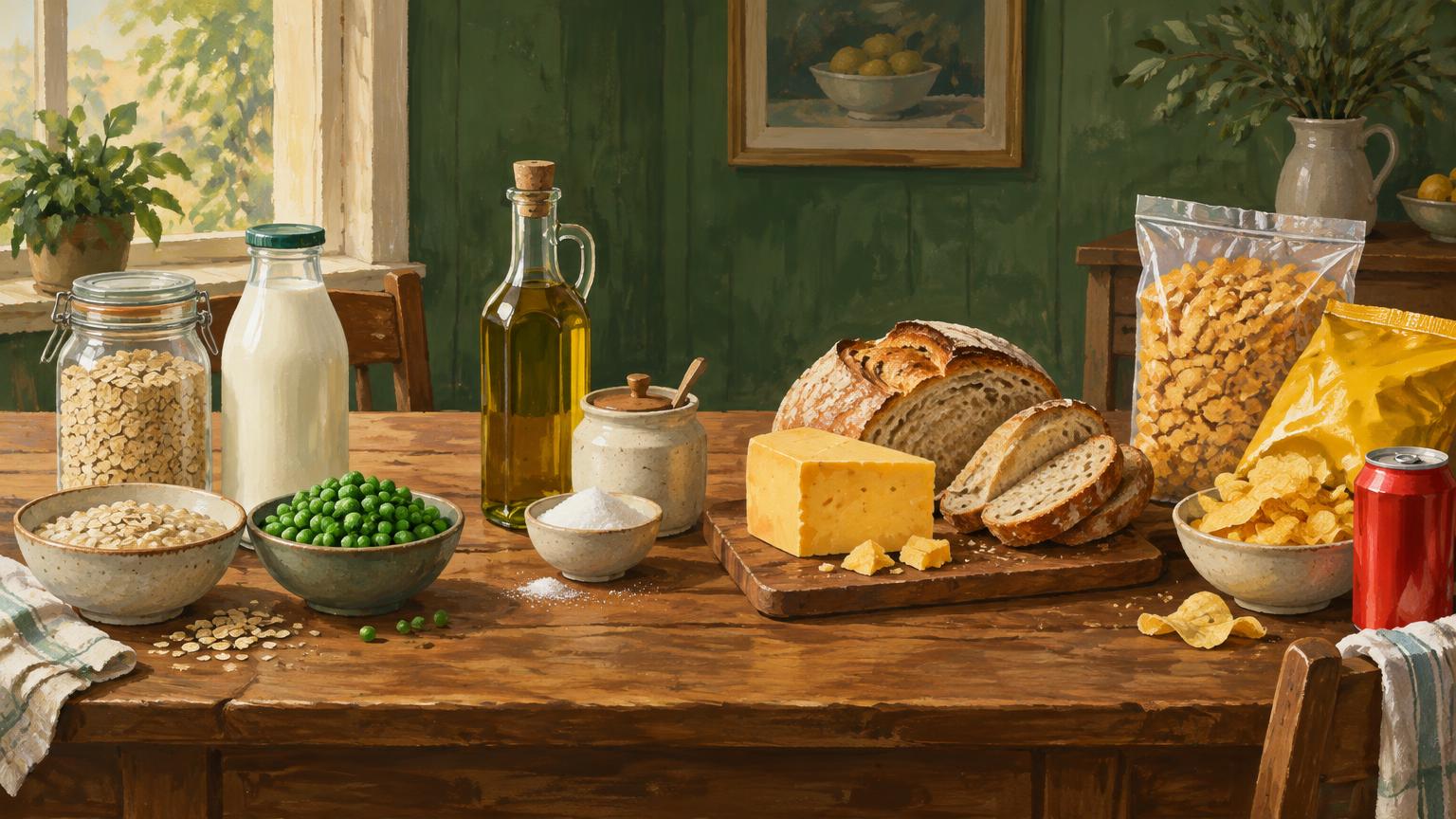
No. Processing is not the same thing as ultra-processing, and the NOVA classification was built to distinguish between them.
NOVA divides foods into four broad groups according to the extent and purpose of processing. It does not simply count calories, E numbers or the number of ingredients printed on the back of a packet.
That's a useful distinction when shopping in Tesco, Dunnes Stores, SuperValu, Aldi or Lidl. A food can be washed, frozen, pasteurised or fermented without becoming ultra-processed. Equally, a cereal or yoghurt sold with reassuring front-of-pack claims may contain ingredients characteristic of a more highly formulated product.
But classification is not always straightforward. A loaf of bread can change groups when its recipe changes. Beans in water and beans in a seasoned sauce are not necessarily equivalent. And a food's NOVA group cannot, on its own, tell you how much sugar, salt, saturated fat or fibre it contains.
Here's how to use NOVA on an actual supermarket shelf without turning it into another rule to fear.
Researchers at the University of São Paulo developed NOVA as a way to classify foods by processing. It has been used in public-health research and discussed in publications from the Food and Agriculture Organization of the United Nations.
| NOVA group | Name | Typical examples | Main idea |
|---|---|---|---|
| 1 | Unprocessed or minimally processed foods | Fruit, plain oats, milk, eggs, unsalted nuts, frozen vegetables | The original food remains recognisable; processes help preserve or prepare it |
| 2 | Processed culinary ingredients | Sugar, salt, butter, vegetable oils | Ingredients extracted or derived from Group 1 or nature, commonly used in cooking |
| 3 | Processed foods | Some cheeses, simple bread, vegetables canned with salt | Mostly Group 1 foods combined with Group 2 ingredients for preservation or preparation |
| 4 | Ultra-processed foods | Many soft drinks, flavoured snacks, industrially formulated bars and some ready meals | Formulations using substances or additives characteristic of industrial food production |
This is a classification system, not a separate legal nutrition label used on every pack in Ireland.
In other words, you may see calories and sugars on a packet without seeing its NOVA group. To assess processing, you often need to examine the ingredients and consider the product's manufacturing method.
The examples below are illustrative food types, not claims that every product sold under a familiar name has the same NOVA group. Where formulation matters, the actual ingredient list must be checked.
| Everyday food | Typical NOVA group | What changes the assessment? |
|---|---|---|
| Plain porridge oats | 1 | Sweetened instant formulations may differ |
| Fresh or frozen plain peas | 1 | Sauces, flavour coatings or complex formulations can change it |
| Pasteurised plain milk | 1 | Flavoured milk drinks can be more highly formulated |
| Whole eggs | 1 | Formulated liquid egg products need individual assessment |
| Plain unsalted nuts | 1 | Chocolate coatings and flavour systems change the formulation |
| Olive oil or rapeseed oil | 2 | These are culinary ingredients, not ready-to-eat meals |
| Granulated sugar | 2 | Group 2 does not mean a nutritional free pass |
| Traditional cheddar | Often 3 | Processed cheese spreads may contain emulsifying salts and other formulation ingredients |
| Simple flour-water-yeast-salt bread | Often 3 | Some industrial packaged breads fit Group 4 |
| Plain beans canned with salt | Often 3 | Beans canned only in water may be Group 1; seasoned formulations vary |
| Ready-to-eat flavoured breakfast cereal | Often 4 | Plain flakes or minimally formulated cereals may differ |
| Protein bar with isolates, sweeteners and flavourings | Often 4 | Assess the exact recipe; protein content alone does not decide it |
These are useful starting points, not a certified score sheet. NOVA classification sometimes requires details that are not obvious from a short package description.
Plain rolled oats have been cleaned, steamed or milled, and rolled into flakes. Those processes make them usable and practical. They do not automatically turn them into an ultra-processed formulation.
Flahavan's plain porridge oats are a familiar Irish example of a simple oat product. The point here is the food category, not a claimed classification for every Flahavan's variant.
An instant flavoured oat sachet is a different question. Look for the full list: oats, sugar, flavourings, milk-derived ingredients or other functional ingredients can change its formulation and NOVA assessment.
Lesson: Processing can make a basic food safer, easier to cook or easier to store without putting it into Group 4.
Peas may be washed, blanched and frozen soon after harvest. Freezing is a preservation method. It is not a synonym for ultra-processing.
For a plain bag labelled with peas as the only ingredient, Group 1 is the typical classification.
A side dish sold as peas in a creamy sauce is different. Its classification depends on the sauce, added substances and processing used.
There is no need to dismiss frozen vegetables because they are convenient. Their fibre, vitamins and other nutrients still matter, and frozen vegetables can make everyday meals easier.
Pasteurisation uses heat to reduce microbiological risks. Homogenisation changes how milk fat is distributed.
Neither process alone makes plain milk a Group 4 food.
A flavoured high-protein milkshake may contain added protein concentrates, sweeteners, flavourings or stabilisers. That is a different product and should be assessed separately.
Lesson: Food safety processing and industrial formulation are not identical ideas.
Fresh eggs are an uncomplicated example of a minimally processed food. A whole egg does not need a long ingredients declaration to qualify as food.
But a ready-made omelette or formulated liquid egg product can contain much more than egg. Its classification depends on what else has been added and how it is made.
The mere presence of a carton or plastic tray is not a NOVA classification criterion.
Plain, unsalted nuts are typically Group 1, even when roasted without additional ingredients.
Once you add a sugar coating, a chocolate shell or a flavouring system, the assessment becomes more complicated.
Remember that nuts are energy-dense because they naturally contain substantial fat. That is a nutritional observation, not an argument that minimally processed nuts are unhealthy.
NOVA and nutrition answer different questions.
Oil is extracted from an agricultural source and used to prepare other foods.
NOVA places common culinary oils in Group 2.
That sometimes surprises people who assume Group 1 must be good and every number above it must be progressively worse.
The groups are not a health league table. Rapeseed oil can supply unsaturated fats even though it is not Group 1. The appropriate quantity and broader diet remain important.
Granulated sugar is another Group 2 culinary ingredient.
Nobody should interpret that as proof that unlimited sugar is nutritious. It simply means sugar has a particular role in the food-processing system.
WHO recommends limiting free sugars, including sugar added in cooking, regardless of NOVA's culinary ingredient category.
This is a clear example of why processing classification cannot replace nutritional guidance.
Cheese is created by processing milk, typically using cultures, enzymes and salt.
Many traditional cheeses fit Group 3 because the original food is preserved or transformed using familiar processes and ingredients.
A processed cheese slice or spread may contain emulsifying salts, modified components and other functional ingredients. Those versions need separate assessment and may fit Group 4.
It is also worth looking at salt, saturated fat and protein. Two cheeses that fall into the same NOVA group can still have different nutrition labels.
Bread is where quick online lists often become misleading.
A simple loaf made with flour, water, yeast and salt can fit Group 3.
An industrial packaged loaf containing certain emulsifiers, flavourings or other ingredients characteristic of ultra-processed formulations may fall into Group 4.
But neither the number of slices nor the fact that the loaf is wrapped in plastic settles the issue.
Bread also provides an obvious nutrition comparison: fibre, wholegrain content and salt vary significantly between products. A simple white bread and a higher-fibre wholemeal product may meet different dietary needs despite both being classed as processed.
When choosing bread, examine its recipe and nutrition, not just its processing group.
Dry beans and beans canned only in water may fit Group 1 because preserving them has not fundamentally changed the food's composition.
Adding salt for preservation can move a simple canned vegetable or pulse product into Group 3 in NOVA's framework.
Beans in a more complex flavoured sauce require individual assessment. A sweetened sauce is not automatically Group 4, but some industrial formulations may contain ingredients characteristic of that group.
Whatever the NOVA classification, beans can still provide fibre and plant protein. Compare salt and sugar figures where sauces are involved.
Some breakfast cereals are industrial formulations involving refined ingredients, added sweeteners, flavourings, colours or processing techniques associated with Group 4.
That does not mean every breakfast cereal is identical.
Plain oats and a colourful sweetened extruded cereal are clearly different products. Even within more highly formulated cereals, nutrition per 100g can vary considerably.
Compare total sugars, fibre, salt and ingredients. Front-of-pack phrases such as source of vitamins or wholegrain can describe real characteristics without telling you the complete nutritional story.
Many protein bars use ingredients that make their texture and protein content possible: milk or plant protein isolates, glycerol or other humectants, sweeteners, emulsifiers, flavourings and coatings.
That can make them a clear example of a Group 4 formulation.
But two bars in Group 4 can have very different amounts of protein, sugar, fibre and saturated fat.
If one supplies 20g protein and another contains much more sugar, NOVA alone will not tell you which is more useful for a particular person.
We explored how to compare those products in Best Protein Bars in Ireland: How Popular Products Compare.
Ultra-processed is a broad category.
It can include sugary soft drinks, confectionery, certain packaged breads, many protein bars, some fortified cereals and some formulated dairy products.
Those foods do not have identical nutritional characteristics.
They can vary in calories, free sugars, fibre, salt, protein, micronutrients and serving size. The ingredients and how regularly the product is consumed matter too.
A classification intended to describe processing does not measure all those characteristics.
This is a practical limitation, not a reason to disregard processing entirely.
A sensible supermarket comparison uses two separate lenses:
The best decision usually uses both.
There is growing research linking diets high in ultra-processed foods with poorer health outcomes. But the strength of the evidence, and what can be concluded from it, needs care.
A 2024 umbrella review in The BMJ brought together 45 pooled analyses from epidemiological meta-analyses involving nearly 9.9 million participants across the contributing studies.
Higher ultra-processed food exposure was associated with several adverse outcomes, including cardiovascular, metabolic and mortality measures.
However, the researchers graded much of the underlying evidence as low or very low certainty. Observational studies can identify associations, but they do not by themselves establish that the processing of every individual food caused the observed result.
People who eat more ultra-processed food can differ in many other ways, including overall dietary patterns, smoking, income, activity and food access. Research tries to account for such differences, but residual confounding remains possible.
In a 2019 NIH-controlled feeding study, 20 adults consumed ultra-processed and unprocessed diets for two weeks each, in a randomised crossover design.
The diets were designed to be matched for presented calories and important nutrients. When participants were allowed to eat as much as they wanted, they consumed approximately 500 more calories per day during the ultra-processed diet phase.
Participants gained weight during the ultra-processed phase and lost weight during the unprocessed phase.
That's more direct evidence that processing-related characteristics can influence eating behaviour under those study conditions.
It was still a small, short trial. It does not prove that all Group 4 foods cause excess energy intake to the same degree.
A later randomised crossover trial in Nature Medicine enrolled 55 adults in England and compared two diets designed to align with healthy dietary guidelines. One relied on minimally processed food, the other on ultra-processed food.
Both approaches produced weight loss over the eight-week study phases. Weight loss was greater on the minimally processed diet, with reported mean changes of about 2.06% versus 1.05%.
This is useful because it compares different processing patterns within diets designed around healthy-eating guidance. Nevertheless, the trial's population and duration limit how broadly its results should be applied.
The UK Scientific Advisory Committee on Nutrition reviewed the evidence and, in a 2025 rapid update, reiterated concerns about associations between high ultra-processed food consumption and adverse outcomes.
It also highlighted uncertainties about whether the risks are attributable to processing itself, the nutritional composition of many such foods, or other associated characteristics.
The sensible reading is neither ignore processing nor every ultra-processed food is poisonous.
It is that dietary patterns high in ultra-processed foods deserve attention, while nutritional quality and individual product differences still matter.
Often you can make an informed assessment, but not always with certainty.
Look for familiar foods and culinary ingredients, then consider whether the product is built around industrially derived components or ingredients used principally to create texture, colour, sweetness or flavour.
Examples that may be characteristic of Group 4 formulations include certain protein isolates, maltodextrin, modified starches, flavourings, non-sugar sweeteners, cosmetic colours and some emulsifiers.
However, one ingredient name is not a stand-alone danger signal.
An E number means an additive has been authorised for specified uses under European rules. It does not automatically mean the ingredient is harmful. Some authorised additives occur naturally in foods, and a long list of herbs and spices may be perfectly ordinary cooking.
A product label can also omit manufacturing details that researchers would need to classify a food confidently.
If the classification is ambiguous, it is more accurate to say uncertain than to invent a definitive NOVA group.
No. NOVA is a research classification framework; it is not the same as the mandatory EU nutrition declaration or a universal government product score.
Irish and EU packaging rules require particular food information, including nutrition data for most prepacked foods, ingredient declarations and allergen information where applicable.
Those labels do not generally require a NOVA number.
Sláinte uses NOVA as one input within a wider scoring methodology, rather than treating it as the entire product verdict.
The published Sláinte methodology weights three components:
| Component | Weight | Main information considered |
|---|---|---|
| Nutrition quality | 55% | Energy, sugars, saturated fat and salt, balanced with fibre, protein and relevant plant content |
| Ingredients | 30% | Declared ingredients, recognised additives and ingredient concerns |
| Processing and quality signals | 15% | NOVA-related processing and formulation signals |
The method also includes category-specific guardrails and score limits. The published methodology, not the examples in this article, determines actual scores.
This matters for foods such as bread, flavoured yoghurt and protein bars. Two products may share a NOVA group but have different nutrient profiles and ingredient lists.
It also matters for foods like butter or olive oil, which are Group 2 culinary ingredients rather than ultra-processed foods. Their classification alone does not tell you what quantity suits your overall diet.
No illustrative NOVA classification in this article should be treated as a verified Sláinte Score. A score requires the correct product record and the current scoring engine.
Explore Sláinte to compare eligible products with the actual label information available.
Try this with two products in the same category, such as two breads or two breakfast cereals.
First: Confirm you are looking at the exact product and flavour. Similar packaging can hide different recipes.
Second: Read the first ingredients. Are they recognisable foods or a mixture of food-derived substances and functional additions?
Third: Consider the purpose of processing. Is the food primarily washed, frozen, pasteurised, fermented or preserved, or is it a heavily formulated ready-to-eat product?
Fourth: Compare nutrition per 100g or 100ml, especially sugar, salt, saturated fat and fibre.
Fifth: Consider how you use the food. An occasional convenience item is not the same as a diet built mostly around that category.
The objective is not to stop eating any food that has been processed. It is to understand the difference between useful preservation and more elaborate formulation, while keeping the overall nutritional picture in view.
NOVA is the name of a food-classification system developed by researchers in Brazil. It groups foods according to the extent and purpose of industrial processing, rather than assigning a nutrient score.
Group 1 covers unprocessed or minimally processed foods; Group 2 covers processed culinary ingredients; Group 3 covers processed foods; Group 4 covers ultra-processed food formulations.
Plain frozen vegetables are generally Group 1. Freezing alone does not make food ultra-processed. Prepared vegetable products with sauces or added ingredients need separate consideration.
Some bread is, but not all. A simple loaf made with flour, water, yeast and salt can be Group 3, while certain industrial packaged formulations may be Group 4.
Many traditional cheeses fit Group 3. Processed cheese products with additional functional ingredients may fall into Group 4. Check the exact formulation.
Common cooking oils are generally Group 2, processed culinary ingredients. That classification does not imply they are nutritionally inferior to all Group 1 foods.
Not necessarily. Beans canned in water and beans with added salt may sit in different groups, while complex prepared bean meals require individual assessment.
No. E numbers identify authorised additives. Their functions and the overall formulation need to be considered. One unfamiliar ingredient does not automatically classify an entire product.
No. Group 4 contains products with very different nutrition profiles. The classification is useful for studying processing, but it does not measure the complete nutritional quality of each food.
There is no general requirement for a NOVA group to appear on prepacked food labels in Ireland. Mandatory EU food labelling is a separate system.
Last reviewed: 21 October 2026