
Is natural food always healthier?
No. Natural can describe origin, flavouring or processing, depending on context. It is not a universal measure of sugar, fibre, salt or overall nutrition.
Published · Updated · Sláinte Editorial
There is a remarkable amount of reassurance packed into the front of a food packet.
Natural. Organic. Wholesome. High protein. No added sugar.
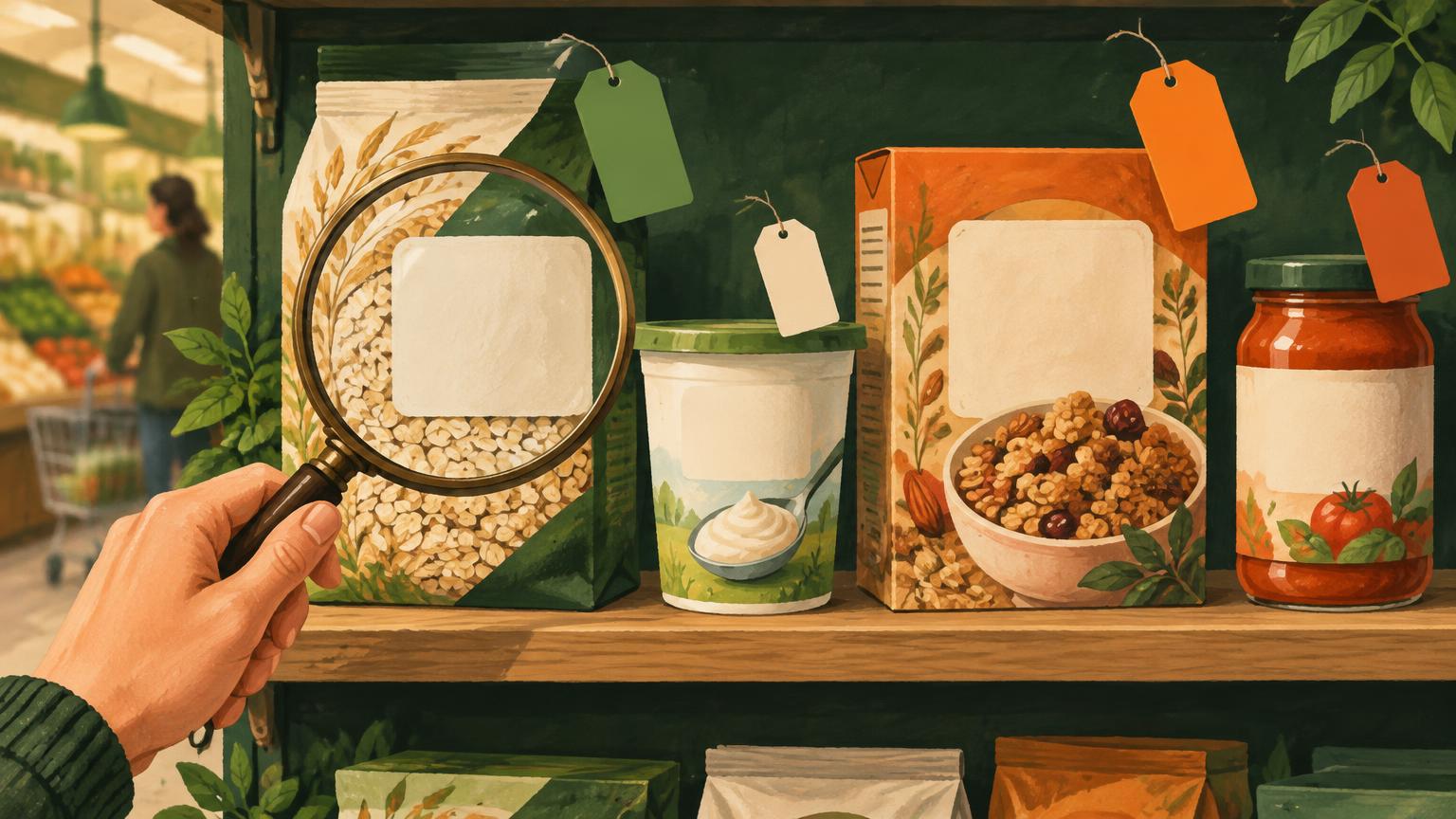
Sometimes those words describe something genuinely useful. Sometimes they tell you very little about the food you are about to eat.
The important difference is that these expressions do not all operate under the same rules. “Organic” identifies a regulated production system. “High protein” is a regulated nutrition claim. “Natural” needs more context. And “healthy” is not a complete nutritional verdict.
If you shop in Tesco, Dunnes Stores, SuperValu, Aldi or Lidl, understanding that distinction is often more useful than memorising a list of ingredients to avoid.
Here is how to read the promises on the front of a packet, then test them against what the back actually says.
Think about four products: organic porridge oats, a high-protein yoghurt, a granola labelled no added sugar, and a sauce described as natural.
All four could have legitimate reasons for using those terms. But the words tell you different things.
| Label wording | The useful question | What the wording does not establish |
|---|---|---|
| Organic | Was it produced under the certified organic system? | That it is low in sugar, salt or saturated fat |
| High protein | Does at least 20% of its energy come from protein? | That every other part of the nutrition profile is favourable |
| Source of fibre | Does it meet the legal fibre threshold? | That it is low in sugar or minimally processed |
| No added sugars | Were sugars or foods used for sweetening added? | That the product contains no sugars at all |
| Natural | Natural in what sense, and under which specific rules? | A universal, legally defined healthy-food score |
| Healthy / good for you | Is this a health claim, and what supports it? | That a pack can be judged by an adjective alone |
This is not an argument that food marketing is worthless. A properly used regulated claim is useful information. The problem begins when we take one characteristic and assume it describes everything else about the food.
Organic is different from most of the vague language used on packaging.
In Ireland, organic food production and labelling are governed by EU rules, principally Regulation (EU) 2018/848. Producers and operators using protected organic terms must comply with an official system of controls and certification.
For qualifying processed foods, at least 95% of the agricultural ingredients by weight must be organic for the product to be described as organic in its sales description, with additional conditions applying to the remainder.
The familiar green leaf logo is therefore more than a graphic chosen by a designer.
Look for the EU organic leaf, the control-body code and the indication of where the agricultural ingredients were farmed. You may see indications such as EU Agriculture, non-EU Agriculture or a more specific country description where the rules permit it.
The leaf is not a guarantee that every ingredient was grown in Ireland. It indicates compliance with the relevant organic rules.
The Food Safety Authority of Ireland also explains that organic labelling is controlled through approved certification bodies and specific categories of permitted claims. A food with one organic ingredient cannot simply market the entire product as fully organic unless it qualifies.
Not automatically.
Organic certification concerns the system used to produce and process food. Nutrition is a different question.
Organic biscuits can still contain sugar and saturated fat. Organic honey remains a concentrated source of free sugars. Organic oats may be an excellent everyday ingredient, but their nutritional value does not come from the word organic alone.
One practical example is Flahavan's Organic Porridge Oats. The product's simple ingredient list, 100% organic wholegrain rolled oats, makes it easy to understand what you are buying. Its fibre, protein and other nutrients are visible in the nutrition declaration. These are separate reasons you might value the product.
Organic tells you about production. The nutrition table tells you about nutrients. Neither replaces the other.
Natural is one of the easiest words to misunderstand because it can refer to different attributes in different settings.
Unlike certified organic, there is no single EU-wide numerical definition that turns “natural food” into a general indicator of nutritional quality.
That does not make natural descriptions a free-for-all. EU food-information law prohibits information that misleads consumers, including about a food's characteristics, composition or method of manufacture. Some uses of the word are covered by specific rules.
“Natural flavouring”, for instance, is not simply a casual phrase.
Regulation (EC) No 1334/2008 sets conditions for how natural flavourings can be described. A flavouring labelled simply “natural flavouring” must meet the regulation's rules about the source and type of the flavouring component.
A more specific description, such as natural strawberry flavouring, is subject to source requirements. Where a source is named in that form, at least 95% by weight of the flavouring component must come from that source, subject to the regulation's full conditions.
But a natural flavouring is still a flavouring. Its presence does not mean that a yoghurt contains a large amount of fruit, that its sugar content is low, or that the whole product has been assessed as healthy.
If strawberries are pictured prominently, the quantity of strawberries in the product may also need to be declared under the relevant ingredient-percentage rules.
The correct questions are: What is the ingredient? What does its description legally mean? How much of the emphasised food is present? What does the finished product's nutrition look like?
European health-claims law takes claims about health-related benefits seriously.
Under Regulation (EC) No 1924/2006, specific health claims generally must be authorised and used under their conditions. Article 10(3) also addresses references to general, non-specific benefits for overall good health or health-related wellbeing: they may be made only when accompanied by an appropriate specific authorised health claim.
This does not mean every use of the everyday adjective “healthy” has one universal numerical legal threshold. Meaning, presentation and context matter.
It does mean that marketers cannot reasonably turn a vague health impression into a substitute for substantiated claims.
For a shopper, the practical lesson is simpler: a positive-sounding pack doesn't demonstrate that a product is right for everyone.
A snack described as wholesome may still be high in saturated fat. A drink presented as part of an active lifestyle may contain considerable sugar. A food can also be valuable in someone's diet without making any front-of-pack health claim at all.
Nutrition claims such as low sugars, high fibre, low fat and high protein have defined legal conditions.
Some common thresholds for solid foods are:
| Claim | Relevant legal condition |
|---|---|
| Low sugars | No more than 5g sugars per 100g |
| Sugars-free | No more than 0.5g sugars per 100g or 100ml |
| Low fat | No more than 3g fat per 100g |
| High fibre | At least 6g fibre per 100g, or 3g per 100 kcal |
| High protein | At least 20% of the food's energy comes from protein |
| Source of protein | At least 12% of energy comes from protein |
Liquids have different limits for some claims, and each claim comes with legal conditions beyond this quick table.
These claims answer precise questions. They are not universal certificates of healthy eating.
Take a high-protein chocolate-coated bar. It can legitimately meet the high-protein condition while containing sweeteners, polyols and several grams of saturated fat.
Or consider a high-fibre breakfast cereal that also contains substantial sugars and salt. Its fibre claim can be accurate without telling you whether it is a better choice than another cereal.
If you want to know what the legal claim means, look up the claim. If you want to decide which product to buy, keep reading the label.
“No added sugars” is regulated. It means the manufacturer has not added mono- or disaccharides or other foods used for their sweetening properties, subject to the applicable conditions.
It does not mean that the finished food contains zero sugars.
Milk naturally contains lactose. Fruit naturally contains sugars. Dried fruit can contribute substantial sugars to a cereal even when none have been added during manufacture.
This is why plain yoghurt can display sugars on its nutrition panel without any added table sugar.
It is also why a sweetened high-protein yoghurt and a plain high-protein yoghurt can have very different profiles even when the tubs look similar.
Compare the ingredients, not just the banner. Glenisk Natural Fat Free Protein Yoghurt lists skimmed milk and cultures and declares 3.5g sugars per 100g. Its Vanilla Fat Free Protein Yoghurt has sugar among the listed ingredients and declares 10g sugars per 100g. The label does not make one product morally good and the other bad; it makes the difference measurable.
You can read our dedicated explanation in “No Added Sugar” Does Not Mean “No Sugar”.
No. Not on its own.
An ingredient list with oats, seeds, nuts, fruit, spices and added vitamins can be lengthy without telling you that the food is nutritionally poor.
A short list can also describe foods that should be consumed in moderate quantities, such as salt, sugar or butter.
What the list can reveal is composition: what ingredients were used, their general order by weight, which allergens are present, and sometimes the percentage of a highlighted ingredient.
It can also reveal whether a product contains sweeteners, flavourings or stabilisers. Their function and regulatory status matter more than whether a name sounds scientific.
A sensible shopper reads the ingredient list alongside the nutrition declaration, not instead of it.
These expressions are frequently used to create an impression of simplicity.
“No artificial colours” may tell you something true about the formulation, but it does not establish that the food is lower in sugar or more nutritious. An alternative colour may still be used, or the product may not require colour at all.
“Clean label” is largely an industry and marketing expression rather than a harmonised EU nutrition-claim category with a standard threshold like high fibre.
A claim should not be misleading; that is still important. But the shopper has to work out what particular characteristic is being highlighted.
The shorter question is usually better than the marketing language: What is actually in the food?
The next time a package says natural, organic or healthy, try this sequence.
A product can be a good choice for your circumstances without ticking every marketing box. And a packet with several attractive claims can still warrant a closer look.
Sláinte is built around what can be checked on the label, rather than the strength of a marketing message.
The public Sláinte methodology weights nutrition at 55%, ingredients at 30%, and processing and quality signals at 15%. It uses category-specific rules and guardrails, because a sauce, snack bar and plain oats should not all be interpreted in the same way.
An organic logo is not a substitute for a favourable nutrient profile. A high-protein claim does not erase high sugars or saturated fat. A simple ingredient list is useful information, but it cannot rescue a product with an unfavourable nutrition profile indefinitely.
The app also has published caps and exceptions for certain categories. Its scores come from the current verified product record and scoring engine, not a judgement we can invent from a marketing phrase.
Read how the Sláinte Score works, or scan your next product.
No. Natural can describe origin, flavouring or processing, depending on context. It is not a universal measure of sugar, fibre, salt or overall nutrition.
Organic identifies a regulated production system. It does not automatically mean lower calories, sugars or saturated fat. Compare the nutritional composition of the actual foods.
It indicates that the product meets the relevant EU organic-production and certification requirements. The accompanying code and origin statement help identify the control system and source of agricultural ingredients.
EU health claims are regulated. Specific health claims generally require authorisation, and general non-specific references to health benefits are subject to accompanying-claim requirements. The context of the wording matters.
Not necessarily. A natural flavouring is a regulated flavouring description. Check the separate ingredient list and fruit percentages to understand actual fruit content.
No. Foods may contain naturally occurring sugars. “Sugars-free” has a different legal threshold.
No. It means the product meets a rule concerning the share of energy supplied by protein. Other nutritional characteristics still need checking.
It is not a harmonised nutrition claim with a fixed threshold comparable to low sugars or high fibre. General rules against misleading food information still apply.
No. Additives and flavourings perform different functions and are subject to regulatory controls. Their presence alone cannot tell you the finished food's complete nutritional quality.
Last reviewed: 17 October 2026