
How much protein do I need per day?
EFSA sets a population reference intake of 0.83g of protein per kilogram of body weight daily for healthy adults. Individual requirements can differ according to activity, age, health and other circumstances.
Published · Updated · Sláinte Editorial
EFSA's reference intake for healthy adults is 0.83g of protein per kilogram of body weight a day. For an 80kg adult, that's about 66g. People doing regular strength training may benefit from more, but most of it can come from ordinary food.
Walk through an Irish supermarket and you'll find protein advertised on almost everything.
Protein yoghurts. Protein milk. Protein porridge. Protein bars. Protein puddings.
It's become one of the most prominent selling points in food.
And it's easy to understand why.
Protein is essential for maintaining muscles, repairing tissues and supporting normal bodily functions. It also contributes to growth and development.
But somewhere along the way, an important question has become surprisingly difficult to answer.
How much protein do you actually need?
According to the European Food Safety Authority (EFSA), the population reference intake for healthy adults is 0.83g of protein per kilogram of body weight per day.
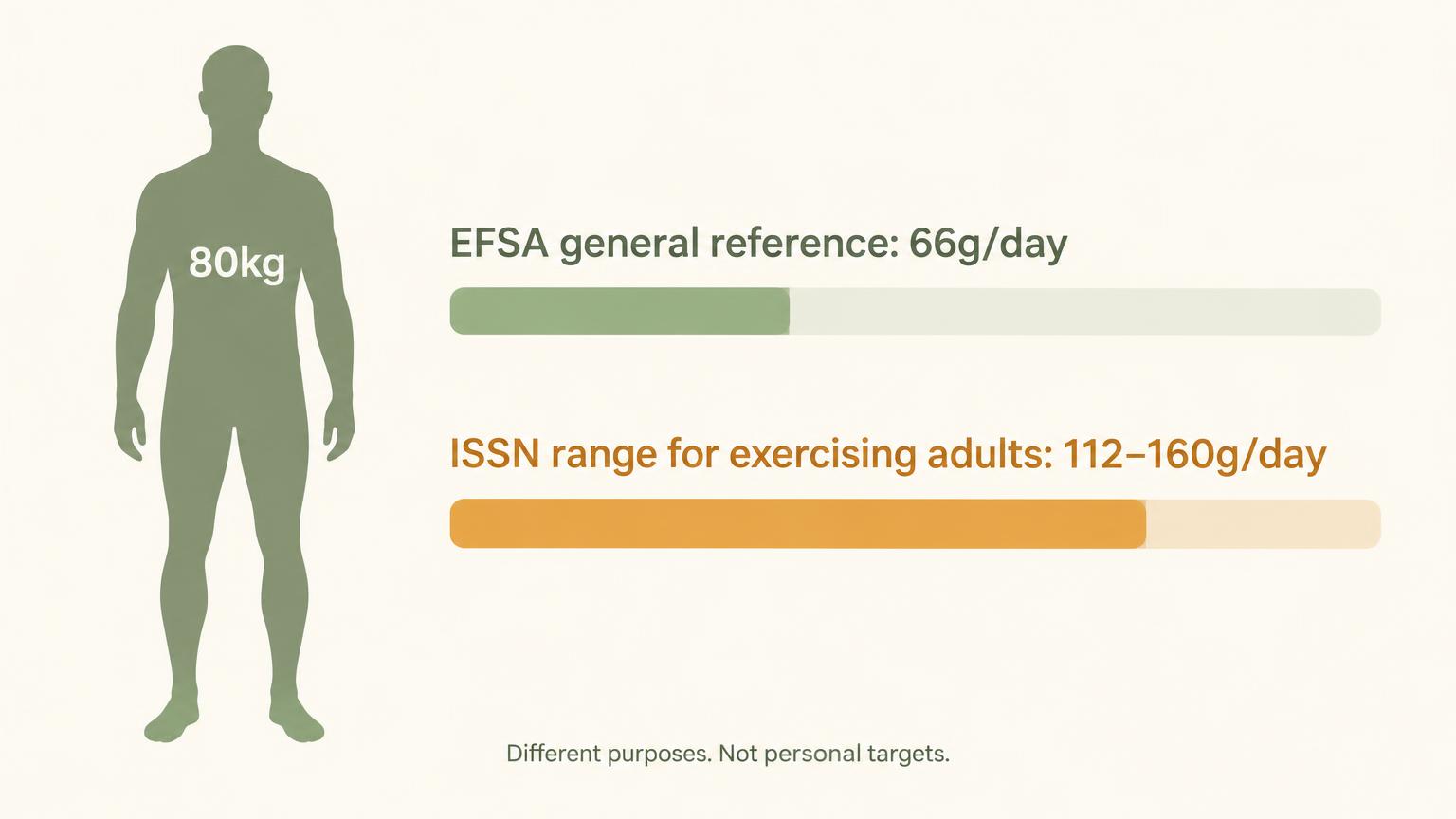
For an adult weighing 80kg, that's approximately 66g of protein daily.
That's considerably less than many of the figures promoted in fitness-related marketing.
But there's an important distinction.
The EFSA figure is a reference intake intended to meet the requirements of nearly all healthy adults in the general population. It isn't necessarily the optimal intake for someone undertaking regular strength training, trying to build muscle or managing particular health needs.
So let's look at what the science recommends, what different foods actually provide and whether buying high-protein products is necessary.
Protein requirements are often expressed relative to body weight.
The EFSA population reference intake for adults is:
0.83g of protein per kilogram of body weight per day.
This applies to healthy adults, including older adults, as a general reference.
The calculation is straightforward.
Daily protein reference intake = body weight in kg × 0.83.
For example:
80kg × 0.83 = 66.4g protein per day.
Here's what that looks like across several body weights.
| Body weight | EFSA reference intake |
|---|---|
| 50kg | 41.5g |
| 60kg | 49.8g |
| 70kg | 58.1g |
| 80kg | 66.4g |
| 90kg | 74.7g |
| 100kg | 83g |
Source: EFSA Scientific Opinion on Dietary Reference Values for Protein, 2012.
These are population-level reference amounts, not individual prescriptions or maximum limits.
Age, activity, pregnancy, illness, body composition and other circumstances may affect someone's requirements.
The calculation may also need clinical adjustment in certain circumstances, so multiplying total body weight isn't always the appropriate way to establish a personalised target.
Because protein recommendations are often discussed in two very different contexts.
The first concerns meeting general dietary requirements and avoiding inadequate intake.
The second concerns optimising outcomes such as muscle growth or recovery from exercise.
Those aren't necessarily the same amount.
An adult who spends most of the day sitting at a desk may have different protein needs from someone undertaking demanding resistance training several times a week.
Neither person's requirements can be determined by reading the front of a protein bar.
Regular resistance training changes the picture.
The International Society of Sports Nutrition (ISSN) published a position stand recommending approximately 1.4 to 2.0g of protein per kilogram of body weight daily for most healthy exercising individuals looking to support muscle mass.
This is a sports-nutrition recommendation rather than the general-population reference intake.
Here's how the two approaches compare.
| Body weight | EFSA general reference | ISSN exercising range |
|---|---|---|
| 60kg | 50g | 84–120g |
| 70kg | 58g | 98–140g |
| 80kg | 66g | 112–160g |
| 90kg | 75g | 126–180g |
| 100kg | 83g | 140–200g |
Values rounded. The ISSN range concerns healthy exercising individuals and should not be interpreted as a requirement for everybody who occasionally exercises.
For an 80kg person undertaking regular strength training, the sports-nutrition range is approximately 112 to 160g per day.
That is a substantial difference from the general reference intake of 66g.
But even within sports nutrition, more is not automatically better.
The upper end of a suggested range isn't a target everyone must reach, and resistance training, total energy intake, recovery and consistency remain important.
Someone training recreationally also does not necessarily need the same approach as a competitive athlete.
This is where the discussion becomes much more useful.
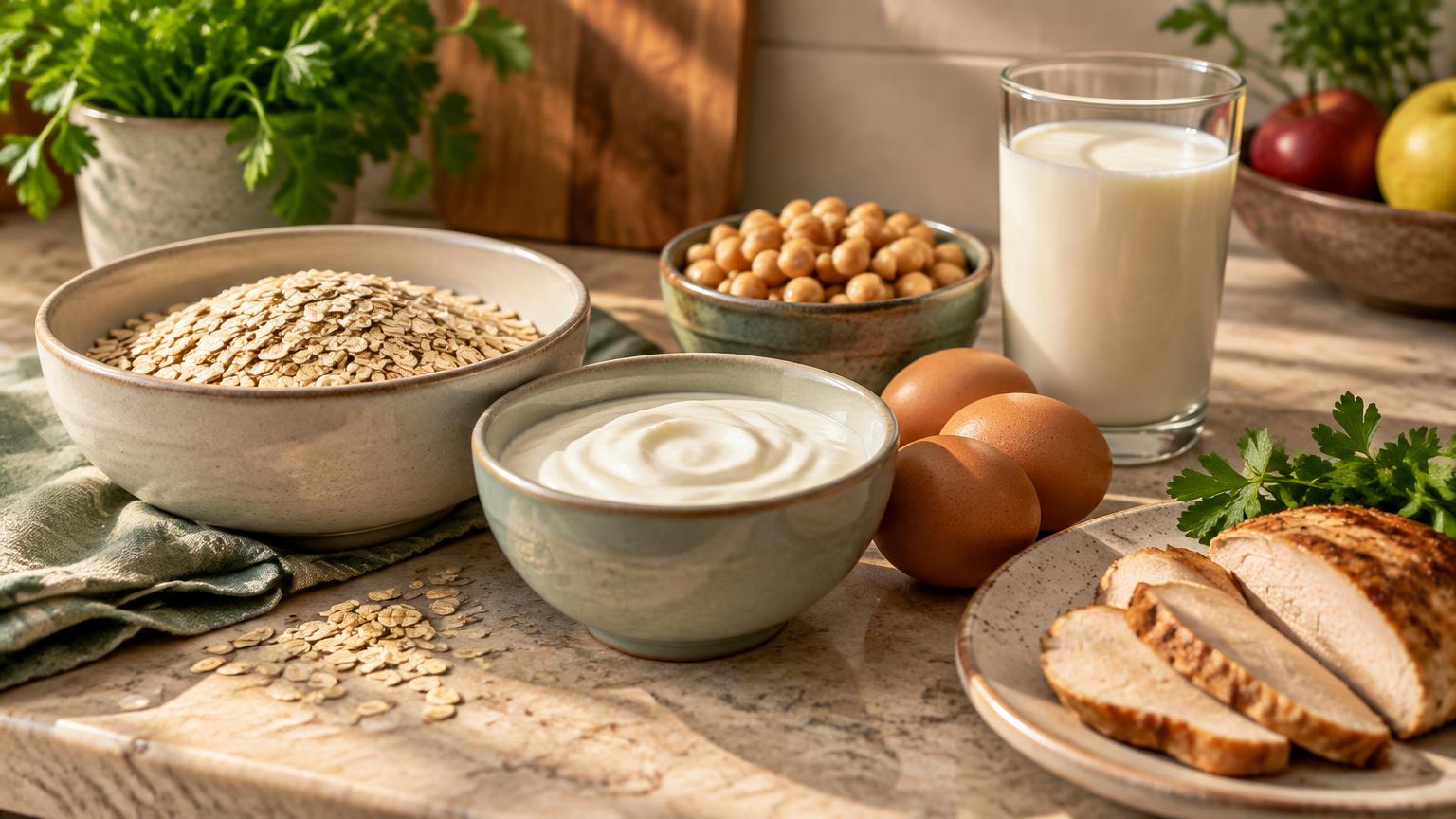
You don't need to guess how much protein a yoghurt, carton of milk or tin of chickpeas contains.
The nutrition information is printed on the packaging.
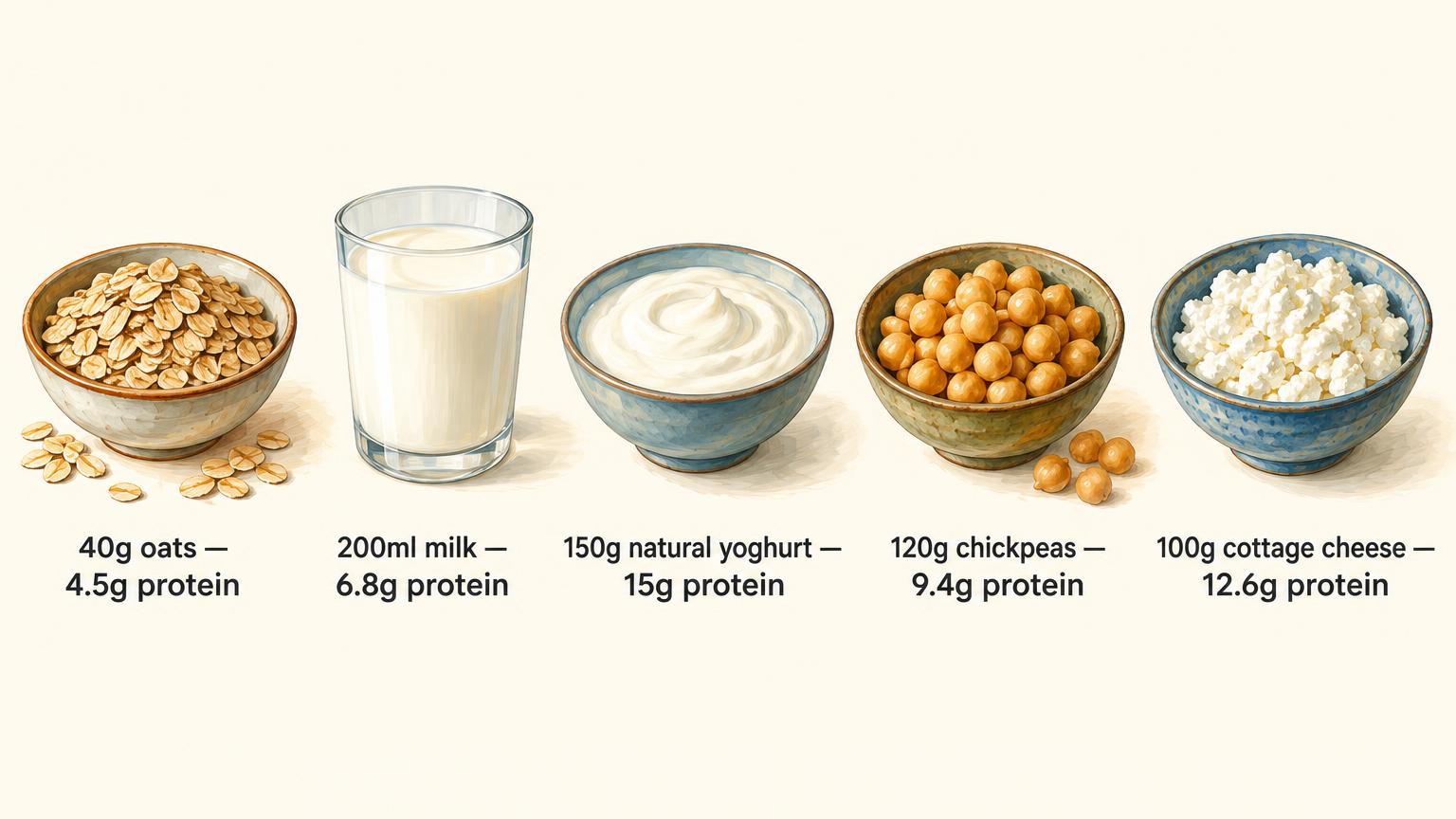
We checked five products listed by Tesco Ireland to see how much protein they provide in realistic quantities.
| Product | Example quantity | Protein |
|---|---|---|
| Flahavan's Organic Porridge Oats | 40g dry oats | 4.5g |
| Avonmore Fresh Whole Milk | 200ml | 6.8g |
| Glenisk Natural Fat Free Protein Yoghurt | 150g | 15g |
| Tesco Chickpeas in Water | 120g drained | 9.4g |
| Glenisk Luxury High Protein Cottage Cheese | 100g | 12.6g |
Sources: Tesco Ireland product nutrition listings, checked 16 October 2026. Yoghurt and cottage cheese servings have been calculated from the published per-100g figures. Values are rounded.
There are several interesting things about this comparison.
First, protein isn't exclusively found in meat or specialist sports products.
Oats, beans, milk and yoghurt all contribute.
Second, the quantities you actually consume can change the picture.
A food containing 10g of protein per 100g supplies 20g when you eat 200g.
Third, protein content is not the only thing worth considering.
The chickpeas also provide fibre.
Milk provides calcium.
Oats provide wholegrain carbohydrate and fibre.
Cottage cheese provides protein but can also contain meaningful amounts of saturated fat, depending on the formulation.
Each food contributes different nutrients.
Waterford-based Flahavan's lists approximately 11g of protein per 100g in its Organic Porridge Oats.
A typical 40g dry serving provides approximately 4.5g.
That might not sound particularly impressive next to a protein bar.
But oats also provide fibre, complex carbohydrate and other nutrients.
And most people don't eat them entirely on their own.
Prepare that 40g portion with 200ml of Avonmore whole milk and the combination provides approximately:
4.5g + 6.8g = 11.3g protein.
That's before adding nuts, seeds or other toppings.
It's a reminder that the protein in a meal often comes from several ingredients.
The Glenisk Natural Fat Free Protein Yoghurt contains 10g of protein per 100g.
A 150g portion therefore provides approximately 15g.
A 200g portion provides approximately 20g.
The ingredient list is particularly straightforward:
Skimmed milk and live yoghurt cultures.
The product contains 3.5g of sugars per 100g, according to its published label.
Those sugars occur naturally in the milk, rather than being added table sugar.
This makes it an interesting example of a high-protein food that doesn't require an extensive list of additional protein concentrates, flavours or sweeteners.
That doesn't establish that every Glenisk product has the same nutritional profile.
Different flavours and formulations can vary.
Tesco's tinned chickpeas contain 7.8g of protein per 100g drained.
A 120g serving provides approximately 9.4g.
But protein isn't their only nutritional advantage.
They also contain 5.2g of fibre per 100g.
That's approximately 6.2g of fibre in a 120g portion.
So the chickpeas provide both protein and fibre, alongside carbohydrate and other nutrients.
They're a useful example of why foods should not be ranked solely according to which provides the most protein.
A tin of chickpeas and a protein shake serve different purposes.
One isn't automatically superior to the other.
A 200ml glass of Avonmore whole milk contains 6.8g of protein.
It also contains calcium, vitamin B12 and naturally occurring lactose.
The same serving provides approximately 4.4g of saturated fat, according to the product label.
Someone prioritising lower saturated fat might choose a lower-fat milk instead.
The important point is that protein needs to be considered alongside the rest of the food's nutritional characteristics.
Glenisk's Luxury High Protein Cottage Cheese contains 12.6g of protein per 100g.
Its 320g pot is advertised as containing approximately 40g of protein in total.
That sounds impressive.
But there's a considerable difference between a 100g portion and consuming the complete 320g pot.
The product also contains 4.7g of saturated fat per 100g.
Again, that doesn't automatically make it a poor choice.
It means the portion size and complete nutritional profile matter.
It's easier to understand protein intake when you stop looking at individual food products and consider how they add up.
Using the verified products above, imagine the following quantities spread across a day.
40g Flahavan's porridge oats with 200ml Avonmore whole milk.
Protein: approximately 11.3g.
120g drained Tesco chickpeas included in a salad, wrap or another meal.
Protein from the chickpeas: approximately 9.4g.
200g Glenisk Natural Fat Free Protein Yoghurt.
Protein: approximately 20g.
100g Glenisk Luxury High Protein Cottage Cheese, served alongside other foods.
Protein from the cottage cheese: approximately 12.6g.
| Food | Protein |
|---|---|
| Oats and milk | 11.3g |
| Chickpeas | 9.4g |
| Natural protein yoghurt | 20g |
| Cottage cheese | 12.6g |
| Combined protein | 53.3g |
This isn't a complete meal plan, and it isn't intended as one.
It excludes the protein and other nutrients from additional foods, such as bread, vegetables, fish, meat, tofu or other ingredients used throughout the day.
It is simply a demonstration of how several ordinary products can contribute substantial protein.
For a healthy adult weighing 70kg, the EFSA population reference intake is approximately 58g daily.
The foods in this example provide most of that amount.
But a person following the higher protein intake often recommended for resistance training would need considerably more.
That's why the appropriate quantity depends on the person rather than the marketing claim.
Not necessarily.
Protein powders and ready-to-drink shakes can be convenient, particularly for people who struggle to meet higher protein requirements through ordinary meals.
But there is no general requirement for healthy adults to consume protein supplements.
Food sources can provide the protein that many people need.
The HSE's healthy-eating guidance recommends a varied diet containing foods such as milk, yoghurt, fish, lean meat, eggs, beans and nuts.
That variety also helps supply nutrients beyond protein.
A protein powder, by comparison, may be designed primarily to provide protein efficiently.
That can be useful in some circumstances.
But convenience is not the same as necessity.
Some people may find them practical because of:
But a scoop containing 25g of protein isn't automatically better than a meal providing a similar amount.
The rest of the diet still matters.
And when choosing supplements, it is important to check the ingredients, serving information and suitability for individual circumstances.
Both can contribute to daily protein requirements.
Animal-derived foods such as milk, eggs, meat and fish often provide all essential amino acids in proportions that make them useful protein sources.
Plant foods vary more in their individual amino-acid profiles and digestibility.
But that doesn't mean plant-based diets are inherently inadequate in protein.
A varied diet containing foods such as beans, lentils, tofu, soya products, grains, nuts and seeds can supply protein and essential amino acids.
EFSA's population reference intake for protein is intended to apply to mixed dietary protein, including plant and animal sources.
There is no general requirement to combine particular plant proteins within the same meal for everyone following a varied plant-based diet.
The overall intake and variety across the day matter more.
Chickpeas provide less protein per 100g than many animal-derived protein foods.
But they also provide fibre.
That is a meaningful nutritional difference.
A chicken breast and a serving of chickpeas shouldn't be treated as interchangeable simply because both contain protein.
Their energy, fibre, fat and micronutrient compositions differ.
Both can contribute to a balanced diet.
Protein can contribute to feelings of fullness, and adequate protein intake can help support the maintenance of muscle.
But consuming more protein does not automatically cause fat loss.
Body weight is influenced by total energy intake, energy expenditure and other factors over time.
A food labelled high protein can still be energy-dense.
It may also contain added sugars, saturated fat or other ingredients that matter to the overall diet.
For example, adding a protein bar to an otherwise unchanged diet increases total energy intake.
Replacing another snack with a protein-rich option might change the balance of that person's diet in a different way.
The context matters.
Protein can be useful when planning meals, but it doesn't replace the need to consider overall food quality, portion size and individual requirements.
You'll often hear that protein must be consumed immediately after exercise.
The evidence is more nuanced.
The ISSN identifies total daily protein intake as an important factor in supporting muscle growth and maintenance in exercising individuals.
Consuming protein around exercise can be helpful, but the idea that everyone has only a very short window in which protein can be used effectively is an oversimplification.
For healthy people undertaking resistance training, distributing protein across meals can be a practical strategy.
The ISSN's position stand discusses approximate protein doses of 20–40g per eating occasion for many exercising individuals, depending on body size, age and other factors.
That isn't a compulsory amount for every meal.
It also isn't a recommendation that everyone must eat four or five separate protein-heavy meals.
People who are less active, older, pregnant, recovering from illness or managing medical conditions may have different considerations.
The sensible approach is to focus on an appropriate daily intake before worrying about whether a protein snack is consumed at an exact time.
No.
A food can legitimately be high in protein without being particularly high in fibre.
It can also contain substantial quantities of sugar, salt or saturated fat.
Likewise, a food providing a moderate amount of protein may supply valuable nutrients that aren't obvious from its front-of-pack branding.
This is particularly relevant to protein bars, flavoured yoghurts and fortified snacks.
Under EU Regulation 1924/2006, which applies in Ireland, a high-protein claim means that at least 20% of the food's energy comes from protein.
A source-of-protein claim requires at least 12%.
These claims describe the proportion of energy supplied by protein.
They do not establish that the product is healthy overall.
A product also doesn't qualify as high protein simply because a large serving contains 20g or 30g.
For more detail, read High Protein Doesn't Always Mean Healthy.
European food labels use standard reference intakes for an average adult.
For protein, that reference intake is 50g per day.
You might see a food providing 10g of protein described as delivering 20% of an adult's reference intake.
That calculation is correct for the standard labelling reference.
But it isn't a personalised protein target.
The label's 50g reference intake and EFSA's body-weight-based population reference intake serve different purposes.
The 50g figure standardises food labelling.
The EFSA figure provides population-level dietary guidance using body weight.
And sports-nutrition recommendations may differ again.
A percentage on a food label should not be confused with an individual's precise daily requirement.
You can learn more in How to Read a Food Label in Ireland.
Maintaining muscle is important throughout adulthood, but it becomes especially relevant with age.
Muscle mass and strength can decline over time, and adequate nutrition alongside appropriate physical activity can help support muscle health.
EFSA's general population reference intake includes older adults.
However, other clinical and nutritional guidance sometimes recommends higher protein intakes for older people, depending on health, activity and nutritional status.
The HSE's healthy-eating guidance for older adults encourages including protein-rich foods in at least two meals each day.
Examples include fish, eggs, meat, beans, lentils and nuts.
For someone experiencing unintentional weight loss, reduced appetite, frailty or difficulty eating, individual assessment matters much more than applying a generic figure from the internet.
The same applies to people with kidney disease or other conditions that may require adjustments to protein intake.
In those circumstances, advice should come from an appropriately qualified healthcare professional.
You don't need to chase the biggest protein number in the supermarket.
A few simple questions are more useful.
Start with the nutrition declaration.
Check the amount per 100g or 100ml, then calculate the amount in the portion you actually plan to consume.
Look at fibre, sugars, saturated fat, salt and total energy.
Two foods providing the same protein can have very different nutritional characteristics.
Whole foods, concentrated protein ingredients and formulated snacks can all supply protein.
Understanding the ingredient list helps explain what you're buying.
A recreationally active person, a strength athlete and a largely sedentary adult may not require identical protein intakes.
More protein isn't automatically a better purchase.
An oat-based breakfast with milk and nuts provides protein from several ingredients.
A meal with beans, grains and vegetables also combines different nutritional contributions.
You don't need every individual food to carry a high-protein claim.
Protein is a positive nutritional characteristic, but it doesn't exist in isolation.
The Sláinte food scanner is designed to help users understand how the entire product compares rather than focusing on one number.
Its published food-scoring methodology combines three components:
| Component | Weight |
|---|---|
| Nutrition quality | 55% |
| Ingredients | 30% |
| Processing and quality signals | 15% |
The nutrition component considers protein alongside characteristics such as fibre, sugars, energy, saturated fat and salt.
The ingredients component looks at the declared formulation, including relevant additives.
Processing and quality signals form the remaining part of the assessment.
Additional category-specific rules and score limits apply.
Importantly, the published methodology does not allow a product to compensate indefinitely for unfavourable nutritional characteristics simply by adding more protein.
That means a high-protein snack isn't automatically guaranteed an Excellent Sláinte Score.
And plain foods containing moderate protein can still have strong overall nutritional profiles.
We haven't assigned scores to the foods compared in this article. Exact scores depend on their verified product records and the current Sláinte scoring engine.
You can read the full Sláinte methodology.
Scan your next high-protein product with Sláinte to explore its nutrition, ingredients and available alternatives.
EFSA sets a population reference intake of 0.83g of protein per kilogram of body weight daily for healthy adults. Individual requirements can differ according to activity, age, health and other circumstances.
It depends on your body weight, activity and goals. For many healthy adults, 100g exceeds the general population reference intake. For some larger individuals undertaking demanding resistance training, it may fall below commonly recommended sports-nutrition ranges.
The EFSA population reference intake is approximately 66g daily. For many healthy exercising individuals seeking muscle growth or maintenance, the ISSN discusses a range of approximately 112–160g daily.
No. It is possible to obtain substantial amounts of protein from ordinary foods. Protein powder can be a convenient addition, but it isn't inherently necessary for everyone undertaking resistance training.
It may meet the general EFSA population reference intake for an otherwise healthy adult weighing approximately 60kg. It may be insufficient for someone with higher requirements. The 50g standard reference intake printed on EU food labels isn't a personalised target.
They vary considerably. A protein bar can provide substantial protein but may also contain sugar, sweeteners, polyols, saturated fat or other ingredients. Assess the specific product rather than assuming the category is uniformly healthy or unhealthy.
Plant-based foods can contribute to muscle maintenance and growth when total dietary protein, essential amino-acid intake, energy intake and training are appropriate. Protein source, quantity and overall dietary variety all matter.
Protein can support satiety and muscle maintenance, but increasing protein intake alone does not guarantee weight loss. Total dietary intake and other individual factors remain important.
Protein needs and tolerances vary. For healthy adults, intakes above the general reference amount are not automatically harmful, but exceptionally high intakes are not necessarily beneficial. People with kidney disease or other relevant medical conditions should obtain individual dietary advice.
Protein consumption around exercise can be useful, but an extremely narrow post-exercise window isn't necessary for everyone. Appropriate total daily intake and overall training consistency are important.
The question isn't whether you're buying enough high-protein products. It's whether your normal diet supplies the protein your body actually needs.
For many people, that starts with ordinary food rather than another expensive snack carrying a large number on the packaging.
Last reviewed: 16 October 2026