
Back to Journal

Not From Concentrate Orange Juice vs Whole Oranges: What's Actually Healthier?

Published · Updated  · Sláinte Editorial

A chilled carton of orange juice looks like an easy health decision. The label says 100% fruit. There's no added sugar. It contains vitamin C. Some brands even tell you how many oranges went into the bottle.

All of those things can be true.

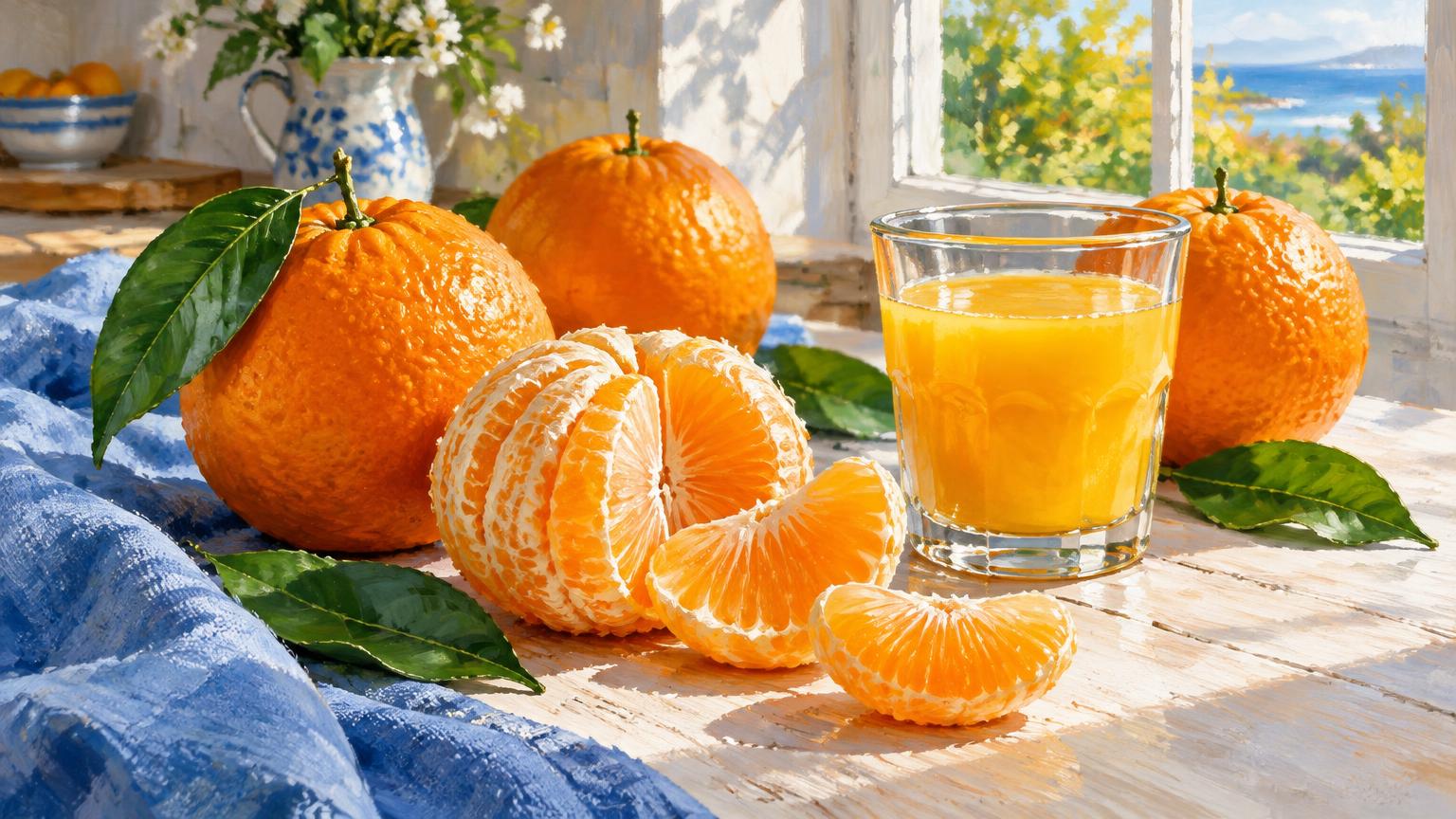
Whole oranges, orange segments and a small glass of orange juice

The figures below come from the exact Irish retailer listings linked in the sources. They are not laboratory measurements or a guarantee that every pack on the shelf uses the same recipe. Check your own pack if it differs.

But they don't make a 300ml glass of juice nutritionally identical to eating two whole oranges.

To understand why, we checked Tropicana Smooth Orange Juice, Innocent Smooth Orange Juice, and Tesco 100% Pure Squeezed Orange Juice With Bits sold in Irish supermarkets. We then compared what the labels tell us with the way whole fruit is eaten.

The biggest finding is not a hidden ingredient. It's a distinction that's easy to miss: a product can contain 100% orange juice and no added sugar, while its naturally occurring sugars still count as free sugars under WHO dietary guidance.

And removing most of the fruit's physical structure changes the eating experience, even when the juice retains valuable nutrients such as vitamin C.

What does 'not from concentrate' actually mean?

Orange juice can be sold as directly extracted juice, or produced from juice that was concentrated and later reconstituted with water under regulated conditions. Not from concentrate describes the production route. It doesn't mean the juice was never processed, stored, chilled or pasteurised.

Commercial juice production may involve extraction, filtration, separation of pulp, pasteurisation or other permitted treatments designed to manage quality and food safety. The exact process varies by producer and product.

A not-from-concentrate juice may contain only orange juice as an ingredient. That's a straightforward declaration, but it doesn't prove that the finished liquid is identical in fibre and structure to the fruit you peeled yourself.

Under the EU rules for fruit juices, categories such as fruit juice, fruit juice from concentrate and fruit nectar are legally distinct. Fruit nectar can have different permitted ingredients from pure fruit juice. Read the legal product name, not just the flavour on the front. Added sugars are not permitted in ordinary fruit juice under the regulated juice category, so their absence is not a unique nutritional advantage of one brand.

The amended EU framework also recognises reduced-sugar fruit juice categories, requiring at least a 30% reduction compared with the corresponding juice. These are distinct designated products. None of the four ordinary orange juices below is identified here as a reduced-sugar version.

Four real Irish supermarket labels

All values below are per 100ml unless otherwise stated.

Product and exact versionEnergyTotal sugarsFibreIngredient statement
Tropicana Smooth Orange Juice, 1.5L40 kcal8.6g0gOrange juice
Innocent Smooth Orange Juice, 330ml38 kcal7.8gNot declared on this exact listingOranges squeezed into juice
Tesco 100% Pure Squeezed Orange Juice With Bits, 1L45 kcal10.0g0.1g100% squeezed orange juice
Tesco Finest Freshly Squeezed Smooth Orange Juice, 1L48 kcal8.5g0.5gOrange (100%)

The first surprise: sugar concentrations vary between products, including drinks made entirely from oranges. Variety of fruit, season, processing and declared values can contribute to differences.

The second: a juice with bits is not automatically high in fibre. The Tesco With Bits listing shows 0.1g fibre per 100ml. The Tesco Finest Smooth version in our comparison lists 0.5g, which shows why you shouldn't infer fibre content solely from whether a juice looks cloudy or contains pulp.

The third: '100% fruit' is accurate and useful, but it isn't equivalent to a low-sugars claim. All four products contain several grams of sugar per 100ml.

Sugars per 150ml
  1. 1Tropicana Smooth: 12.9g
  2. 2Innocent Smooth 330ml variant: 11.7g
  3. 3Tesco With Bits: 15.0g

Comparison based on the specific examples discussed in this article.

What happens when the glass gets bigger?

People sometimes compare juice per 100ml while drinking two or three times that amount.

Using the declared labels, here's how a 150ml glass compares with a 300ml glass.

ProductSugars in 150mlSugars in 300ml
Tropicana Smooth12.9g25.8g
Innocent Smooth, 330ml variant11.7g23.4g
Tesco 100% Pure Squeezed With Bits15.0g30.0g
Tesco Finest Freshly Squeezed Smooth12.8g25.5g

These amounts are calculated from the per-100ml figures and rounded to one decimal place; the retailer may round its serving values differently.

It's easy to drink 300ml with breakfast without considering that it is twice the 150ml portion often used for dietary guidance. That doesn't make orange juice a forbidden food. It shows why the serving size is worth noticing.

For context, WHO recommends limiting free sugars to less than 10% of daily energy and suggests that below 5% may provide additional benefits. For someone eating around 2,000 calories a day, those thresholds correspond to less than 50g and less than 25g respectively.

A 300ml glass of one of these juices can therefore contribute a substantial share of that illustrative amount.

Whole fruit and juice differ
  1. 1Whole orange: intact fruit structure
  2. 2Juice: less retained fibre
  3. 3Juice sugars count as free sugars

Illustrative guide, not a score for a whole category.

But if there is no added sugar, why does it count?

The phrase no added sugar concerns what was or wasn't added during manufacture. A label may truthfully say that the only ingredient is orange juice.

WHO's term free sugars has a different definition. It includes sugars added by manufacturers or consumers and sugars naturally present in honey, syrups, fruit juices and fruit juice concentrates.

So the sugars in pure orange juice count even if nobody added table sugar. Meanwhile, the sugars naturally present inside intact whole fruit are not included in the same way.

That's a nutritional classification, not an allegation that a juice label is false.

For a clearer explanation of the legal claims, visit “No Added Sugar” Does Not Mean “No Sugar”. We've also covered how much sugar is too much.

Why whole oranges are different

When you eat an orange, you peel it, break it into segments and chew. You're consuming the fruit's edible cell structure, water and fibre together. That process takes more time than drinking juice.

Juicing extracts liquid and leaves behind much of the fruit's solid material. The amount of fibre remaining depends on the product and processing method. A pulp-containing product can retain some fibre, but it's not automatically nutritionally equivalent to the original whole fruit.

Whole fruit provides a food matrix, the physical structure in which nutrients are contained. This can affect how quickly the food is eaten and how satisfying it feels. It also makes a difference to dental health and the categorisation of sugars.

That does not mean juice contains nothing useful. Orange juice can provide vitamin C and potassium. It can also be a convenient way to enjoy fruit flavours, especially in modest portions.

The comparison isn't good fruit versus bad juice. It's intact fruit versus a processed liquid with different features.

Is freshly squeezed juice healthier than bottled juice?

Not automatically. Juice squeezed at home and consumed immediately has a different preparation history from shelf-stable or chilled supermarket juice, but both can contain substantial naturally occurring free sugars.

Freshly squeezing fruit does not restore the fibre left in the juicer. The amount of pulp retained depends on what you do with it. And drinking freshly squeezed juice doesn't change WHO's treatment of fruit-juice sugars.

Bottled juice may undergo pasteurisation to improve microbiological safety. The exact treatment can affect some properties of the product, but it should not be described as removing all nutrients or converting juice into something that is simply sugar water.

For vulnerable people, pasteurised juice can be a particularly relevant safety consideration. Pregnant people and anyone advised to avoid unpasteurised products should follow appropriate clinical and food safety guidance.

What about flavour packs and storage tanks?

Orange-juice production can include controlled storage and treatments that maintain consistent quality. EU rules permit certain processes and, under specified conditions, restoration of flavour, pulp and cells in juice products.

But we do not have adequate evidence that the exact Irish Tropicana, Innocent or Tesco products in our table use a particular flavour-pack system or storage practice. It would be irresponsible to present a general processing method as a verified secret ingredient of a named brand.

The labels we checked identify orange juice or oranges as the ingredients. If a future investigation is about an individual manufacturer's industrial process, it should use company specifications, technical documents or firsthand reporting rather than a guess based on its category.

Not from concentrate does not mean untouched. Equally, industrially processed does not mean the product is fake orange juice.

Does juice cause a bigger blood-sugar spike than eating an orange?

Juice usually allows you to consume fruit sugars more quickly and with less of the intact fruit's fibre structure. This makes the comparison relevant to blood-glucose management, but the precise response depends on the portion, type of juice, individual metabolism and the rest of the meal.

It would be misleading to promise that everyone experiences a particular spike or to use the word insulin spike as though it were a diagnosis.

People with diabetes should consider the carbohydrate in drinks and seek individual advice from their diabetes care team. Even for people without diabetes, replacing some large glasses of juice with whole fruit can be a practical way to retain more of the fruit's structure and fibre.

What about the 150ml advice?

NHS healthy eating guidance recommends limiting the combined total of fruit juice and smoothies to about 150ml a day and having them with meals. That is UK guidance, but a useful practical benchmark for Irish readers; it is not being presented here as a separate Irish legal limit.

The reason is that juice contains free sugars, and frequent exposure can contribute to tooth decay. The advice doesn't mean a 160ml glass is suddenly dangerous. It simply encourages modest portions as part of an overall balanced diet.

A whole orange can make a satisfying snack on its own. Juice tends to work better as a small drink alongside a meal rather than the main way of consuming fruit.

How to choose between juice and fruit

If you want a quick drink with breakfast, a small glass of 100% orange juice can fit. If you're looking for a filling fruit snack, eating an orange gives you the intact fruit with more of its natural structure and fibre.

Check the actual carton for sugar per 100ml and per serving. Don't assume a large bottle is one portion. If you prefer some pulp, choose a product whose label shows the fibre you want, rather than assuming 'with bits' guarantees a high-fibre drink.

For families, consider juice as a drink rather than a replacement for offering whole fruit regularly. If you're buying juice for a child, follow age-appropriate national health guidance.

And if the main reason you're choosing a juice is that it says no added sugar, remember that it can still contain substantial naturally occurring free sugars.

Product scores and label checks

The scored examples use the ingredients and nutrition of the exact products identified below, calculated through the same rules as a Sláinte scan. They are product comparisons, not ratings for an entire brand or an unmeasured meal. A barcode link is shown only where the exact catalogue record is matched.

Actual Sláinte Scores from the checked product labels

These are calculated with the scanner's existing rules. Product labels, not brand-wide assumptions, supply the inputs. Processing groups are editorial classifications based on the declared recipe. Unmatched barcodes are not invented.

Tropicana Smooth Orange Juice 1.5L

88

/100

Sláinte Score

Excellent

Short list, real food, nothing hiding.

  • Light in calories
  • Low in sugars
  • Low in saturated fat
  • Fits a balanced diet

What's inside (per 100 g)

The Good Stuff

Watch out for

AdditivesNo additives declared on this label0

Ingredients: Orange Juice

Scored from the exact linked retailer label. No barcode link is shown because the exact catalogue pack has not been established.

Innocent Smooth Orange Juice 330ml

88

/100

Sláinte Score

Excellent

Short list, real food, nothing hiding.

  • Light in calories
  • Low in sugars
  • Low in saturated fat
  • Fits a balanced diet

What's inside (per 100 g)

The Good Stuff

Watch out for

AdditivesNo additives declared on this label0

Ingredients: 4 Juicy Oranges (100%) Squeezed into every bottle

Scored from the exact linked retailer label. No barcode link is shown because the exact catalogue pack has not been established. Fibre is not declared and has not been set to zero.

Tesco Finest Freshly Squeezed Smooth Orange Juice 1L

88

/100

Sláinte Score

Excellent

Short list, real food, nothing hiding.

  • Light in calories
  • Low in sugars
  • Low in saturated fat
  • Fits a balanced diet

What's inside (per 100 g)

The Good Stuff

Watch out for

AdditivesNo additives declared on this label0

Ingredients: Orange (100%).

Scored from the exact linked retailer label. No barcode link is shown because the exact catalogue pack has not been established. Salt is declared as less than 0.01g/100ml; 0.01g is used as a conservative upper bound, not an exact measured amount.

Frequently asked questions

Is not-from-concentrate orange juice healthier?

Not automatically. The phrase describes how juice is made, not its complete nutrition. Compare sugars, fibre, serving size and other nutrients for the exact product.

Does Tropicana contain added sugar?

The Tropicana Smooth Orange Juice variant examined lists orange juice as its ingredient and states no added sugar. It still contains about 8.6g total sugars per 100ml, which are naturally present in the juice.

Is Innocent orange juice high in sugar?

The 330ml Innocent Smooth Orange Juice listing shows 7.8g total sugars per 100ml, corresponding to approximately 26g in the whole bottle. Portion size matters.

Why is a whole orange different from orange juice?

Whole oranges retain more of the intact fruit structure and fibre. Juice is easier to drink quickly and generally contains less fibre. Sugars in fruit juice are counted as free sugars by WHO.

Can orange juice say no added sugar and still have 25g of sugar?

Yes. A larger serving can contain 25g or more naturally occurring total sugars even when none was added during production. No added sugar does not mean sugar-free.

Is juice with bits as good as eating an orange?

Not necessarily. The amount of fibre in juice with bits varies, and it usually does not reproduce the entire structure and fibre of the original whole fruit.

The short version

  • A 100% orange juice carton can be genuine fruit juice and still contain a meaningful quantity of free sugars. 'Not from concentrate' and 'no added sugar' describe real characteristics, but neither replaces a comparison of serving size, sugar and fibre. Whole oranges and bottled juice are not nutritionally interchangeable.