
Back to Journal

The Irish Sliced Pan: What's Actually Different About Sourdough?

Published · Updated  · Sláinte Editorial

There's something familiar about an Irish sliced pan. It folds around a sandwich, makes predictable toast and stays soft enough to survive a few days in the bread bin.

Walk into a bakery, though, and you'll find a different kind of bread: a crusty sourdough loaf, sometimes made with little more than flour, water, a starter and salt. The price is higher, the flavour is tangier and the ingredient list can be shorter.

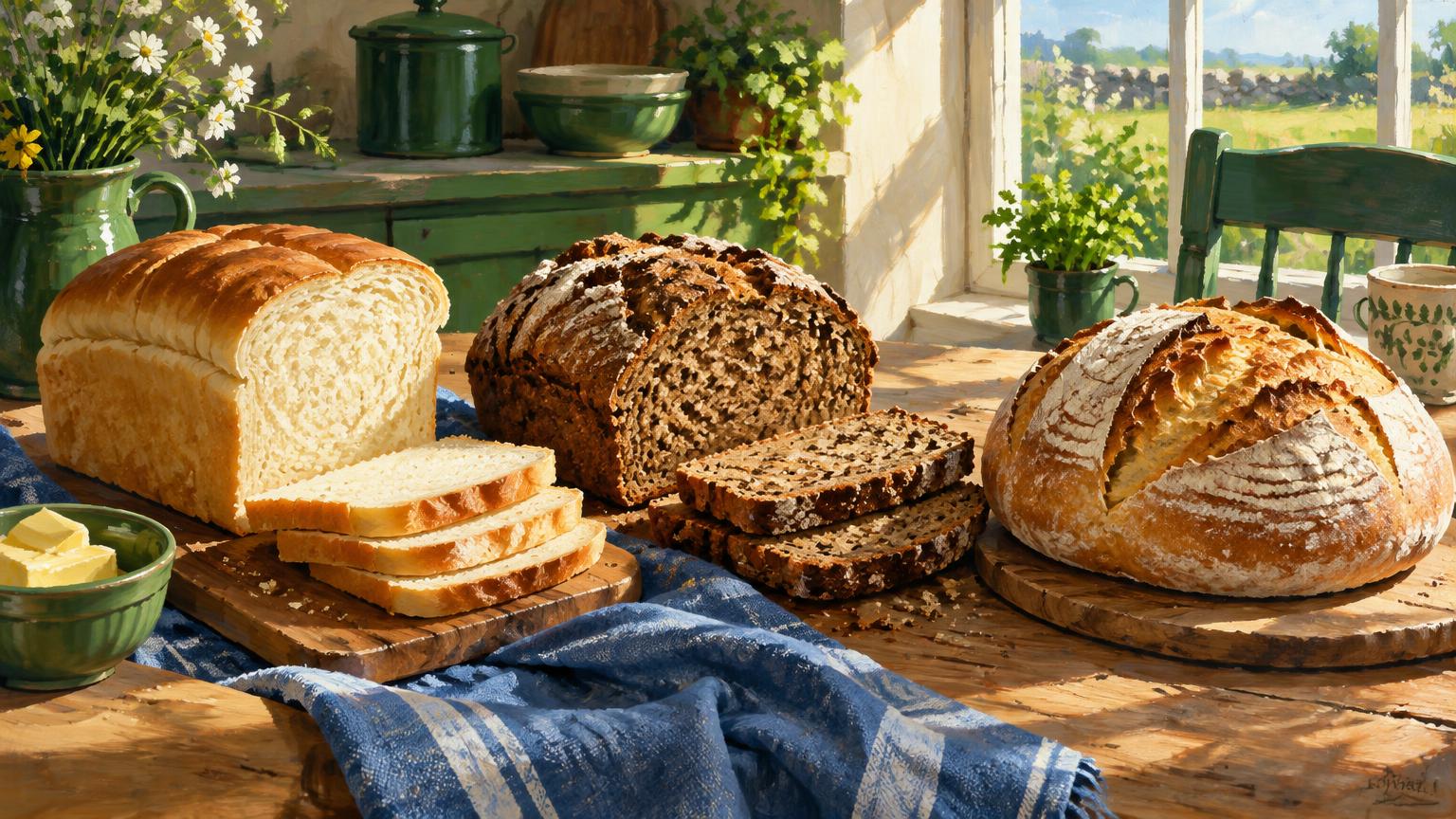
Irish white sliced bread, stoneground soda bread and sourdough arranged side by side

The figures below come from the exact Irish retailer listings linked in the sources. They are not laboratory measurements or a guarantee that every pack on the shelf uses the same recipe. Check your own pack if it differs.

That has created an easy story. Supermarket bread is full of chemicals; sourdough is real bread.

The actual difference is worth understanding, but the story is too simple. Some ordinary sliced pans contain emulsifiers and flour treatment agents, while others are relatively straightforward. A traditional Irish soda bread can have high fibre without being sourdough. And a sourdough loaf made mostly from refined white flour isn't automatically more nutritious than every wholemeal sliced loaf.

We examined Brennan's Family Pan, Pat the Baker White Sliced Pan, John McCambridge Original Whole Wheat Bread and Dunnes Stores House Organic White Sourdough to see what the labels really show.

What is the sliced pan designed to do?

A sliced pan is built for consistency. People want a soft crumb, slices that don't fall apart, an even rise, reliable toast and a practical shelf life.

Commercial bakeries can use mechanical mixing, controlled fermentation, emulsifiers, flour improvers and carefully designed packaging to achieve those characteristics at scale. Some ingredients help stabilise the dough or soften the finished bread; others are included to support production consistency.

The frequently mentioned Chorleywood Bread Process is a method developed for rapid industrial breadmaking. But you cannot determine from the ingredients list alone whether a particular Irish loaf was made using that exact process. It would require manufacturer confirmation.

Nor does a longer shelf life prove that a loaf contains a particular preservative. Packaging, moisture, acidity, hygiene, baking and distribution all affect how long bread stays acceptable.

Four real Irish bread products

ProductEnergy per 100gFibre per 100gSalt per 100gNotable ingredients
Brennan's Family Pan Premium White 800g219 kcal2.8g1.1gWheat flour, rapeseed oil, soya flour, E472e, ascorbic acid, palm fat
Pat the Baker White Sliced Pan 800g233 kcal2.8g1.2gWheat flour, yeast, soya flour, several emulsifiers, calcium propionate, oils
John McCambridge Original Whole Wheat Bread 510g224 kcal6.5g1.3gButtermilk, wholemeal flour, wheat flour, bicarbonate of soda, salt, wheatgerm
Dunnes Stores House Organic White Sourdough 740g276 kcal4.1g1.52gOrganic flour, water, sourdough starter, rye, sprouted rye, salt

Retailer-declared nutrition and ingredients per 100g as sold. These are four different bread styles, not identical formulations. The sourdough figures are from the exact 740g Dunnes product page.

The clearest fibre difference is McCambridge's 6.5g per 100g, compared with 2.8g in the two white pans and 4.1g in the Dunnes white sourdough. The whole wheat loaf has more than twice the fibre of the white pans for the same weight of bread.

This comparison tells you something useful: the type and proportion of grain can matter more than whether the loaf is called artisan, sourdough or traditional.

Bread fibre per 100g
  1. 1Brennan’s white: 2.8g
  2. 2Pat the Baker white: 2.8g
  3. 3McCambridge whole wheat: 6.5g
  4. 4Dunnes white sourdough: 4.1g

Comparison based on the specific examples discussed in this article.

Brennan's: what do the flour treatment agent and emulsifier do?

The listed Brennan's Family Pan formulation contains wheat flour, water, yeast, salt, rapeseed oil, soya flour, emulsifier E472e, ascorbic acid and palm fat.

E472e is a food emulsifier used in baking, including to help with dough structure and finished texture. Ascorbic acid is vitamin C, but in breadmaking it is used as a flour treatment agent. In this context, it plays a technical role in the dough rather than turning bread into a vitamin supplement.

Palm fat and rapeseed oil contribute to the formulation. Their presence does not establish that the bread is dangerous, and we should not compare bread nutrition to a jar of palm oil simply because a small amount appears in the ingredients.

The exact Brennans Family Pan 800g Irish listing shows 2.42g total sugars per 100g despite a no-added-sugar claim. That is possible because total sugars can be naturally present in ingredients or arise in the finished food. For the legal distinction, see our no-added-sugar guide.

The practical nutrition question remains: how much fibre, salt, energy and wholegrain does your actual bread provide?

Three ways to raise bread
  1. 1Sliced pan: yeast
  2. 2Soda bread: bicarbonate
  3. 3Sourdough: fermented starter

Illustrative guide, not a score for a whole category.

Pat the Baker: why several emulsifiers?

Pat the Baker's White Sliced Pan lists mono- and diglycerides of fatty acids, mono- and diacetyl tartaric acid esters of mono- and diglycerides, and sodium stearoyl-2-lactylate. It also lists calcium propionate as a preservative and ascorbic acid as a flour treatment agent.

Those names sound complicated, but they're descriptions of functional food ingredients. Emulsifiers may help dough tolerate mechanical handling, improve crumb softness or slow staling. Calcium propionate is used to help control mould growth in certain baked foods.

A customer can reasonably prefer bread without these ingredients. But preference should not be converted into unsupported claims that an authorised additive is toxic at normal dietary exposure.

The Pat the Baker label we checked provides 3.6g sugars, 2.8g fibre and 1.2g salt per 100g. The most meaningful comparison with Brennan's is therefore not the number of unfamiliar names alone. It's the combined recipe, fibre, salt, price and what you actually enjoy eating.

McCambridge: neither sliced pan nor sourdough

This is the important Irish exception.

John McCambridge Original Whole Wheat Bread is a traditional soda bread, not a yeast-leavened white sliced pan and not a sourdough.

Its ingredients list buttermilk (38%), wholemeal wheat flour, wheat flour, bicarbonate of soda, salt and wheatgerm. The raising agent reacts in the dough, making bread without the same yeast fermentation process as a standard pan.

It provides 6.5g of fibre per 100g and declares no added sugar, contains naturally occurring sugars. That is a useful reminder that brown bread can be an excellent wholegrain option without requiring an elaborate sourdough starter.

But also look at salt: McCambridge has 1.3g per 100g, higher than the two white sliced pans but lower than the Dunnes sourdough at 1.52g. More fibre does not cancel the importance of salt.

For a 36g slice of McCambridge, the listed values are approximately 2.3g fibre and 0.47g salt. Portion size matters because the slices are not always the same weight as the thick white pan.

What's special about sourdough?

Traditional sourdough uses a starter containing yeasts and lactic acid bacteria. These microorganisms ferment dough over time, contributing to acidity, flavour and texture. The process may influence certain components of the flour, including phytate.

The exact Dunnes Stores House Organic White Sourdough 740g listing contains organic wheat flour, water, sourdough made from wheat and rye flours, rye flour, sprouted rye and salt. It declares 276 kcal, 4.1g fibre and 1.52g salt per 100g. That's a clear example of a relatively short bread recipe, but not a demonstration that every product marketed as sourdough uses the same formulation or fermentation time.

Does sourdough spike blood sugar less?

You may have heard that sourdough always produces a lower blood-glucose response. The evidence does not justify such a universal statement.

A 2026 systematic review of human studies reported that the overall case for a superior glycaemic effect of sourdough compared with yeast-fermented bread in healthy adults was not sufficiently convincing. Results varied by the breads tested, study design and other factors.

A loaf made largely from white flour still contains considerable digestible carbohydrate. The type of flour, fibre, portion and other foods in the meal remain important.

Is sourdough gluten-free?

No. Wheat or rye sourdough still contains gluten and is not safe for coeliac disease unless specifically formulated and certified gluten-free. Fermentation does not reliably remove gluten to a safe level.

Is sourdough always less processed?

Not necessarily. Some commercial sourdoughs are formulated with extra yeast, oils or ingredients for consistency. Traditional long-fermented versions may be quite simple, but shoppers need the actual ingredient list.

What about the bread that lasts longer?

Bread staling and mould growth are different processes. A loaf may become stale without becoming unsafe, and it may grow mould even if it still feels relatively soft.

Emulsifiers and fats can affect crumb softness and staling. Preservatives may help inhibit mould where permitted and used. Freezing bread at home is another way to make a loaf last without assuming it needs additional ingredients.

Check the manufacturer's storage instructions, use-by or best-before information and food safety advice. Never eat visibly mouldy bread on the assumption that toasting makes it safe.

How to choose bread in an Irish supermarket

Start with the ingredients, but don't stop there. A loaf where wholemeal flour or wholegrain ingredients feature prominently is often a useful place to begin when increasing dietary fibre. Compare fibre per 100g and actual salt per slice. Consider whether you want soft white sandwich bread, dense wholemeal soda bread, or a crusty sourdough for a particular meal.

If you enjoy a white pan, adding fibre elsewhere in your day matters more than feeling that you've bought the wrong bread. If sourdough is your favourite, check the flour, fibre and serving size rather than treating its name as a medical claim.

It is also worth checking cost per 100g. Artisan bread can be dearer because of labour, fermentation time, production scale and ingredients. That doesn't automatically translate into a proportional health benefit.

Product scores and label checks

The scored examples use the ingredients and nutrition of the exact products identified below, calculated through the same rules as a Sláinte scan. They are product comparisons, not ratings for an entire brand or an unmeasured meal. A barcode link is shown only where the exact catalogue record is matched.

Actual Sláinte Scores from the checked product labels

These are calculated with the scanner's existing rules. Product labels, not brand-wide assumptions, supply the inputs. Processing groups are editorial classifications based on the declared recipe. Unmatched barcodes are not invented.

Brennans Family Pan Premium White 800g

70

/100

Sláinte Score

Good

Grand for most of us, but it's wheat through and through, so steer clear if you're coeliac.

  • Low in sugars
  • Low in saturated fat
  • Good source of protein
  • 2 additives

What's inside (per 100 g)

The Good Stuff

Watch out for

Ingredients: Wheat Flour ( Wheat, Calcium Carbonate, Iron, Thiamin, Niacin), Water, Yeast, Salt, Vegetable Oil (Rapeseed), Soya Flour, Emulsifier: E472e, Flour Treatment Agent: Ascorbic Acid (Vitamin C), Vegetable Fat (Palm)

Scored from the exact linked retailer label. No barcode link is shown because the exact catalogue pack has not been established. The catalogue's older nutrition differs, so this is the retailer-label example rather than a link to that record.

Pat the Baker White Sliced Pan 800g

70

/100

Sláinte Score

Good

Grand for most of us, but it's wheat through and through, so steer clear if you're coeliac.

  • Low in sugars
  • Low in saturated fat
  • Good source of protein
  • 2 additives

What's inside (per 100 g)

The Good Stuff

Watch out for

Ingredients: WHEAT Flour (WHEAT Flour, WHEAT Gluten, Niacin, Thiamin, Iron, Calcium Cabonate), Water, Yeast, Salt, SOYA Flour, Emulsifiers (Mono and Di Glycerides of Fatty Acids, Mono and Di Acetyl Tartaric Acid Esters of Mono and Di Glycerides of Fatty Acids, Sodium Stearoyl - 2 - Lactylate), Preservative (Calcium Propionate), Vegetable Oils and Fats (Palm and Rapeseed), Flour Treatment Agent (Ascorbic Acid)

Scored from the exact linked retailer label. No barcode link is shown because the exact catalogue pack has not been established.

McCambridge Original Whole Wheat Bread 510g

55

/100

Sláinte Score

Good

Salt is the main thing holding this back.

  • Low in sugars
  • Low in saturated fat
  • No additives declared on this label
  • Fits a balanced diet

What's inside (per 100 g)

The Good Stuff

Watch out for

AdditivesNo additives declared on this label0

Ingredients: Buttermilk (38%), Wholemeal Wheat Flour, Wheat Flour, Raising Agent: Sodium Bicarbonate, Salt, Wheatgerm

Scored from the exact linked retailer label. No barcode link is shown because the exact catalogue pack has not been established.

Dunnes Stores House Organic White Sourdough 740g

78

/100

Sláinte Score

Excellent

Grand for most of us, but it's wheat through and through, so steer clear if you're coeliac.

  • Low in sugars
  • Low in saturated fat
  • No additives declared on this label
  • Too salty

What's inside (per 100 g)

The Good Stuff

Watch out for

AdditivesNo additives declared on this label0

Ingredients: Organic Wheat Flour, Water, Sourdough [Water, Organic Wheat Flour, Organic Wholemeal Wheat Flour, Organic Rye Flour, Starter Culture], Organic Rye Flour, Organic Sprouted Rye [Organic Rye Kernels, Water], Salt

Scored from the exact linked retailer label. No barcode link is shown because the exact catalogue pack has not been established.

Frequently asked questions

Does Brennan's bread contain preservatives?

The Brennans Family Pan 800g listing examined names E472e as an emulsifier and ascorbic acid as a flour treatment agent, but does not list a preservative. That does not establish the formulation of every other Brennans loaf. Check your exact pack.

Is Pat the Baker ultra-processed?

It contains several emulsifiers and a preservative in the formulation examined, which can be relevant to NOVA classification. But a final category depends on the precise product and classification rules. Do not infer a clinical health outcome from the category alone.

Is McCambridge better than sliced pan?

For fibre, the McCambridge whole wheat loaf we checked provides considerably more per 100g than the two white pans. It also has a higher salt figure. Better depends on the nutrient and your needs.

Is supermarket sourdough genuine sourdough?

Some supermarket loaves use a starter and a relatively simple recipe. Others may use additional ingredients or shorter processes. Ingredient declarations help, but fermentation method sometimes requires manufacturer information.

Is sourdough safe for coeliacs?

Ordinary wheat or rye sourdough is not gluten-free. People with coeliac disease need products specifically labelled gluten-free and appropriate to their dietary requirements.

The short version

  • The biggest proven difference in our comparison is wholegrain fibre, not a blanket verdict against industrial bread. Traditional sourdough can have a simple recipe, but it isn't automatically low carbohydrate, low salt or superior in every measure. Read the bread you actually buy.