
Back to Journal

Greens Powders in Ireland: Is AG1 Worth the Money?

Published · Updated  · Sláinte Editorial

You may have seen the routine. A scoop of green powder goes into a glass, the bottle gets a shake and a social media caption suggests that one drink has helped someone put their entire health routine in order.

Greens powders appeal because they promise simplicity. Instead of thinking about vegetables, fruit and supplements separately, you buy a single tub or pouch. Some products combine concentrated plant powders with vitamins, minerals, extracts, probiotics and other ingredients.

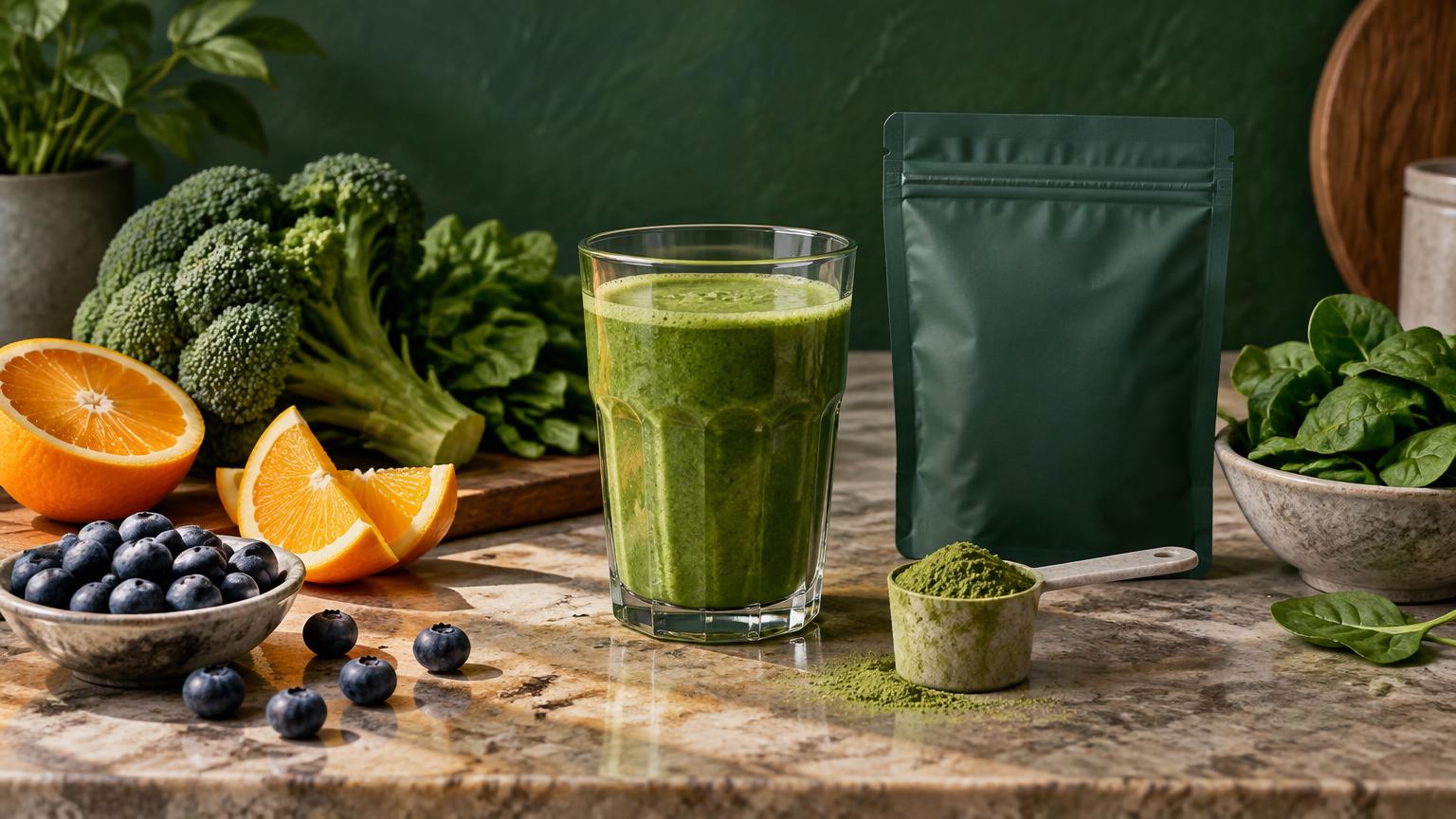
Illustration for Greens Powders in Ireland: Is AG1 Worth the Money?

That can be convenient. But convenience is different from proof that a powder improves your health, and a long ingredient list is not the same thing as eating a varied diet.

For this investigation, we examined AG1's European formula alongside other greens products sold to Irish shoppers. We also looked at an awkward but essential comparison: what happens when you spend the same money on ordinary food and a vitamin D supplement where one is recommended?

The conclusion is not that greens powders are useless or dangerous. It is that the label needs to show you what you are actually getting, in what dose, and at what price.

What actually goes into a greens powder?

The word "greens" doesn't describe one regulated recipe. One product may contain a few dehydrated vegetable powders, while another includes dozens of different ingredients, some in milligram quantities.

Common components include spinach powder, kale, wheatgrass, spirulina, chlorella, vitamins, minerals, fibre ingredients, flavourings and botanical extracts. Some formulations also contain added cultures or enzymes.

Those are different kinds of ingredients. A vitamin such as B12 has a defined dietary role. A powdered vegetable can contribute nutrients but won't necessarily reproduce the same amount of water, volume or fibre that you'd get from a portion of fresh or frozen vegetables. A herbal extract may have much less robust evidence for a specific advertised benefit.

This is why counting "superfoods" is a poor way to compare products. If a sachet lists 40 plants, it does not follow that each plant is present in a quantity likely to have a meaningful effect.

Equally, a supplement with eight well-labelled ingredients is not automatically superior to one with 20. You need to know which nutrients and substances are present, their amounts, and whether the claims made about them are supported.

AG1: what does the European label actually say?

AG1's official European product information identifies a 13g daily serving and 30 servings per pouch. The brand describes the formula as containing more than 70 ingredients.

Its published nutrition declaration for one serving includes approximately:

NutrientAG1, 13g serving
Energy41 kcal
Protein2.6g
Carbohydrate4.4g
Of which sugars1.2g
Fat0.9g
Salt0.1g

AG1 also declares individual vitamin and mineral quantities. Its European label shows, for example, 420mg of vitamin C per daily serving, equivalent to 525% of the EU reference intake for that vitamin.

That is a measurable nutritional contribution. It does not, on its own, establish that a healthy adult needs a product with that much vitamin C, or that higher amounts generate proportionately greater health benefits.

The formula also contains a range of plant powders and extracts. Where individual botanical doses are not easily isolated on a label, you cannot infer that every named botanical has been studied at the dose delivered in the finished product.

For transparency, readers should distinguish three things: the number of ingredients, the quantities actually declared, and evidence for outcomes from the finished formulation. Those are not interchangeable.

The price comparison Irish shoppers should make

The linked European offer used for this comparison lists a 30-serving pouch at €87, or €2.90 per serving. Treat this as a price example, not a live checkout price: pack options, subscriptions and delivery can change what you pay.

Using that example price, a daily serving would represent approximately €87 across 30 days. A person taking it every day for a year would spend about €1,058.50, assuming the same unit price throughout. That is a significant recurring grocery decision.

Now consider what this expenditure is being compared with. A bag of frozen vegetables, fresh seasonal fruit, beans, oats and plain yoghurt are foods, not concentrated supplements. They also provide portions, textures, water, fibre and energy that a 13g powder cannot simply replicate.

Buying those foods isn't a like-for-like substitute for every vitamin in AG1. Conversely, AG1 isn't a like-for-like replacement for a meal or vegetable portion. A sensible comparison asks which actual nutritional gap you're trying to address.

If you have a specific deficiency or higher requirement, an appropriately chosen supplement may be more targeted than a broad blend. If you are simply struggling to eat vegetables, the first question is whether a more practical shopping or meal routine could help.

What about cheaper greens powders?

Irish retailers also list products such as Bulk Complete Greens and PER4M Greens, while sports-nutrition retailers stock other blended products. Their formulas and pricing vary widely.

Bulk, for example, markets its Complete Greens product as a simpler eight-green blend. PER4M Greens is sold through Irish supplement retailers, with one listing describing a 30-serving tub. These are not necessarily equivalent to AG1 because they do not all provide the same vitamin and mineral fortification.

ProductWhat to checkWhy it matters
AG1 European formula13g serving; vitamin/mineral declaration; listed botanicals; €2.90 sample costBroad fortified formula with a relatively high recurring cost
Bulk Complete GreensActual eight-ingredient blend; recommended dose; nutrition panelMore focused plant-powder product; not automatically an AG1 equivalent
PER4M GreensCurrent Irish retailer label, serving size and ingredientsLower headline price may involve a different formulation or quantity
Plain vegetables and fruitPrice per edible portion, variety, fibre and food volumeFood should not be treated as a supplement powder in another form

Price and formulation examples refer to the linked supplier pages. Verify the exact flavours and pack sizes before making a current price claim.

A lower-priced greens product may fit someone's preferences, but it shouldn't be advertised as containing the same nutrients as AG1 unless the labels demonstrate that.

Can greens powders replace vegetables?

No. They're not a direct substitute for a varied diet.

Fresh, frozen and canned vegetables contribute water, fibre, volume, different textures and a wide range of nutrients. Legumes and wholegrains add other nutritional benefits. Having actual food on your plate also changes what your meal looks and feels like.

A powder may contribute selected vitamins or minerals, but it generally doesn't provide the same eating experience or complete nutritional profile as several servings of vegetables.

The Food Safety Authority of Ireland explains that food supplements must carry a statement that they should not replace a varied diet. Their labelling also cannot claim to prevent, treat or cure disease.

That doesn't make supplementation illegitimate. It simply keeps it in the correct category.

One of the strongest practical strategies is to make vegetables easier to eat: keep frozen mixed vegetables for quick dinners, add beans to soups, use prewashed salad where helpful or prepare portions of chopped vegetables in advance.

None of those habits requires a premium powder subscription.

What about vitamin D in Ireland?

This is a particularly relevant point because Ireland has a genuine seasonal vitamin D issue.

The HSE recommends that healthy teenagers and adults aged 13 to 64 take 15 micrograms of vitamin D daily from Halloween to St Patrick's Day, with year-round supplementation advised for certain groups. People aged 65 and over are advised to take 15 micrograms all year round. Personal circumstances, prescribed doses and medical advice can modify these recommendations.

That's a specific recommendation about a specific nutrient. It should not be obscured by a vague promise that a "greens blend" covers all your bases.

Check whether your greens product contains vitamin D, which form it uses, and the amount per serving. Some premium packages include vitamin D as a separate product. Do not assume every green powder automatically delivers the recommended amount.

Taking several fortified supplements together can also lead to excessive intakes of certain nutrients. Compare labels before stacking a multivitamin, a greens powder and additional vitamin tablets.

Are the probiotics and enzymes worth paying for?

Some greens powders contain probiotic cultures, digestive enzymes or other ingredients marketed around gut health.

The evidence varies by ingredient, strain, dose and intended outcome. For probiotics, the exact microbial strain and the number of viable organisms matter, as does the condition or population being studied. The word "probiotic" by itself does not establish a measurable benefit for everyone.

Likewise, an enzyme added to a supplement is not evidence that a healthy digestive system generally requires help from that enzyme. People with diagnosed digestive or absorption disorders may need specific clinical advice, which is different from a general wellness product.

A manufacturer may cite studies on individual ingredients. Ideally, you would also want independent research testing the actual finished product, at the advertised serving size, in people resembling its intended users.

This is a higher evidential bar than asking whether spirulina or a particular vitamin has ever been studied.

Four label questions before buying

1. Is this a food or a supplement? Look at how it's described and the recommended serving. Supplements and foods fulfil different roles.

2. Are the active amounts disclosed? A long list of plants is less informative when important quantities aren't separately available.

3. Am I trying to address a real dietary gap? If so, a targeted, evidence-based approach may be more useful than a general-purpose powder.

4. What's the monthly cost? Compare realistic daily use, not just the pouch price. Check subscriptions, delivery costs and how many servings the package actually contains.

How Sláinte can help

Sláinte's scanner can help explain verified labels. Supplements have a separate methodology and should not be ranked against ordinary foods using the food-only formula.

For greens powders, the useful comparison is the declared composition: ingredients, dosages where available, nutrient amounts, regulated claims and cost per serving. This guide compares those facts rather than treating a supplement as an ordinary food.

The point isn't to declare a winner because it contains the most plants or the shortest ingredient list. It's to make the purchase easier to understand.

Frequently asked questions

Is AG1 worth the money in Ireland?

That depends on whether its declared nutrients, convenience and price address your needs. At the reviewed European price of €2.90 per serving, it's a substantial recurring expense. It does not replace vegetables or a varied diet.

Are greens powders the same as eating vegetables?

No. Powders may contribute selected nutrients, but they don't reproduce the full food volume, texture, fibre profile and eating experience of varied vegetables and fruit.

Do I need AG1 if I already take vitamin D?

Not necessarily. Ireland has specific vitamin D supplementation guidance, but taking vitamin D doesn't automatically create a need for a broad greens powder. Review other nutrient needs individually.

Are greens supplements safe every day?

Suitability depends on the actual formulation, dose, medications and health circumstances. Check overlapping fortified nutrients, and seek advice if pregnant, managing a medical condition or taking medicines that may interact with supplements.

Do more ingredients mean a healthier greens powder?

No. An ingredient count tells you very little about dose, bioavailability, evidence or the finished product's nutritional contribution.

The short version

  • Greens powders can provide nutrients, and some people appreciate the convenience. But they are not a substitute for everyday vegetables, nor are a high price and an extensive ingredient list proof of superior outcomes.
  • In Ireland, checking the dosage, vitamin D content, nutrient declarations, recurring cost and quality of evidence is more valuable than chasing the longest list of "superfoods".
  • A supplement should be judged by what it actually delivers, not the number of ingredients advertised on the front.