
Are baby fruit pouches healthy?
They can form part of a varied age-appropriate diet and are convenient occasionally. They should not displace a wide range of tastes and textures or be assumed to provide a balanced meal by themselves.
Published · Updated · Sláinte Editorial
You are in Tesco or SuperValu with a baby who is getting impatient. The pouch says organic, made with fruit and no added sugar. It is convenient, sealed and easy to bring home. There is a lot to like about that.
But the front of a baby food pouch tells you relatively little about how its texture fits into a child's feeding development, how often it should be used or how much total sugar appears on the nutrition label.
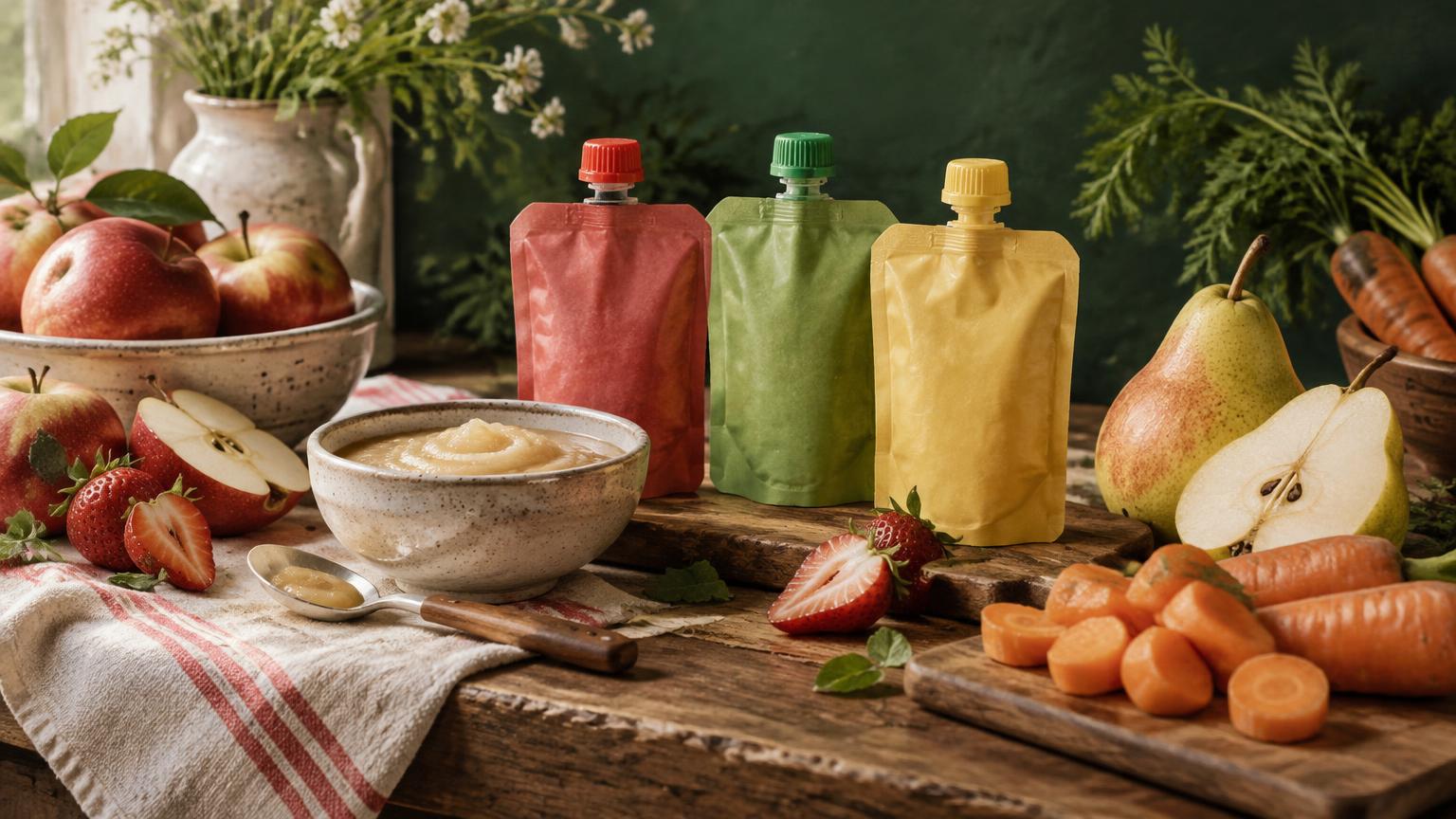
This is not a story about parents making poor choices. Baby pouches can be useful when travelling or when a suitable family meal is not available. The issue is treating a smooth fruit purée as an automatic substitute for the variety of tastes and textures a developing child needs.
Ireland's HSE advises that shop-bought baby foods can be helpful occasionally, but families should avoid relying on them every day. It also recommends serving pouch contents from a bowl or spoon rather than allowing babies to suck directly from the pouch.
We examined real Irish listings for Ella's Kitchen, Little Freddie, Cow & Gate and Piccolo to understand what those labels do and do not tell us.
These products are not all intended to do the same job. Three are sweet fruit-led foods. One is a savoury meal containing beef and vegetables.
| Product | Pack | Total sugars | Fibre | Protein | Recipe context |
|---|---|---|---|---|---|
| Ella's Kitchen Strawberries & Apples | 120g | 11.8g per pouch | 1.4g | under 0.6g | Apples 78%, strawberries 22%, dash of lemon concentrate |
| Little Freddie Apples, Bananas & Oats | 100g | 10.9g per pouch | 1.2g | 0g declared | Apples 80%, banana 18%, oats 2% |
| Cow & Gate Apple & Banana | 100g | Not reported in linked listing | 1.7g | 0.4g | Apple 76%, banana 24%, lemon juice, vitamin C |
| Piccolo Sweet Potato & Beef Ragu Stage 2 | 130g | 4.6g per pouch | 2.0g | 5.7g | Vegetable and beef savoury meal |
Sources: Tesco Ireland listings. The Cow & Gate retailer extract did not provide a total-sugars figure, so none is invented. Savoury and fruit pouches are different meal types; this table is not a ranking.
The sweet fruit products contain naturally occurring sugars. That fact is consistent with an accurate no-added-sugar claim. It does not mean sugar has been poured into them by the manufacturer.
The Piccolo savoury product provides a different nutritional profile, including protein from beef. The objective is not to crown one pouch the best for every baby. Different ages and meals have different requirements.
This is probably the single most useful label lesson for parents.
Ella's Kitchen Strawberries & Apples lists 11.8g total sugars per 120g pouch. It also states that no sugar has been added. Both can be correct, because the sugars are naturally present in the fruit.
Under EU nutrition-claims legislation, “no added sugars” refers to whether sugar or other ingredients used for their sweetening properties have been added. It is not a promise that the finished food contains zero total sugars.
A related but separate concept is free sugars. WHO Europe has raised concern about commercial infant foods dominated by sweet fruit purées, including how puréeing can release sugars that were previously held within plant cell structures. This area is more nuanced than simply saying every gram of sugar in a purée has the same status as sugar added to a fizzy drink.
It would be wrong to state that a 100% fruit pouch is nutritionally identical to cola. Fruit purées still contain fruit constituents and some fibre, and are designed for a completely different use.
Nevertheless, the term no added sugar should not end the label-reading process. For the detailed legal distinction, see Sláinte's guide to what no added sugar actually means.
Think about an age-appropriate soft piece of pear compared with the same fruit blended smooth.
The nutritional ingredients may be similar, but the child's experience is different. A baby explores texture, learns how food feels in the mouth and gradually develops skills for moving food around and chewing.
Very smooth purées are appropriate at certain stages, but they should not be the only texture offered indefinitely. Both the HSE and NHS encourage moving on to mashed, lumpier and suitable finger foods as feeding skills develop.
A squeeze pouch can bypass some of that learning if the child always sucks food directly from the nozzle. That is why Ireland's HSE recommends transferring pouch contents into a bowl and feeding from a spoon.
This is not a suggestion to give hard pieces of fruit, whole nuts or other choking hazards to infants. All foods must be prepared to match developmental readiness and safe feeding guidance.
The strawberries-and-apples pouch lists organic apples, organic strawberries and a dash of lemon juice concentrate. The simple formulation is a useful feature if you want to know exactly which fruits are included.
It provides 45 kcal, 9.8g total sugars and 1.2g fibre per 100g on the selected listing. The 120g pouch contains roughly 54 kcal, 11.8g sugars and 1.4g fibre.
That is a valid ingredient and nutritional description, not an argument that the pouch is harmful. It is also not proof that the product alone makes a nutritionally complete meal.
Little Freddie Apples, Bananas & Oats contains 80% apple, 18% banana and 2% oats, plus a small amount of lemon juice concentrate.
The oats may change flavour and texture, but the recipe is overwhelmingly fruit. Its labelled 100g serving contains 10.9g sugars and 1.2g fibre.
A parent buying it as an occasional fruit accompaniment may be perfectly satisfied. Someone expecting an oat-based breakfast should understand that the oats are a small fraction of the recipe.
Cow & Gate Apple & Banana lists 76% apple and 24% banana, plus lemon juice from concentrate and vitamin C. The listing identifies no added sugar and provides fibre and other nutritional values.
The linked retailer listing does not provide a complete sugars declaration for this exact pouch, so the table leaves that value unreported. Check the current pack for the full nutrition panel.
That might seem fussy, but it is the difference between a reliable product guide and an article with numbers invented to fill a table.
Piccolo's Sweet Potato & Beef Ragu Stage 2 contains sweet potato, vegetables, beef, some cheddar and herbs. It supplies 5.7g protein per 130g pouch and 4.6g total sugars in the listed formulation.
This demonstrates why comparing a savoury meal pouch with a fruit snack is not the same as comparing two apple purées. The foods have different ingredients and purposes.
Some savoury pouches may be useful when suitable homemade food is not available. As with fruit pouches, they should fit into a broader diet offering variety and texture.
Not every sweet-tasting pouch has sugar added, and “high sugar” has legal and nutritional contexts.
A label such as 9.8g sugars per 100g describes total sugars. It does not reveal how much of that amount, if any, was introduced as refined sugar or syrup. You need the ingredient list for that.
It is also unhelpful to compare a baby's 60g portion with a teenager's large soft drink without considering who is eating it and why.
For parents, the more useful questions are these: how much fruit purée is being served, how often is it offered, is the child eating other textures, and is the broader diet varied enough to supply important nutrients such as iron?
The WHO European Region has specifically noted the high sweetness of many commercial fruit-based foods for young children and the concern that they may crowd out less sweet foods if relied upon too heavily.
Ireland's HSE explains that shop-bought baby foods can be useful when travelling or eating away from home. It advises against relying on them daily, in part because learning to enjoy ordinary family foods is an important aim of introducing solids.
The HSE recommends serving pouch food in a bowl and using a spoon, rather than allowing a baby to suck it directly from the pouch. Varied textures help children develop eating skills.
Introducing complementary foods generally begins around six months, depending on the baby's readiness and professional guidance. A commercial label suggesting suitability from four months should not override mainstream public-health advice.
Always follow age-appropriate food preparation, allergy introduction and choking-risk guidance. Parents facing feeding or growth concerns should consult a GP, public health nurse or paediatric dietitian.
1. Turn the pouch over. Read the actual fruit percentages and whether the product is a fruit snack, yoghurt blend or savoury meal.
2. Look at “of which sugars”. Do not assume “no added sugar” means the number will be zero, and do not interpret a naturally occurring sugar figure as evidence of wrongdoing.
3. Offer varied textures. A smooth pouch can be convenient, but it shouldn't be the only way a child meets fruit and vegetables.
4. Serve it with a spoon and choose appropriate portions. This encourages normal feeding skills and avoids prolonged sucking from the nozzle.
These small checks are more useful than treating a whole brand as either safe or unsafe.
Sláinte can show the verified ingredients, nutrition and scoring explanation for a matched product. It can also help parents compare two pouches that claim similar things on the front.
The usual food score must not be mistaken for an infant-feeding recommendation. An excellent adult-oriented nutrition score does not confirm that something is appropriate for a six-month-old, free from a particular allergen, or safe in its current texture.
For ingredient transparency, use Sláinte's scanner. For feeding readiness, textures and choking risks, follow the HSE and your healthcare professional.
The exact pouch labels are discussed above without a numerical ranking. A food score would not assess age suitability, choking risk, allergy introduction or texture readiness.
They can form part of a varied age-appropriate diet and are convenient occasionally. They should not displace a wide range of tastes and textures or be assumed to provide a balanced meal by themselves.
The product may contain naturally occurring sugars from fruit. “No added sugar” is a regulated formulation claim, while the nutrition declaration shows total sugars.
They can contain similar ingredients, but smooth purée changes the texture and eating experience. WHO Europe has also raised concerns about the high sweetness and easily available sugars in many commercial fruit purées.
The HSE recommends squeezing the contents into a bowl and feeding with a spoon. It helps children experience food textures and practise eating skills rather than relying on suction from the pouch.
Mainstream HSE and NHS advice supports introducing suitable complementary foods around six months, once the baby is developmentally ready. Do not treat a “4+ months” pack label as an instruction to start early.
Last reviewed: 24 October 2026