
Back to Journal

Kerrygold Butter vs Dairygold and Flora: Which Is Actually Healthier?

Published · Updated  · Sláinte Editorial

Ask an Irish household about butter and you'll probably get a strong opinion. Some swear by a block of Kerrygold. Others grew up with a Dairygold tub in the fridge. Plenty of people prefer Flora because it's easy to spread straight from the fridge.

In the past few years, the debate has become more complicated. One side points to butter's simple ingredients. Another points to the saturated fat in dairy butter and recommends spreads containing more unsaturated vegetable oils. Then there are cholesterol-lowering spreads enriched with plant sterols, which have a different purpose again.

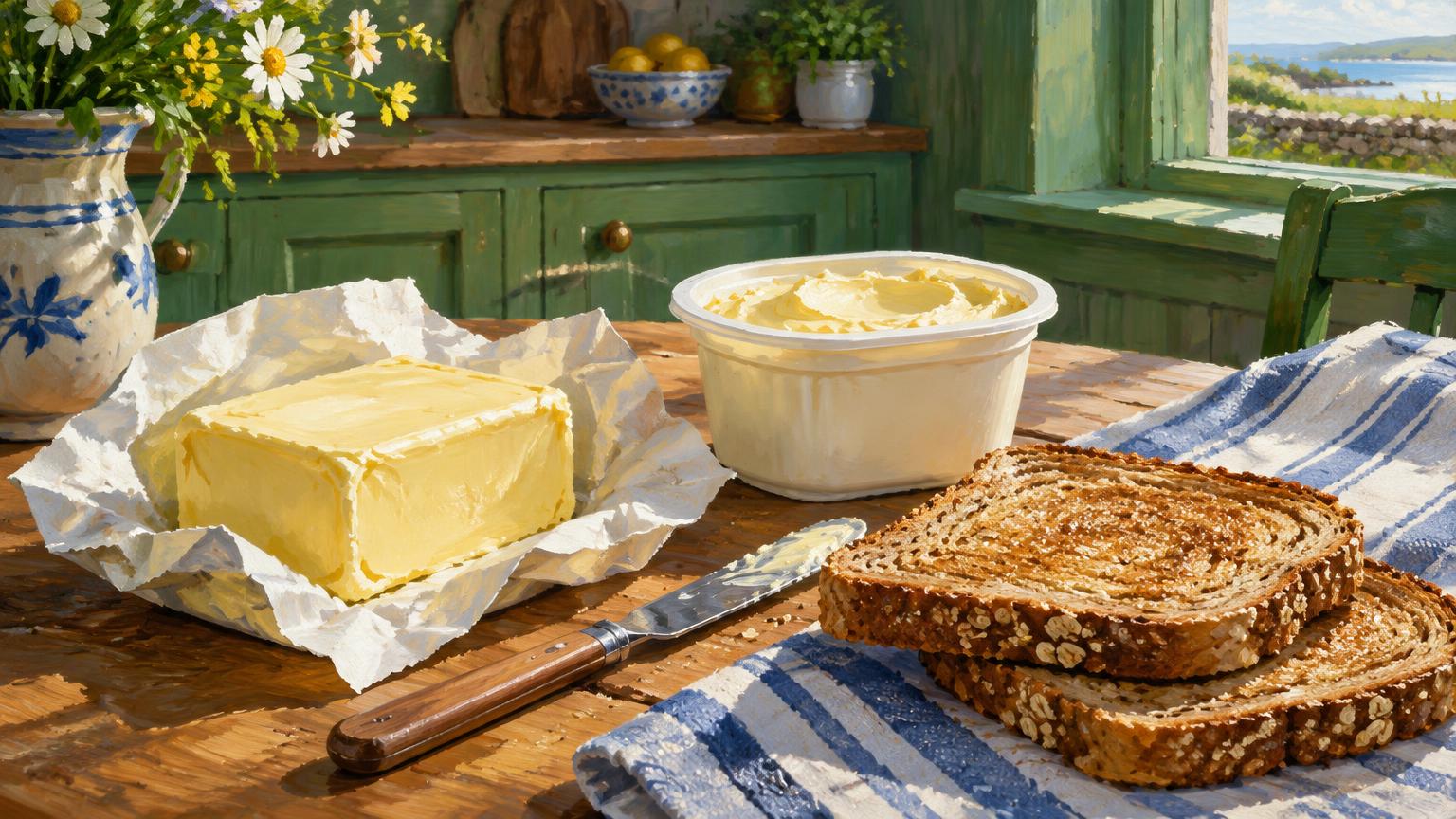
Irish butter and spreadable fat on toast

The figures below come from the exact Irish retailer listings linked in the sources. They are not laboratory measurements or a guarantee that every pack on the shelf uses the same recipe. Check your own pack if it differs.

So which should you choose?

The answer is not determined by how many ingredients appear on the pack. Pure butter generally contains more saturated fat than many vegetable-oil-based spreads. That is relevant to heart health. But different spreads have different types and quantities of oils, and products marketed as soft butter can be butter blended with vegetable oil rather than pure butter.

We examined Kerrygold Irish Creamery Butter, Dairygold Original, Flora Original and Flora ProActiv Buttery. We also checked the difference between Kerrygold's Irish butter tub and the separate Soft Butter described on its international website.

First, not all spreads are the same food

There are at least four categories worth distinguishing.

Pure butter is made primarily from churned cream, with salt in salted varieties. Its fat is largely dairy fat.

Dairy and vegetable-oil blends, such as Dairygold Original, combine dairy ingredients with plant oil or fat to change spreadability and texture. Do not assume every soft butter tub is one of these blends.

Vegetable-based spreads, such as Flora Original, are based mainly on plant oils and other ingredients. Their saturated fat depends on which fats they contain, including any coconut or palm fat.

Plant-sterol spreads, such as Flora ProActiv, are speciality products formulated with added plant sterols to help manage cholesterol for suitable users. They are not merely generic margarine.

None of these labels alone proves overall healthfulness. To compare them, look at ingredients, saturated fat, salt, serving size and the intended use.

Four real supermarket nutrition labels

ProductCalories per 100gFat per 100gSaturated fat per 100gSaturated fat per 10g
Kerrygold Pure Irish Salted Butter744 kcal80g53g5.3g
Dairygold Original582 kcal63g21g2.1g
Flora Original Plant Spread632 kcal70g20g2.0g
ProActiv Buttery Taste 450g530 kcal59g12g1.2g

The table uses Tesco Ireland listings for Kerrygold Irish Creamery Butter 454g, Dairygold Original 454g and Flora Original 450g, plus SuperValu's ProActiv Buttery Taste 450g listing. The scored Dairygold card below is the separately identified 227g pack, whose salt declaration differs. Pack variants are not interchangeable.

Look at the final column. In an equal 10g serving, pure salted Kerrygold supplies roughly 5.3g of saturated fat, compared with 2.1g for Dairygold Original and 2.0g for Flora Original.

This doesn't mean a tiny amount of butter is forbidden. It means that if you regularly use a spread and are trying to reduce saturated fat, the difference is nutritionally meaningful.

It's also important not to assume every plant spread is equally low in saturated fat. Flora Original contains coconut fat in addition to rapeseed and sunflower oils, so the complete formulation matters.

Saturated fat per 10g
  1. 1Kerrygold salted butter: 5.3g
  2. 2Dairygold Original: 2.1g
  3. 3Flora Original: 2.0g

Comparison based on the specific examples discussed in this article.

Kerrygold: the simplicity argument

Kerrygold Pure Irish Salted Butter is marketed as a traditional dairy product and has a straightforward formulation. The brand emphasises Irish grass-fed cows, and the salted version is essentially butter and salt.

A short ingredient list makes the product easy to understand and can be a reason someone prefers it. Butter also has a distinctive flavour and works well in baking and cooking.

But it is still concentrated dairy fat. The version checked has about 53g saturated fat per 100g. That figure doesn't disappear because the cream came from grass-fed cows or because there are few ingredients.

A short ingredient list answers a formulation question. Saturated fat answers a different nutrition question. Both can be relevant without either one cancelling the other.

Four different spread categories
  1. 1Pure dairy butter
  2. 2Dairy and plant oil blends
  3. 3Plant spreads and sterol spreads

Illustrative guide, not a score for a whole category.

Dairygold Original: not simply pure butter

Dairygold Original is a blended spread. The listed ingredients are cream, palm oil, rapeseed oil, salt and colour (carotenes).

It provides 21g saturated fat per 100g on the product version checked, much less than the pure Kerrygold butter example. It also contains less total fat by weight, so it contains fewer calories per equivalent weight.

That doesn't mean everybody will prefer its taste or texture. It simply means the product is not nutritionally identical to a block of pure butter.

What about palm oil?

Palm oil contains saturated and unsaturated fats. The exact impact of a food on dietary saturated fat depends on how much palm fat is present and which other fats are used.

In this Dairygold recipe, the declared saturated fat gives you an actual measured comparison. Saying 'palm oil is present' does not tell you its quantity or prove the finished spread is worse for cholesterol than pure butter.

There are also environmental questions around palm oil sourcing. Those are important but separate from the nutritional issue, and they require evidence about sourcing and certification rather than conclusions from the ingredient name alone.

Flora Original: a plant-oil spread

The Flora Original variant listed by Tesco Ireland contains rapeseed and sunflower oils, water, coconut fat, salt, lecithin, faba bean preparation, flavourings and vitamin A. The formulation is listed as palm-oil-free.

Its saturated fat is about 20g per 100g in this version. That's similar to the Dairygold figure and considerably below the Kerrygold butter example.

Rapeseed and sunflower oils provide unsaturated fats. The presence of coconut fat contributes to the product's saturated-fat content, which is why the nutrition label matters even if a spread is described as plant-based.

A vegetable spread can be more processed in formulation terms while still helping someone lower saturated fat compared with butter. That may sound counterintuitive if you've heard that simpler foods are always better, but it reflects the difference between processing categories and individual nutrients.

Kerrygold butter tubs: check the Irish product, not an overseas recipe

Kerrygold's Irish manufacturer page describes its Irish Creamery Butter 400g tub as sharing the same simple ingredients as its Irish butter block. It is not described as a rapeseed-oil blend.

A separate international Kerrygold Soft Butter page describes a butter-and-rapeseed-oil blend in 227g and 250g tubs. That is a different product description and must not be applied to the Irish 400g butter tub.

For shoppers, this is a useful reminder to check the full product name. Kerrygold alone is not enough to identify the ingredient list.

Flora ProActiv: a different purpose again

Flora ProActiv contains plant sterol esters, added as a functional ingredient. Plant sterols can reduce intestinal absorption of cholesterol and lower LDL cholesterol when consumed at effective amounts as part of an appropriate diet.

The current SuperValu Irish listings for ProActiv Buttery Taste in 250g and 450g tubs both list rapeseed, coconut and sunflower oils, water, plant sterol esters, salt, lecithin, natural flavourings and vitamins A and D. They do not list the buttermilk, palm oil or preservative in the older healthcare-professional recipe. These are different formulations and must not be combined. Both retailer listings declare 0.54g plant sterols per 10g serving.

But this is not an ordinary recommendation for everyone to add a speciality spread to their breakfast. Plant-sterol foods are aimed at people who need to lower cholesterol, and there are specific labelling conditions and precautions. People taking cholesterol-lowering medicines should use these foods only under medical supervision. They may not be nutritionally appropriate for pregnant or breastfeeding people or children under five. They are not intended for people who do not need to control blood cholesterol. Avoid more than 3g of added plant sterols or stanols daily, and use them within a varied diet that includes fruit and vegetables.

The current 250g and 450g SuperValu listings agree on 530 kcal, 59g total fat, 12g saturated fat and 0.8g salt per 100g. That corresponds to 1.2g saturated fat and 0.08g salt in 10g. These independently published retailer figures resolve the missing comparison without guessing a decimal correction to the older manufacturer table. A score is still withheld until the exact formulation and product record are matched.

What does the science say about butter and heart health?

The Irish Heart Foundation advises that butter is high in saturated fat and that vegetable-based spreads generally contain more mono- and polyunsaturated fats, which are preferable for heart and cholesterol health.

That doesn't mean every highly processed food is good for the heart, or that every food containing saturated fat is harmful in isolation. It means replacing some saturated fat with unsaturated fat is consistent with established cardiovascular dietary guidance.

This is not a debate that can be settled by comparing one ingredient list's length with another. The types and proportions of fatty acids matter.

Overall food patterns also matter. A person who eats vegetables, wholegrains, fish, beans and nuts regularly but enjoys a small amount of butter is in a different position from someone whose diet is consistently high in saturated fat and low in fibre.

Does it matter if butter is grass-fed?

Grass-fed milk can vary somewhat in its fatty-acid profile and composition. But it does not make butter low in saturated fat, and the health effects cannot be inferred from the word grass-fed alone.

If provenance or flavour is your reason for choosing Irish butter, that's a valid preference. Just don't treat it as evidence that you can ignore the declared saturated-fat content.

The same applies to a spread's 'natural ingredients' branding. The product might be made from familiar ingredients but still vary substantially in fat composition.

The practical buying decision

If you love the flavour of butter, keep the portion modest, especially if your overall saturated-fat intake is already high. If reducing saturated fat is a priority, compare spreads with more unsaturated fats using the actual nutrition table. If your doctor or dietitian has recommended a cholesterol-lowering product, follow advice on whether a plant-sterol spread is appropriate.

Look at salt if you use several servings daily. Don't confuse a 10g amount lightly spread on toast with a large portion used in cooking. And when comparing products, be sure the amounts are equal.

None of these decisions requires a war between butter and margarine. It requires understanding what you're choosing and why.

Product scores and label checks

The scored examples use the ingredients and nutrition of the exact products identified below, calculated through the same rules as a Sláinte scan. They are product comparisons, not ratings for an entire brand or an unmeasured meal. A barcode link is shown only where the exact catalogue record is matched.

Two identifiable spread products, scored from reviewed labels

These cards calculate with the same scoring rules as a scan. A score is not a cholesterol treatment recommendation. The other spreads need reliable exact-pack labels before a score is shown.

Kerrygold Irish Creamery Butter

30

/100

Sláinte Score

Poor

Saturated fat is what pulls this down.

  • Low in sugars
  • No additives declared on this label
  • Too caloric
  • High in saturated fat
  • Too salty

What's inside (per 100 g)

The Good Stuff

Watch out for

AdditivesNo additives declared on this label0

Ingredients: Cream, Salt (1.8%), Salted Sweet Cream Butter. Fat 80% min.

This is the matched 454g Irish creamery butter, not every Kerrygold product.

Dairygold Original 227g

54

/100

Sláinte Score

Good

Saturated fat is what pulls this down.

  • Low in sugars
  • 1 additive
  • Too caloric
  • High in saturated fat
  • Too salty

What's inside (per 100 g)

The Good Stuff

Watch out for

Ingredients: Cream, Palm oil, Rapeseed oil, salt, Colour (Carotenes)

The matched 227g pack declares 1.5g salt per 100g, compared with 1.34g on the separate 454g listing. Sugars are declared as less than 0.5g; the calculation uses 0.5g as a conservative upper bound, not an exact amount.

Frequently asked questions

Is Kerrygold healthier than Dairygold?

Not in every respect. Pure Kerrygold salted butter has a simpler formulation, while Dairygold Original contains considerably less saturated fat per equal weight in the versions examined. The better choice depends on what you're trying to optimise.

Is Dairygold real butter?

Dairygold Original is listed as a blended spread made from cream and vegetable oils, not as a pure butter block. Read the exact product name and ingredient list.

Is Flora healthier than butter?

Some Flora spreads contain substantially less saturated fat than butter. That can matter for heart health, but formulations vary and a plant-based label does not establish the complete nutritional profile.

Does the Irish Kerrygold butter tub contain rapeseed oil?

Kerrygold's Irish 400g Creamery Butter tub is described by the manufacturer as having the same simple ingredients as the Irish butter block. The international Soft Butter blend contains rapeseed oil, but that is a different product. Check the exact name and market.

Is Flora ProActiv suitable for everyone?

No. Its added plant sterols are intended for appropriate cholesterol-management use and are subject to specific precautions. Ask a qualified professional if you're unsure whether it suits you.

The short version

  • Pure butter can have a shorter ingredient list but more saturated fat. Some vegetable spreads have more ingredients and less saturated fat. Both facts can be true at once. A useful comparison takes into account the specific product, the type of fat, the amount used and your dietary needs.