
Back to Journal

The Irish Chicken Fillet Roll: What Is Actually in a Deli Lunch?

Published · Updated  · Sláinte Editorial

A chicken fillet roll has become a familiar part of Irish life. You pull into Centra, SPAR or Londis, order a hot roll, choose the toppings and head back to work with lunch sorted.

It's convenient, filling and, to plenty of people, a perfectly ordinary lunch. But if you try to calculate its calories or salt from memory, things get complicated quickly. How big is the baguette? Which chicken product is used? How much mayonnaise went in? Was it buttered? And did you add cheese, bacon or a second sauce?

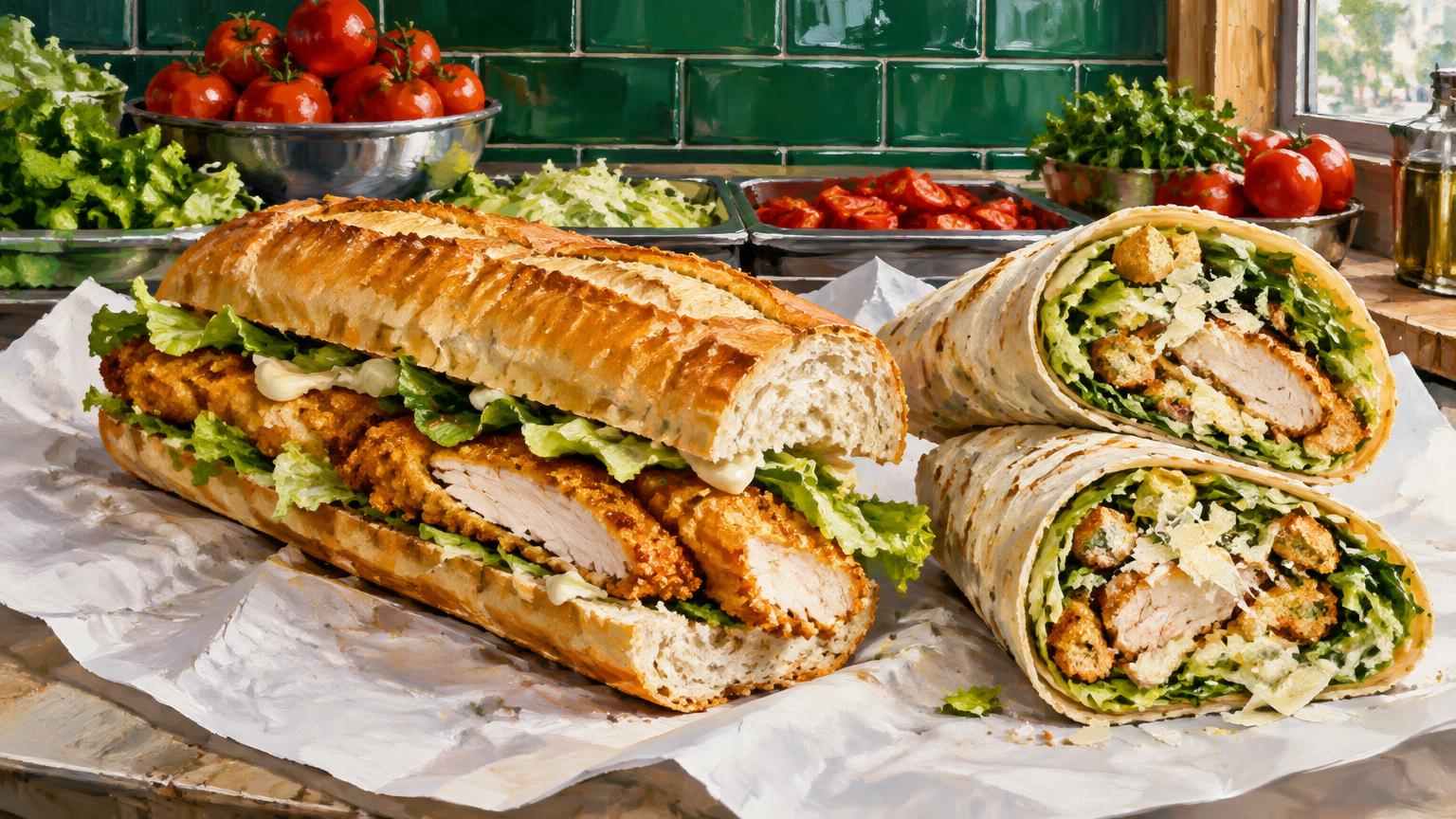
Irish hot chicken fillet roll and chicken Caesar wrap on a deli counter

The figures below come from the exact Irish retailer listings linked in the sources. They are not laboratory measurements or a guarantee that every pack on the shelf uses the same recipe. Check your own pack if it differs.

There's a difference between saying a chicken fillet roll can be energy-dense and salty and claiming that every roll contains more than a full day's salt allowance. The first is a reasonable consideration. The second needs evidence from the actual recipe and serving.

We looked at official Irish food listings for breaded chicken, baguettes and prepacked Caesar wraps to understand where the nutrients come from. We also checked Centra's own guidance, which explains that individually operated stores may use ingredient substitutions. This makes a single national figure unreliable.

The difficulty with one calorie number

Unlike a sealed supermarket bar with a fixed serving size, a made-to-order deli roll varies. Different counter staff use different portions. Stores may have different suppliers or stock. Customers choose their own sauces and fillings.

Two chicken rolls ordered in the same shop can differ substantially if one has lettuce and tomato while the other has cheese, bacon and extra mayo.

The way to understand a roll is to break it into its parts: bread, chicken, sauce and extras. The next step is to calculate using actual quantities. Without those quantities, a precise calorie total would be invented.

First ingredient: the baguette

A typical white deli roll contributes energy largely from flour and contains its own salt. Bread isn't nutritionally empty, but it often contributes less fibre than a comparable wholegrain alternative.

For a concrete example, Tesco White Baguette declares 261 kcal, 4.0g fibre and 0.99g salt per 100g. Its ingredient list contains wheat flour, water, salt, wheat gluten, yeast, malted wheat flour and ascorbic acid, with rapeseed oil listed as a processing aid.

That label doesn't tell us what Centra or SPAR uses. It simply demonstrates why the size of the bread matters.

For example, 100g of this specific baguette contains 0.99g salt. 150g of this baguette would contain about 1.49g salt. Those are transparent arithmetic examples based on one product, not measurements of any petrol-station roll.

If you choose a bigger roll, both calories and salt generally rise with the weight of bread. If you choose a wholegrain or smaller roll, the result can change.

What makes up a deli roll
  1. 1Bread and its portion size
  2. 2Coated chicken and its supplier
  3. 3Sauce, salad and extras

Comparison based on the specific examples discussed in this article.

Second ingredient: breaded chicken

Chicken is a source of protein. But the word chicken on a menu doesn't tell you how much of the finished fillet is meat, how heavily it is coated or whether it contains added water.

Take Tesco Frozen Southern Fried Chicken Goujons, 360g. Its product description identifies chicken breast with added water, chopped and shaped in a crispy crumb. Its ingredient declaration lists 46% chicken breast, followed by water, flour, rapeseed oil, salt, modified starch, seasonings and phosphates.

Its published nutrition, when oven cooked according to the listing, is 210 kcal and 2.00g salt per 100g. A 111g cooked serving provides 233 kcal and 2.22g salt.

That is already a meaningful amount of salt for one component of a meal. But these are Tesco goujons, not the chicken used by Centra, SPAR or Londis. We cannot assume deli outlets use that product or an equivalent recipe.

A different product, Western Brand Southern Fried Chicken Goujons, lists 54% chicken and 1.20g salt per 100g in its published label. These differences show why knowing the specific supplier matters.

Is every hot chicken fillet mechanically reformed?

No. Some coated poultry products use whole chicken breast fillets; others use chopped and shaped meat. The ingredient declarations and product descriptions distinguish them. Do not use the terms reformed, processed and breaded interchangeably as though they all describe the same product.

A measured component, not a deli total
  1. 1Tesco goujons: 111g cooked serving
  2. 22.22g salt in that serving
  3. 337% of the 6g adult daily limit

Illustrative guide, not a score for a whole category.

Third ingredient: mayonnaise and sauces

Mayonnaise is usually made with oil, egg and acid ingredients. It provides flavour and a creamy texture, but also contributes a substantial amount of energy, depending on the recipe and quantity.

For example, Tesco Real Mayonnaise lists rapeseed oil first, followed by egg, water, vinegar, sugar, salt and other ingredients. That does not make it automatically harmful. Rapeseed oil is largely unsaturated fat, and mayonnaise can be enjoyed in sensible portions.

The relevant question in a deli meal is how much is added. A modest spread and several generous squeezes are different servings. Caesar dressing, garlic mayo and spicy mayo also have different ingredient profiles.

If you are trying to make lunch less energy-dense, requesting a smaller amount of sauce is a more direct intervention than worrying about whether rapeseed oil appears in the list.

A real prepacked wrap comparison

A useful reference is the Tesco Chicken Caesar Wrap listing from Tesco Ireland. It describes a tortilla with Caesar mayonnaise, cooked chicken breast, lettuce and bacon.

The Tesco listing's nutrition table declares 578 kcal, 21.5g protein and 1.72g salt for its 181g pack column. However, its heading says 176g, while the nutrition table and net contents say 181g. These are the published 181g-column figures, not a verified measurement of a 176g wrap. Check the physical pack before applying them to your lunch.

Estimated nutrition for a 176g wrap

If the wrap weighs 176g and has the same recipe as Tesco's per-100g panel, multiply each value by 1.76. This gives the estimates below. It does not resolve the retailer's conflicting pack weights or confirm the nutrition of the pack in your hand.

NutrientTesco declared per 100gEstimated per 176g wrap
Energy (kcal)319561
Fat (g)19.334.0
Saturates (g)3.05.3
Carbohydrate (g)23.741.7
Sugars (g)1.52.6
Fibre (g)1.52.6
Protein (g)11.920.9
Salt (g)0.951.67

The ingredients include Caesar mayonnaise, chicken, bacon, tortilla ingredients and additional oils and seasonings. It is a good example of how a wrap marketed as a chicken lunch can derive much of its energy from the dressing and tortilla as well as the filling.

Different Caesar wrap recipes and pack sizes should not be treated as nutritionally identical. We have not used the inconsistent wrap listing for a barcode-linked score.

A prepacked item has the advantage of a declared complete serving. A counter-made wrap requires information from the store's actual recipe or a component-by-component calculation.

How much salt is too much?

The HSE advises adults to consume no more than 6g of salt per day. That's for the entire diet, not a maximum per meal.

A 111g serving of the specific Tesco southern fried goujons examined contains 2.22g, or about 37% of the 6g daily amount. Add bread with salt and a salty sauce and the total rises. If you also have crisps, soup or a highly salted dinner, intake can build up quickly.

That doesn't prove one Centra roll exceeds 6g salt. It shows why salt needs to be measured rather than estimated from appearance.

A practical choice is to check the exact nutrition and allergen material a store provides, particularly if you regularly order the same lunch.

What about a deli salad bowl?

A salad bowl can be a good way to include vegetables, beans or protein. But its nutritional content depends on what actually goes in.

A bowl of mixed vegetables with plain chicken and a moderate dressing is quite different from a bowl dominated by pasta, creamy sauce, cheese and breaded toppings. Neither should be judged by the single word salad.

The vegetables contribute fibre and other nutrients. Dressings and toppings contribute flavour, energy and sometimes salt. A substantial salad may be a complete meal, while a small undressed salad may leave someone hungry.

The question is how to assemble a meal that suits your appetite and needs, rather than trying to assign a good or bad rating to all salad bars.

The local deli test: three lunch formats

Lunch formatWhat to inspectWhat we can say
Made-to-order hot chicken fillet rollBread size, exact chicken, sauce portion, toppingsTotal varies by store and order
Packaged chicken Caesar wrapComplete-pack label, fat, salt, proteinExact figures exist for a sealed SKU
Made-to-order deli saladDressing, protein, fibre-rich foods, portionDepends on what is chosen

This distinction is central to Sláinte's approach. It can score a verified barcode product, but a made-to-order meal composed of several unmeasured ingredients is not automatically a single scannable product with a valid production score.

Four changes that make a deli lunch easier to assess

Ask for a smaller amount of sauce. That changes the meal without requiring a new bread or protein source. Add vegetables. Lettuce, tomato and other fillings can improve variety. Consider the bread and chicken portions. Two large components provide more energy than two small ones. Use the store's actual nutrition information when possible. Staff may help identify allergens and suppliers, but recipes can vary.

There is also no requirement to stop eating chicken fillet rolls. A convenient lunch can fit within an overall balanced eating pattern. Knowing the difference between a measured nutrition figure and a social-media guess is the valuable part.

Product scores and label checks

The scored examples use the ingredients and nutrition of the exact products identified below, calculated through the same rules as a Sláinte scan. They are product comparisons, not ratings for an entire brand or an unmeasured meal. A barcode link is shown only where the exact catalogue record is matched.

Actual Sláinte Scores from the checked product labels

These are calculated with the scanner's existing rules. Product labels, not brand-wide assumptions, supply the inputs. Processing groups are editorial classifications based on the declared recipe. Unmatched barcodes are not invented.

Tesco Southern Fried Chicken Goujons 360g

49

/100

Sláinte Score

Poor

Heavily processed, however the front of the pack reads.

  • Low in sugars
  • Low in saturated fat
  • Good source of protein
  • 1 additive
  • Too salty

What's inside (per 100 g)

The Good Stuff

Watch out for

Ingredients: Chicken Breast (46%), Water, Wheat Flour ( Wheat Flour, Calcium Carbonate, Iron, Niacin, Thiamin), Rapeseed Oil, Salt, Modified Wheat Starch, Wheat Starch, Fennel, Black Pepper, Cornflour, Dextrose, Wheat Gluten, Dried Egg, Yeast Extract, Stabilisers (Sodium Di, Tri, & Polyphosphates), Flavouring, Garlic Powder, Yeast, Sugar, Onion Powder, Pepper Extract.

Scored from the exact linked retailer label. No barcode link is shown because the exact catalogue pack has not been established. Nutrition and serving refer to oven-cooked goujons, not the frozen weight or a deli roll.

Western Brand Southern Fried Chicken Goujons 400g

49

/100

Sláinte Score

Poor

Heavily processed, however the front of the pack reads.

  • Low in sugars
  • Good source of protein
  • 3 additives

What's inside (per 100 g)

The Good Stuff

Watch out for

Ingredients: Chicken (54%), Wheat Flour ( Wheat Flour, Calcium Carbonate, Iron, Niacin, Thiamin), Water, Wheat Starch, Salt, Vegetable Oil (Rapeseed), Wheat Gluten, Pea Fibre, Spice, Sugar, Dextrose, Yeast, Fennel, Citric Acid, Triphosphates, Garlic Powder, Spice Extracts (Black Pepper, Nutmeg), Natural Onion Flavouring, Onion Powder, Yeast Extract, Garlic Extract, Onion Oil

Scored from the exact linked retailer label. No barcode link is shown because the exact catalogue pack has not been established.

Tesco White Baguette 330g

74

/100

Sláinte Score

Good

Grand for most of us, but it's wheat through and through, so steer clear if you're coeliac.

  • Low in sugars
  • Low in saturated fat
  • Good source of protein
  • 1 additive

What's inside (per 100 g)

The Good Stuff

Watch out for

Ingredients: Wheat Flour, Water, Salt, Wheat Gluten, Yeast, Malted Wheat Flour, Ascorbic Acid, Processing Aid (Rapeseed Oil).

Scored from the exact linked retailer label. No barcode link is shown because the exact catalogue pack has not been established.

Frequently asked questions

How many calories are in an Irish chicken fillet roll?

There is no single reliable figure for every Irish deli roll. Bread, coated chicken size, sauce and toppings vary. A precise estimate needs the store's recipe or weighed ingredients.

Is a chicken fillet roll healthy?

It can contribute protein and make a convenient lunch, but it may also be energy-dense and high in salt. Judge the actual serving, ingredients and rest of your diet rather than assuming all rolls are identical.

How much salt is in a hot chicken roll?

It varies. One Tesco goujon example contains 2.22g salt for a specified 111g cooked serving, but that is not a measured deli roll. The bread and sauces can add more.

Are prepacked Caesar wraps lower in calories?

Not necessarily. The Tesco Chicken Caesar Wrap examined lists around 578 kcal per pack. A different chicken roll could be higher or lower depending on its size and ingredients.

Can Sláinte scan my Centra chicken fillet roll?

Only if the exact product is represented as a verified scannable record or a validated meal feature exists. Otherwise, scanning the individually packaged components is more reliable than inventing a score for a custom-made meal.

The short version

  • Irish deli food is convenient, but its health profile comes from real portions and ingredients. Don't accept a dramatic headline claiming every roll has the same calories or exceeds the day's salt allowance. Ask what's in yours, compare what you can verify, and make changes that suit your routine.